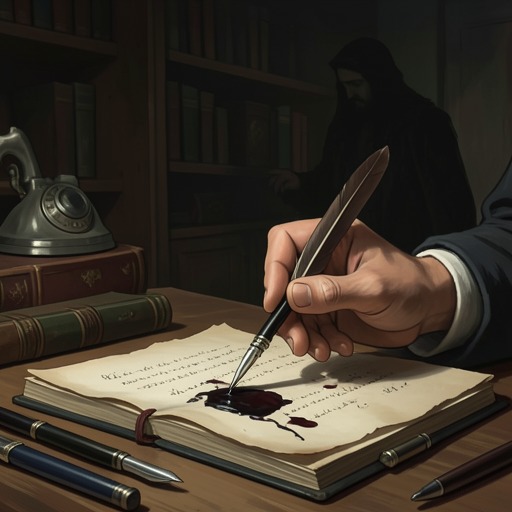
the ideal reader suffering from an ideal insomnia
Finnegans WakeThe ideal reader suffering from an ideal insomnia is an imagined reader whose impossible endurance gives form to the work of reading a damaged, mutable document. The figure is not presented through a personal biography or a plot of independent actions; instead, the text makes the reader’s sleepless labor its measure, imagining a mind that must return to the manuscript again and again while its signs remain uncertain.
An endless task of reading
The phrase appears amid an inventory of marks that have been engraved, retouched, wiped at the edges, and padded over. The text imagines them being examined for a trillion times, until the reader’s head either sinks or swims. That extravagant duration makes insomnia more than a metaphor for alertness: reading becomes a prolonged encounter with a document that refuses to yield a single, clean version of itself.
The surrounding passage calls attention to red marks scattered over the text, drawing notice to errors, omissions, repetitions, and misalignments. It also describes a warning sign that allows the words following it to be taken in any order. The ideal reader must therefore do more than recover sentences; the reader faces gaps and alternatives built into the page, and must keep interpreting without the assurance that one sequence will settle every question.
The document that demands the reader
The manuscript is described as carrying several layers of intervention: words are corrected and overlaid, while margins, underlinings, punctuation-like signs, and odd letterforms complicate the reading. A word can hide within a maze of confused drapery; a wandering mark seems to return to a sore point in the past. These details turn the page into an active field of evidence, where visual form and revision matter alongside verbal content.
The passage also presents writing as vulnerable to time and material change. Elsewhere in its account of the document, the inkhorn, pen, paper, collaborating minds, spellings, pronunciations, and meanings are all described as changing. The surviving scrap is valued precisely because so much has been lost or plundered. The ideal reader’s task is thus not simply to decipher a stable original, but to work through traces whose history has altered what can be known.
Reading amid uncertainty
The document’s signs invite interpretation but do not guarantee it. Initials associated with Earwicker appear among a dense field of marks; a particular sign is treated as capable of standing for a title or accompanying a consort, while numbers and shapes suggest several possible readings. The text’s abundance of clues does not close the case. Instead, each apparent key opens further possibilities, making the reader’s persistence inseparable from uncertainty.
A related episode describes an unpunctuated document whose reverse, held against a lit rush, yields a striking clue: its front bears punctures and gashes made by a pronged instrument. The wounds are interpreted as four kinds of stop, and inquiries associate them with a fork and a series of professional and personal suspicions. This episode makes the page’s physical damage part of its meaning, but it also shows how interpretation proceeds through conjecture, inference, and competing explanations rather than direct access to an unquestionable original.
Narrative significance
The ideal reader is a structural figure for the book’s demands on interpretation. The reader must attend to damaged writing, shifting identities, and signs that can be rearranged, while accepting that close scrutiny may multiply rather than eliminate ambiguity. Insomnia gives that process its paradoxical shape: a reader imagined as tireless is needed because the text cannot be exhausted by one reading.
The figure also clarifies the difference between decipherment and certainty. The document invites labor through its densely layered marks, yet its revisions, losses, and variable signs resist a definitive solution. The ideal reader’s sleeplessness is therefore not a promise that every puzzle will finally be solved; it names the sustained attention required to keep reading when the page remains unsettled.