Coterie succession vacuum after the previous leader's death
FirebugThe Coterie succession vacuum after the previous leader's death began when the leader died suddenly and no clear successor was positioned to take over. The resulting dispute was not only about who would lead: Duncan recalls that Venus’s bid was unpopular with some senior members, while his own alternative might have steered the organization away from the more lethal course it took under her. The gap between those possibilities helps explain why Venus’s rule came to feel, to Ava, indistinguishable from the Coterie itself.
The vacancy and Venus’s claim
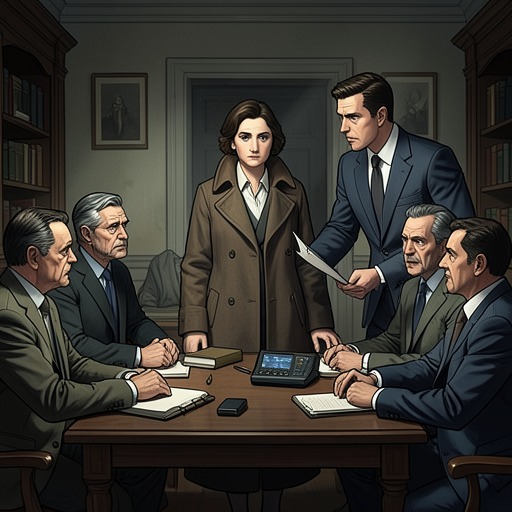
Duncan recounts that the Coterie usually had a lieutenant ready to assume leadership when a leader died. This time, circumstances aligned so that there was no clear successor. Venus was pushing for the position, but she had only been with the organization for a year or two and was unpopular with a number of its higher-ups. The account does not name the deceased leader or explain precisely why the usual succession arrangement failed; its emphasis is on the uncertainty that left leadership open to contest.
That uncertainty mattered to the organization’s direction. Duncan describes the Coterie at the time as less lethal than it later became. He does not present it as benevolent, but believes that under different leadership it might have become something closer to a new Council. Venus, he says, took it in the other direction. Her accession thus marks more than the filling of an empty office: in Duncan’s retrospective, it is the point at which a possible institutional alternative gave way to a more violent order.
Duncan as an alternative
A couple of the Coterie’s higher-ups sought out Duncan and asked him to step in. Lock questions whether Duncan seemed like a likely candidate, and Duncan’s answer is not that he had been an obvious heir: he explains that he had once been Coterie before retiring. His former membership, rather than any stated claim to succession, is the concrete connection the account gives between him and the leadership offer.
The invitation presents a counterfactual that weighs heavily on Ava. She imagines Duncan at the head of the Coterie as a less dangerous possibility, and connects his refusal to the chain of events confronting her: Cade’s kidnapping, the burned store, and her mother’s death. These are Ava’s anguished thoughts, not proof that Duncan could have prevented those events or knew what would follow. Duncan dates the offer only approximately, to twenty or twenty-five years earlier, and the supplied account does not disclose why he declined it. The unanswered question leaves the lost alternative vivid without resolving it.
Venus’s consolidation and Duncan’s risk
When Duncan tells this history, Ava has understood Venus as nearly synonymous with the Coterie. She knows in theory that there was a leader before Venus, but had treated that past as irrelevant to the immediate danger she associates with Venus. Duncan challenges that view: Venus wants people to believe there can be no Coterie without her and that escape from the organization is impossible. He also describes Councils operating in some areas to protect the weak and keep groups like the Coterie out, complicating Venus’s claim to universal authority. Les adds that Portsmouth would be different because it is Council territory; the protection is geographically limited, not a guarantee wherever Ava is.
For Ava, the leadership offer changes how she reads Duncan’s position in the present. She infers that because senior members once considered him as an alternative, Venus will continue to regard him as competition and a threat until he is eliminated. This is Ava’s conclusion from the history Duncan reveals, rather than a reported declaration by Venus. It turns an old succession dispute into an immediate source of danger for the man who refused the post.
Membership, ritual, and the reach of authority
Ava’s own entry into the Coterie shows how leadership is made consequential for its members. She was barely thirteen at her blood-pact ceremony, with armed Coterie guards holding her in place. Cade, although her legal guardian, was barred from attending because he was neither Coterie nor an Associate. The exclusion makes organizational status decisive even in a child’s life: guardianship did not give him standing in the ritual that would bind her to the group.
The ceremony converts that hierarchy into bodily experience. A witch marks Ava’s forehead, palms, and feet with oil, then blows ash onto the marks; the burning wards her, if not permanently. Venus cuts Ava’s hand with a silver knife and places her own fire ward in Ava’s palm, where it disappears into blood and ash. She declares that the Coterie is Ava’s family and that her life and actions belong to it. The wound is then used to collect blood and ash, while Ava signs a parchment with ink made from both. Ava understands the signature as largely formal: the ritual, not the document, carries the magic of the pact.
The details do not explain the rules for choosing a leader, but they show why the outcome of the succession matters beyond the people competing for office. Venus’s authority is exercised through a binding institution that claims members’ loyalty and treats their exclusion or inclusion as its own decision. Ava’s memory ends with the cowls coming down and her recognition that she has been made Elite, with no going back. Set beside Duncan’s account of an earlier leadership choice, that irreversible initiation gives the succession dispute its human consequence: the direction chosen at the top becomes the power governing those bound below.