Firebug overexertion limit
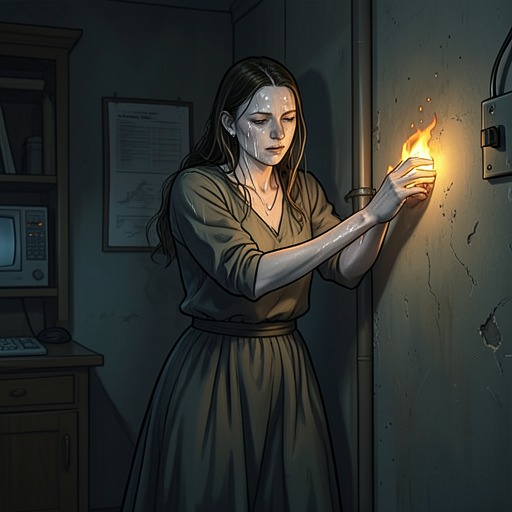
FirebugThe Firebug overexertion limit is the bodily cost that constrains how long and how intensely Ava can use her fire. During the fight at Heaven, power that helps her create confusion and escape also drains her until she is dizzy, shaky, and unable to remain conscious. The episode makes a tactical advantage inseparable from a physical liability: fire can change the battlefield, but producing and sustaining it leaves Ava with less capacity to endure what follows.
Evidence of a Bodily Limit
Ava recognizes the danger while facing a powerful new opponent. She hopes he will fail to pace himself and that his body will begin drawing on energy normally used to run automatic systems such as the heart and lungs. This is Ava’s fear and tactical speculation, not a confirmed account of what happens to him. Its importance is that she understands overexertion as more than ordinary tiredness: in her estimation, pushing too far could threaten essential bodily functions. The scene does not establish a measurable threshold or confirm that this consequence occurs, but it shows that firebug power is not cost-free.
The battle soon gives that concern a more immediate, observable counterpart in Ava herself. Before it is over, she can feel her energy flagging, and moving her head too quickly makes her dizzy. She has also recently endured what she calls her disastrous night in Heaven, leaving her to enter another firefight already depleted. Her assessment of the fight is therefore shaped by both the demands of the present and the toll of the earlier night. Owen’s experience makes speed essential, while Ava’s weakened condition makes sustained action increasingly risky.
Escalating Power and Tactical Cost
Ava uses fire not only to attack but to control the pace and conditions of the fight. After being knocked down, she throws short bursts of flame primarily to keep opponents occupied and buy time to think. Later, as Lock, Ezra, and Ava make their way toward an exit, she keeps fires going and starts new ones to intensify the confusion. This work is difficult to sustain: sprinklers are suppressing the flames, and she is trying to keep the fires burning while no longer in the ballroom. Her abilities are thus tied to continuous effort rather than a single decisive burst.
The cost rises when Ava uses her power on a larger scale. After Lock grows trees from pieces of wood, Ava blows them up to create more confusion during the escape. The feat is useful, but the later symptoms give it a clear physical consequence: she has a dry mouth, a worsening headache, blurred vision, and shakiness. In the emergency lighting, moving her head leaves trails and makes the scene blur. She explicitly connects the exertion of blowing up the trees with how much energy it took. Power that helps the group get out also reduces Ava’s ability to navigate the escape.
Range, Endurance, and Collapse
Ava’s fire control also has a spatial limit. While leaving the ballroom, she continues to maintain its fires from farther away, knowing that the connection will eventually break once she is sufficiently removed. She tries to prolong it in the meantime, even as her brain feels foggy. The scene therefore distinguishes two constraints: maintaining the effect consumes effort, and distance eventually interrupts it. The evidence gives no precise range, and Ava’s uncertainty about when the link will fail remains part of the danger.
Outside, the costs accumulate rather than quickly passing. Ava is shaky after sprinting, the adrenaline, and the fires; her headache has become severe and her mouth is extremely dry. She is still exhausted when she tries to create a blaze around Lock’s car and expand flame inside its gas tank. The explosion is deliberate theatrical misdirection, not an ordinary result of the car’s fuel: Ava helps the fire along so onlookers will believe the display. The maneuver serves the escape, but she passes out immediately afterward.
Recovery and Practical Consequences
Ava wakes in Ezra’s car at a minimart, covered by Lock’s leather jacket, with Ezra asleep in the back after repeatedly shifting forms. She describes her condition as a firebug hangover and recognizes that she has overdone it. Even simple self-care is difficult: her hands shake too much to open the pocket holding her electrolyte pills. She cannot readily get out of the car to look for Lock, and she doubts she could wake Ezra. Her immediate vulnerability makes the cost concrete in small tasks, not just in the dramatic collapse that ends the escape.
Lock’s presence matters because Ava has someone to rely on while she is incapacitated. She reflects that without him she could have been in serious trouble, unable even to manage a button. The limit consequently affects both combat and dependence: using power to protect the group can leave Ava unable to protect or care for herself afterward. The episode establishes neither a universal recovery time nor a precise allowance for fire use. Instead, it shows the accumulating signs Ava experiences, the tactical pressure that leads her to keep going, and the abrupt point at which exhaustion takes over.