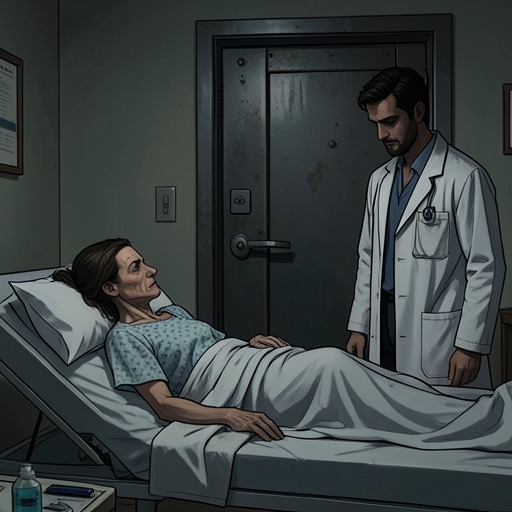
Kate Is Diagnosed with and Treated for Breast Cancer
Firefly LaneKate’s diagnosis and treatment for breast cancer turn a small, long-standing change in her body into a crisis that reorganizes her family’s life and gives new weight to care, waiting, and friendship. The illness first becomes unmistakable during a routine examination; it then advances through surgery, chemotherapy, and radiation, none of which prevents its spread. The course of the disease is marked not only by clinical decisions but by the distance between what Kate’s body is experiencing and what those closest to her can know or bear to say.
Discovery and Diagnosis
During a routine examination, Dr. Silver notices discoloration beneath Kate’s right nipple and asks how long it has been there. Kate describes a quarter-sized red patch, slightly puckered skin, and a problem that had seemed to come and go over roughly nine months to a year. It had begun like a bug bite; her family doctor had treated it as an infection with antibiotics, which appeared to help temporarily. Because her mammogram had been clear, Kate has continued to understand the recurring warmth as evidence of infection rather than cancer.
Dr. Silver does not treat the clean mammogram as a reason to dismiss the visible change. She calls to arrange an immediate breast ultrasound, then sends Kate across the hall for a biopsy. The sudden move from an ordinary appointment to urgent tests gives the diagnosis its force: a familiar symptom, repeatedly interpreted as temporary, now demands a different explanation. The scene locates the turning point in a careful clinical observation rather than in a dramatic discovery by Kate herself.
Telling the Family and Beginning Treatment
After the test results arrive, Kate prepares to tell Johnny. She puts on a pink cashmere sweater that her children gave her for Christmas the previous year, along with worn Levi’s, ties her hair back, and applies makeup because she wants to look healthy for what comes next. Johnny has already learned the result during the agonizing wait for the doctor’s call. When Kate tells him she has cancer, his effort to remain strong—and the emotion visible in his eyes—helps steady her rather than undoing her resolve.
Kate also tells her family that she is sick, initially softening the news before the children. Marah eventually asks whether it is cancer, and Kate answers yes. The exchange makes the diagnosis a shared fact, not merely a private medical disclosure between spouses. The family’s response unfolds against uncertainty: examples of people who recovered offer Marah a way to imagine a future, while Kate’s own treatment and subsequent deterioration show that reassurance cannot settle what will happen in her case.
Treatment, Waiting, and Estrangement
The treatment is extensive. Six weeks after the diagnosis, Kate has had both breasts removed and undergone chemotherapy and radiation. The treatments leave her flesh raw and burned, yet she is still waiting for Tully to call. In the meantime, Kate’s family gathers around her for breakfast and packs its things into the car; amid these ordinary preparations, Kate keeps glancing at the phone, expecting contact from her closest friend.
The contrast between the family’s physical presence and Tully’s absence gives the treatment period a relational consequence beyond its medical cost. When Tully comes home on January 2, she finds an empty apartment. The delay has allowed time to pass while Kate is undergoing major treatment, and the missed connection becomes part of the friends’ painful estrangement. Illness here makes waiting a repeated condition: Kate waits for the phone to ring, while Tully later learns how much has happened in the interval.
Metastasis and Kate’s Decision
The disease ultimately spreads to Kate’s brain. After a minor stroke, doctors operate, but once inside they find that there is nothing more they can do. Johnny explains the metastasis to Tully, and Kate’s mother confirms that the cancer is in her brain. The news changes the meaning of treatment: the earlier interventions have not stopped the disease, and the immediate question is no longer how to resume ordinary life but how to spend the time remaining.
Tully responds by trying to find another possibility. She recalls a breast-cancer program she hosted and proposes calling a doctor in Ontario who is working with a new drug. Kate says that she has had all the treatments and none has worked; she is done with treatment and asks Tully simply to be with her. Her decision draws a clear boundary between the public professional knowledge Tully can mobilize and the care Kate wants from her friend. At this point, presence matters more to Kate than another promise of a cure.
The Body’s Decline and the Meaning of Care
As the weeks pass, Kate’s body weakens in several distinct ways: she struggles to find words and finish sentences, her fingers tremble, nausea becomes difficult to bear, and she is persistently cold. By late July, her pain has led to a near doubling of her morphine dose. Her doctor says addiction is no longer the relevant concern, marking how far the situation has moved from the ordinary measures by which treatment and medication might usually be judged.
The account makes the illness concrete through changes in speech, movement, temperature, nausea, and pain rather than reducing it to a diagnosis alone. At the same time, the presence Kate asks for becomes the central form of care available after treatment has failed. Her cancer narrative therefore turns on a shift from trying to reverse the disease to staying beside Kate within the limits it imposes: the decisive outcome is not recovery, but the recognition that companionship is what she wants and what her friends and family must now provide.