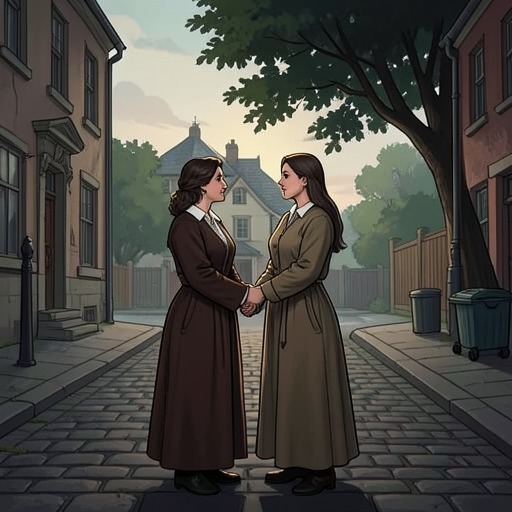
Kate Mularkey
Firefly LaneKate Mularkey’s life is shaped by a tension between her deep attachment to Tully Hart and her effort to discover what she wants apart from her friend. Initially a lonely, bookish teenager who has been rejected by both popular and “good” students, she becomes Tully’s first dependable friend and shares Tully’s dream of becoming a reporter. Yet the qualities that make Kate a thoughtful journalist also make her wary of the profession: she can write and film strong stories, but hesitates to intrude on people’s grief. Her story is not simply a quieter version of Tully’s rise. It is a separate coming-of-age, in which friendship, family, ambition, and love pull her toward choices of her own.
Identity and Early Isolation
In 1974, Kate is in eighth grade and dreads school. A year earlier, her two closest friends had turned away from her after she refused to join their drug use, parties, and class-cutting. Their former circle left her socially stranded: students who had been considered “good” also kept their distance because she had once belonged to the stoners’ group. Reading became her refuge. She had read The Lord of the Rings so many times that she could recite whole scenes from memory.
Kate’s friendship with Tully begins against this background of exclusion. When Tully begins to cry, Kate does not try to explain away the distress or press her for an account. She simply hugs her. Tully initially flinches at the unexpected contact, then clings to Kate, afraid of losing the unexpected comfort. The contrast is central to Kate’s character: her first response is not performance or advice, but quiet physical reassurance.
The friendship soon becomes mutual rather than merely consoling. Tully asks whether they are friends, and Kate answers that they are. Tully immediately shifts into her lively, self-appointed role as Kate’s guide to makeup and fashion, sharing Twinkies and inviting herself to Kate’s house. Kate’s acceptance gives the friendship a practical everyday form: companionship, teasing, and the easy assumption that they will keep making room for each other.
Friendship, Home, and a Shared Ambition
The Mularkey household offers Tully a glimpse of the family life she has longed for. While Kate’s family watches the evening news, Mrs. Mularkey points out that Jean Enersen is changing the world as one of the first women to anchor a nightly news program. Tully suddenly declares that she will become a reporter. The moment also plants an ambition for Kate: the dream takes root in a family kitchen, where a woman’s presence on television makes a professional future seem imaginable.
Kate and Tully turn that possibility into a shared plan. They imagine themselves as reporters who will follow stories and write them up together, and Mrs. Mularkey’s pride in Tully’s ambition becomes part of the correspondence that connects them. The promise of a joint future matters especially to Tully, whose dream helps her imagine a life beyond abandonment. For Kate, the same ambition is both a bond with her friend and a path she will eventually need to assess for herself.
Their loyalty is expressed in an explicit promise. After Tully asks whether Kate had worried about her, Kate tells her they will be best friends forever and promises she will always be there, no matter what. The pledge gives their closeness its own language: not simply affection in the present, but a commitment to remain available through whatever changes their lives bring.
By the end of high school, the pair have become so closely identified that classmates combine their names as “TullyandKate.” Tully edits the school paper, and Kate works beside her, editing stories. Kate enjoys the reflected excitement and popularity of Tully’s achievements, but the arrangement also depends on familiarity: she feels safe in the world she knows. When college approaches, she is reluctant to leave home despite years of late-night plans beginning with the words “when we’re in college.” Tully closes Kate’s suitcase for her and assures her that she is ready, making the departure another small instance of Tully moving forward while Kate hesitates at a threshold.
Journalism and the Limits of Imitation
At the University of Washington, Tully responds to the scale of the university as a challenge; its size daunts Kate. Tully begins preparing for network work immediately, taking communications courses while reading at least four newspapers a day and watching newscasts. Kate’s path is less certain. During her first weeks she meets repeatedly with her School of Communications adviser to work out an academic plan, but the school will not let her into upper-level broadcasting and journalism classes until she has waited her turn. She is impatient with that delay, even as it exposes the distance between wanting a career and being able to enter its advanced training.
Kate nevertheless develops substantial journalistic abilities. At the university she learns to direct Rush Week skits, organize a dance for three hundred people, and feel at ease at parties among people she does not know. In class she writes sharp stories with hooks and memorable openings, and she learns to film a story while moving with the action. Her journalism professors repeatedly praise her work and tell her she has a gift. These achievements make her later doubts more complicated than a lack of talent: the issue is whether she wants to use that talent in the competitive style the career seems to demand.
Where Tully can push ahead and ask any question, Kate finds it difficult to intrude on people’s grief. She increasingly holds back from pursuing stories of her own and edits Tully’s instead. The difference is a professional conflict as well as a personal contrast. Kate’s sensitivity does not prevent her from reporting effectively, but she fears it will keep her from becoming a network producer or a first-rate reporter. Sitting in broadcast and communications classes, she comes to regard continued study as a way of lying to herself about a future she may not want.
When she tries to explain this uncertainty, Kate contrasts herself directly with Tully. She says she does not eat, sleep, and breathe the news, and imagines that people as relentless as Tully would outcompete her for a scoop. Although her grades are excellent and her professors value her reliability, she concludes that journalism, whether television or print, is not a realistic career for her. Margie Mularkey challenges the authority Kate gives to realism. She points to the economic pressures facing her family and to her own limited opportunities after raising children without an education, then urges Kate to dream big while she still can. Her encouragement does not settle Kate’s decision, but it reframes hesitation as something other than sound judgment.
Private Desire and the Life Kate Chooses
Kate’s attachment to Tully also complicates her private life. For years she has loved Johnny Ryan, but neither he nor Tully understands the truth. Tully does not know that Johnny wants her, and Johnny does not realize that Kate wants him. Kate recognizes the irony that three people who search through the wreckage of life for truth can remain blind to what matters in their own lives. The unspoken triangle persists because Kate repeatedly backs away from telling Tully, particularly after the guilt she feels over what she once gave Tully about Chad Wiley.
When Kate finally tells Tully that she is in love, she initially lets the moment sound new. She then makes clear that she has loved Johnny for years. The disclosure changes a long-held secret into a fact their friendship must accommodate. It also marks an act of self-assertion: Kate speaks plainly about a desire she has protected by silence, rather than continuing to let her fear of Tully’s possible response make the choice for her.
Johnny later proposes to Kate by getting down on one knee and asking her to marry him as Kathleen Scarlett Mularkey. Kate wants to say yes, but fear keeps her from answering immediately; instead she asks whether Johnny is sure. His assurance allows her to accept the reality of his commitment. The proposal gives form to a relationship that had long existed in Kate’s hopes, while the pause before her answer shows that happiness does not immediately erase her uncertainty.
Career, Contrast, and Character
Kate’s relationship with Tully is built on a durable paradox: the two share a dream, yet they do not share the same temperament or measure of success. Tully turns news into a vocation and pursues its opportunities with relentless focus. Kate can write, film, organize, and succeed academically, but does not want to make every human encounter serve a story. Her doubts arise not because she is incapable, but because the professional ideal she sees in Tully may not fit her own instincts.
That difference makes Kate more than a companion to Tully’s ambition. As a teenager, she offers the kind of unshowy care that Tully has rarely known; as a student, she becomes an accomplished editor and reporter while questioning the costs of the work; in her personal life, she eventually voices the love she has kept concealed and confronts the vulnerability of accepting a proposal. Across these moments, Kate’s defining movement is from safety in familiar roles toward choices that belong to her. Her friendship with Tully remains essential, but it does not erase her separate desires or the questions she must answer about the life she wants.