Kate’s journal
Firefly LaneKate’s journal is a hand-tooled, leather-bound book that begins as Tully’s gift to Kate during her terminal illness and becomes Kate’s account of the person her children might otherwise have too little time to know. Its movement from a blank page to a nearly completed life story reverses the direction of Tully’s childhood scrapbooks: both women preserve experience in the hope of being seen, but Kate writes not to win an absent mother’s pride, but to leave her own truth to her family.
The Gift and Its Purpose
Tully gives Kate the journal while Kate is gravely ill. She has written “Katie’s story” on its first page, offering not a finished portrait but an invitation to make one. Kate initially resists: writing was something her mother, Johnny, and Tully had wanted for her, she says, and she believes it is too late to begin. Tully answers with a purpose Kate can act on. The journal is for Marah and the boys, who will one day want to know who their mother was. She cannot prescribe what Kate should say; she tells her to write what she remembers.
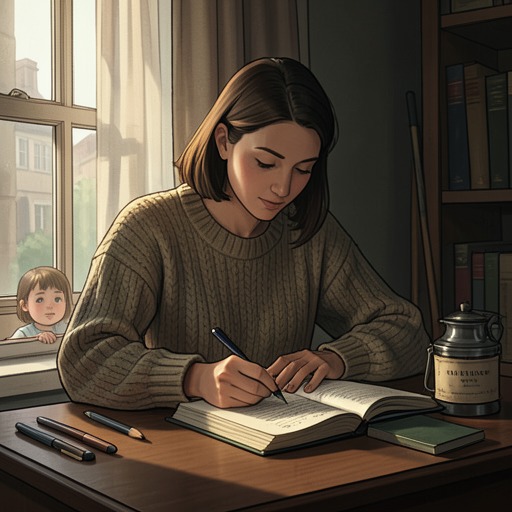
The gift’s material form makes the invitation tangible. Kate holds the leather cover, traces its etchings, and feels the gold-edged paper. The pages are still blank, but they carry a future audience: her children, who may know her through illness and loss without having had enough time to know her as a whole woman. Writing will hurt, Kate understands, because remembering means revisiting both the good and the bad. Yet she recognizes that the only gift she can now give her children is the truth of who she was.
Writing from the Present
Kate begins without a plan, opening the journal and writing. Her first entry approaches her life through the fear that governs her final illness. Panic arrives physically, as a knot in her stomach, nausea, and breathlessness; its trigger changes from day to day. A husband’s kiss or the sadness in his eyes can make her feel that Johnny is already grieving for her while she is still alive. The journal therefore does not begin as a tidy chronology. It starts inside the unsettled present, where the prospect of death alters the meaning of ordinary intimacy.
Her writing also turns toward Marah. Kate admits that she would give anything for another of their old, fierce arguments. She understands those fights differently now: Marah had been trying to become herself beyond being her mother’s daughter, while Kate had been afraid to let her go. She calls that conflict a circle of love and regrets not recognizing it sooner. She acknowledges that both she and Marah regret things they said, but insists that their shared love matters more than those words. The journal becomes a place where Kate can make that understanding explicit for the daughter with whom she had once struggled to connect.
Memory, Selection, and Legacy
As the summer advances, Kate continues writing, though the work slows as her strength diminishes. The book is not simply a sequence of dates and names. Looking back over her nearly finished account, she reflects that people begin a life story thinking it will be about facts, achievements, failures, and the timeline of youth and middle age. What remains most vivid to her instead is love, family, and laughter. She wants her children to know how proud she is of them—and of herself—and that she, Johnny, and the children had everything she had wanted.
That reflection gives the journal a deliberate shape: it moves from fear and regret toward an understanding of a life through its relationships. Kate does not erase difficulty. Her writing holds illness, maternal exhaustion, the pain of her conflict with Marah, and the happiness of family within the same account. The distinction between a bare record and a life remembered matters to her: dates and events may organize the story, but affection is what she wants her children to carry from it.
The Journal Returns to Tully
Kate eventually hands the journal to Tully. Tully has watched the writing change pace over the summer, from quick and easy work to increasingly slow effort in Kate’s final weeks. Receiving the book leaves her unable to speak; she takes Kate’s hand, opens to the first page, and finds a sentence that remembers their friendship from its beginning: “The first time I saw Tully Hart, I thought: Wow! Look at those boobs.” She laughs and keeps reading. The opening joke restores the irreverent girlhood voice inside the grave circumstances of Kate’s illness, while making clear that the book’s family history includes the friend who helped call it into being.
The journal’s significance also echoes Tully’s own childhood practice. On her eleventh birthday, Tully stared at the blank first page of a scrapbook and imagined giving it to her absent mother one day, as evidence of what she had missed. She filled successive books with photographs, tickets, and accounts of good days, sometimes embellishing them in the hope that her mother might be proud. Kate’s journal answers that earlier wish in a different register. It is not a performance intended to persuade an absent parent: it is Kate’s own recollection, offered to children who need to know her, and then entrusted to the friend who has shared so much of the life it records.
Friendship as a Written Record
Before the journal, letters had already served as a lifeline between Kate and Tully. For three years, Tully wrote to Kate every Sunday evening about ordinary pleasures and private worries, including her continuing dream that her mother would return and be proud of her. When Tully’s grandfather died, Kate’s sympathy reached her through a phone call, and Tully was able, with Kate, to be more nearly herself rather than embellishing her story. Their written and spoken exchanges preserve different forms of closeness: letters sustain friendship across separation, while Kate’s journal makes a life legible to the next generation.
Other written records in the novel show how personal documents can carry a voice across absence. During Johnny’s reporting from Baghdad, a message addressed “Dear Katie” brings the distance and uncertainty of the war into the household. Kate’s journal works in the opposite direction: rather than reporting an unfolding danger to someone waiting at home, it gathers a life for those who will remain after its author is gone. Its last passage insists that the enduring measure is not accomplishment alone, but the love, family, and laughter that made the life hers. When Kate gives it to Tully, that account becomes both a legacy for her children and a final act of trust between the two friends.