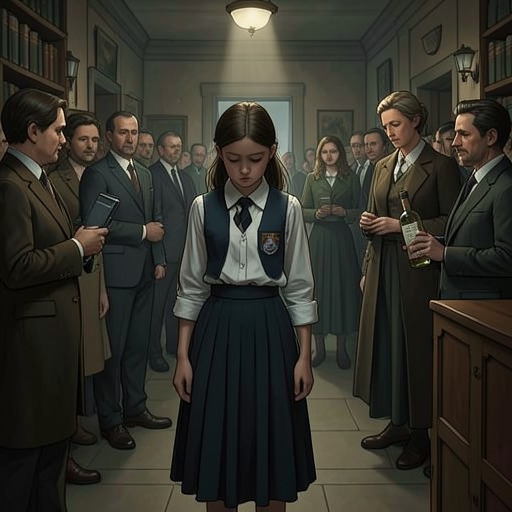
Tully Hart’s abandonment at the 1970 antiwar protest
Firefly LaneTully Hart’s abandonment at the 1970 antiwar protest is the childhood rupture around which much of her later longing for dependable love takes shape. In a crowded Seattle demonstration, her mother, Dorothy, slips away; Tully waits for her, but she never returns. The child interprets the loss not as her mother’s choice but as proof that she herself has done something wrong, a belief that reverberates through Tully’s later attachments and helps explain why being held, believed, and stayed with can matter more than reassurance alone.
The protest and the separation
The episode begins on a busy downtown Seattle street filled with demonstrators chanting and yelling, their signs bearing slogans such as MAKE LOVE NOT WAR and HELL NO, WE WON’T GO. Tully has never seen so many people gathered in one place. The protest is not presented to her as an abstract political cause: it is a bewildering, overwhelming crowd through which she must keep hold of her mother’s hand. When the demonstrators swell around them, the physical closeness that had made the day manageable abruptly vanishes.
Tully finds herself holding on to nothing. She screams for her mother, pushes through the bodies, and keeps calling until her voice fails. No one turns or answers, though people are everywhere. She returns to the curb where she last saw Dorothy and waits, crying and trying to be brave, convinced that her mother will come back. The decisive fact is not simply that Tully becomes lost in a crowd: Dorothy does not return for her.
Rescue and the child's explanation
The separation’s aftermath is fragmented in Tully’s memory. For years she cannot recall what happened between waiting in the crowd and waking on a dirty cement stoop on an otherwise empty street. What remains is the image of a policeman on horseback, high above her, asking whether she is alone. Tully can answer only that she is, without crying. He takes her back to the house on Queen Anne Hill, where her grandmother holds her, kisses her cheek, and tells her that what happened was not her fault.
The reassurance does not dislodge Tully’s own explanation. She decides that she must have done something wrong or been bad, and imagines that next time her mother comes back she will try harder. Her response converts abandonment into a test she believes she can pass: she promises herself that she will become president and never say she is sorry again. The child’s ambition and determination thus carry a private, impossible bargain—the hope that becoming worthy enough will make a missing parent return.
The consequences reach into ordinary life after the protest. Tully memorizes the names of every U.S. president in order and tells people for months that she will be the first woman president; she even quits ballet. On her eleventh birthday, while her grandmother lights the candles and sings, Tully repeatedly looks toward the door, expecting her mother to arrive. No one knocks and the phone does not ring. The empty scrapbook among her presents becomes another quiet detail of the day: a project meant to keep her occupied cannot fill the place of the parent whose return she is still waiting for.
The wound in later relationships
The protest’s emotional pattern recurs when Tully is older, not as a repetition of the same event but as a renewed fear that closeness can disappear. After Tully begins to cry, Kate hugs her. The touch is foreign enough that Tully initially flinches and starts to pull away; then she cannot move and clings to Kate, afraid that without her she will drift away and be lost. The scene gives physical form to a need the protest first exposed: Tully wants connection, yet unexpected tenderness can feel unfamiliar, even as separation feels perilous.
When Tully tells Kate that Pat Richmond raped her, she must force the truth into speech, describing it as a fire inside her that she cannot contain. Her shame makes her avoid looking at Kate while she waits for judgment. Instead, Kate asks quietly whether she is okay. The disclosure and response do not erase the earlier abandonment, but they create a different relational experience: Tully can reveal something painful and meet concern rather than rejection. Across these scenes, Kate’s presence becomes more than friendship in name; it offers Tully an experience of being witnessed and comforted without requiring her to earn care by becoming exceptional.
That support also appears when Tully tells Kate that her grandmother has died. She admits that she is angry at Dorothy, her grandmother, and God, then breaks into sobs. Kate holds her and lets her cry without trying to talk over the loss. The episode’s earlier image of the grandmother holding the child thus has a painful counterpoint: the caregiver who once brought Tully home is gone, but Kate remains beside her while she grieves. Tully’s fear of abandonment does not prevent her from accepting support; rather, the scenes show how deeply she needs the reliable presence that was missing at the protest.
Echoes in illness and caregiving
The past’s force is clearest when Kate faces catastrophic illness. After Kate collapses and is taken to the hospital, Tully insists on staying in the ambulance beside her, repeating that she is right there. At the hospital, she is pushed aside as the staff hurry Kate inside, and she watches her best friend being taken away. The moment reverses the childhood scene’s central helplessness: Tully cannot control what happens to someone she loves, but she tries to make her presence unmistakable rather than disappear.
As Kate’s cancer affects her brain, Johnny warns Tully that Kate’s faculties have been impaired and that she may not recognize her. The warning sharpens the risk of their final encounter: the friend whose steadfastness has countered Tully’s old fear may no longer be able to respond to her. Tully nevertheless makes room for the possibility of presence without recognition, accepting that Kate’s condition may limit what their reunion can give her.
On Kate’s last night in the hospital, Tully persuades Johnny to take the children home and takes his place in the other bed. She pushes it across the linoleum until it nearly touches Kate’s, then brings a recording of her final television show. The two watch it together like schoolgirls at a sleepover. The bedside scene does not undo Dorothy’s disappearance or promise that love can prevent loss. Instead, it gives the old pattern a different ending: faced with a friend who is dying, Tully stays close, places her bed beside Kate’s, and shares something of herself. The protest is therefore both a source of Tully’s enduring vulnerability and a measure of the care she later learns to give and receive.