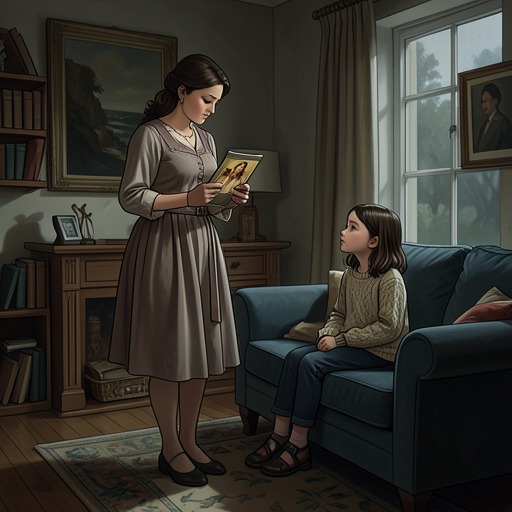
Tully and Kate are arrested at a party, and the Mularkeys take Tully in
Firefly LaneTully and Kate are arrested after a reckless party, but the decisive consequence is not punishment: it is the Mularkey family’s decision to take Tully in. In the wake of her grandmother’s death and Cloud’s renewed abandonment, the arrest brings Tully to the edge of juvenile hall and another uncertain foster placement. Margie’s offer of a home turns that crisis into a lasting experience of belonging, one Tully remembers as the beginning of a new life within the loud, loving Mularkey family.
Grief and the decision to go
The party begins in the aftermath of two losses. Tully’s grandmother has died, and Cloud has abandoned her again. Grief gives way to anger, which Tully feels as a force she cannot contain; she knows the plan is reckless, but slowing down would mean letting her fear catch up. She and Kate get ready in Tully’s mother’s old bedroom, and Kate discovers something she urgently wants Tully to read. The scene sets the evening’s momentum against the instability in Tully’s life: the party is a bad idea, but she cannot turn back.
They drive to Karen Abner’s house with a Kiss tape playing loudly in the car, singing all the way. The party has already drawn several cars, some hidden among the trees, and its crowded basement offers a sharp change of atmosphere: loud music, smoke and incense, kids dancing, boys playing foosball, and others getting high. Tully takes Kate’s hand and leads her downstairs. The detail matters because the night is not simply Tully acting alone; Kate accompanies her into the gathering, and the two friends soon have to escape it together.
The arrest
After someone calls out that the police have arrived, Tully and Kate flee the house. They make their way up the hill and through scrub brush to the car; Kate is terrified and says she is going to be sick. Tully insists they will not be caught, gets behind the wheel, and reverses at speed. The car slams into something, throwing Kate forward so that her forehead hits the dashboard.
The obstacle is Officer Dan, who recognizes the two girls as the Firefly Lane girls and recalls having driven Tully away from Snohomish three years earlier. His appearance binds the immediate trouble to Tully’s longer history of displacement. He tells them to get out of the car, addresses Tully by her full name, Tallulah, and tells Kate that the party is over. Their attempt to outrun the consequences ends in an arrest, and Kate is caught up in the same encounter as Tully.
The prospect of another placement
Afterward, Tully faces the possibility of juvenile hall. Mrs. Mularkey tells her plainly that this is what the authorities want, while Tully looks down at her hands, unable to bear the disappointment she sees in Mrs. Mularkey’s face. Her first response is to imagine the next rejection: she assumes a foster family will no longer want her. Mrs. Mularkey also confirms that Cloud has refused to take custody of her, making the prospect of another placement more than an abstract fear.
Kate believes another family could be found, but Tully says that Kate lives in a different world from hers. That difference is not a quarrel between the friends so much as a measure of their unequal security: Kate can imagine a solution because she has a home to return to, while Tully expects each new arrangement to fail. The arrest exposes the precarity beneath her recklessness. She is not only facing the consequences of the party; she is waiting to learn whether anyone will keep her.
Margie’s offer and Tully’s new beginning
Mrs. Mularkey tells Tully that Kate wants her to live with the family. Tully cannot accept the possibility at once and answers, “Yeah, right.” Mrs. Mularkey makes the offer concrete rather than sentimental: a girl in their house would have chores, would follow rules, and would not be allowed to smoke. Tully looks up and asks whether she really means that she can live with them. Mrs. Mularkey touches her jaw and explains that she knows how hard Tully’s life has been and cannot stand for her to return to it.
As the possibility of a home becomes real, Tully begins to cry for all she has lost: her grandmother, the foster family, and Cloud. She hands Mrs. Mularkey the crumpled, half-empty pack of cigarettes, a small gesture that accompanies her acceptance of the household’s rules and care. Mrs. Mularkey welcomes her into the family and holds her while she cries. The emotional reversal is decisive: what began as an attempt to escape trouble becomes the moment Tully is offered a place to belong.
Lasting significance
Tully later remembers this welcome as the beginning of becoming someone new. While living with the Mularkeys, she finds a self that does not have to keep secrets, lie, or pretend to be someone else; the family does not treat her as unwanted or inadequate. The arrest thus becomes a hinge in her story not because it erases her earlier abandonment, but because it brings her into a household where she is explicitly accepted.
That welcome also acquires meaning through its recurrence in Tully’s memory. She carries Margie’s words and the experience of being held into later years, wherever she goes and whoever is with her. She remembers the senior year she spent inseparable from Kate and part of the Mularkey family as the single best year of her life. The lasting consequence of the night is therefore larger than a change in living arrangements: after repeated losses, Tully is given a family that helps her imagine belonging as something she can inhabit rather than merely hope for.