“There is no one thing that’s true. It’s all true.”
For Whom the Bell Tolls“There is no one thing that’s true. It’s all true.” is Robert Jordan’s late reflection on the coexistence of incompatible-seeming realities. Spoken inwardly as he lies alone with a broken leg and awaits death, the thought gathers the beauty, violence, belief, and uncertainty that his final hours have forced him to hold at once; his immediate protest against one part of it keeps the formulation from becoming easy reconciliation.
The Saying in Its Moment
Robert Jordan thinks through the phrase while trying to prepare himself to move from the tree where he has been leaning. He has concluded that he must get into a position where he can still be useful, and acknowledges that the break has left the lower part of his leg without sensation. The reflection therefore emerges not as a detached maxim but amid practical urgency: he is injured, isolated, and trying to use the time left to him.
He looks down the slope and regrets leaving the world, while hoping that his efforts have done some good. He reflects that he has fought for what he believed in for a year and that victory here might mean victory everywhere. In this context, “all” extends beyond private experience: the statement arises from a commitment to a collective struggle whose outcome remains uncertain.
Beauty, Violence, and Conflicting Realities
The passage sets Madrid, imagined beyond the hills and across the plain, against Pilar’s account of old women drinking blood at a slaughterhouse. Robert Jordan recognizes both as true, refusing to let the city’s beauty cancel violence or violence make beauty unreal. The phrase names this refusal to simplify what the novel places side by side.
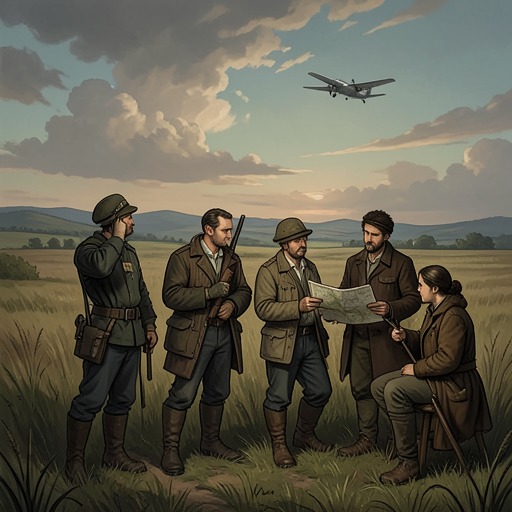
The same tension sharpens when he considers the planes. He briefly reasons that they are beautiful whether they belong to his side or the enemy, then immediately rejects the thought. The correction matters: he can recognize beauty across the division without ceasing to oppose the force that threatens him and his cause. The saying accommodates contradiction, but does not erase judgment or allegiance.
Doubt, Memory, and the Final Outlook
Robert Jordan’s reflection follows his effort to distinguish what he has learned from what he cannot verify. He wishes there were a way to pass on his knowledge and thinks that he had been learning quickly at the end. He also considers speaking with Karkov in Madrid, a possibility that remains beyond his immediate reach. The thought of an audience for what he has learned gives way to the recognition that the city is both a real destination and a vision across the landscape.
The phrase’s importance lies in its double movement: it broadens perception to admit beauty, atrocity, and uncertainty together, then exposes the strain of doing so through Robert Jordan’s blunt resistance to the planes’ beauty. In the closing isolation of his reflection, the claim offers neither a neat explanation nor escape from the war. It registers a consciousness trying to hold the world whole even as his own time in it is ending.