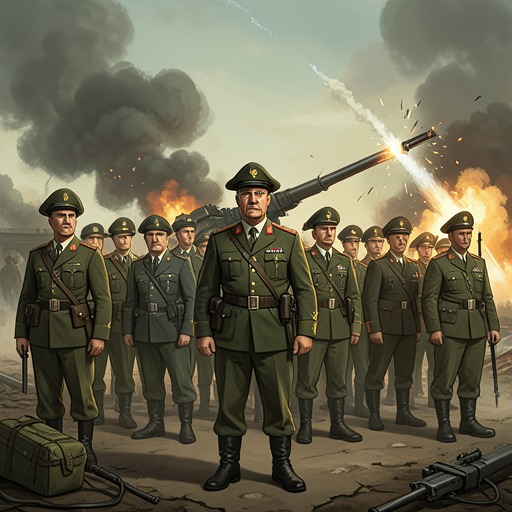
Attack on the fascist outposts
For Whom the Bell TollsThe attack on the fascist outposts is the coordinated assault that opens the bridge-demolition operation, putting the plan’s timing and division of forces to a test. The outposts are to be attacked only after the bombing begins; while the fighting unfolds at the sawmill and along the road, Robert Jordan works beneath the bridge to place the charges. The operation advances, but the fighting costs two lives at the sawmill.
Plan and Tactical Purpose
Robert Jordan’s instructions to Pilar make the timing explicit: no attack on the post is to begin until she hears the bombs. Once the post has been destroyed, her group is to fall back toward the bridge and cover the road from above and from his left flank. He repeats that nobody should move, fire, or throw a bomb before the bombardment begins. The sequence is not incidental: the bombing signals the start, and the attacks on the posts are coordinated with the work of destroying the bridge.
The larger military purpose is to prevent reinforcements from travelling up the road. In the earlier plan, the bridge is to be blown after the main attack starts, so that no reinforcements can come over that route. The outpost assaults and the bridge demolition thus depend on timing as well as force: the attackers must engage the posts while Jordan places the explosives, with the road kept under observation and the withdrawal covered.
Terrain, Observation, and Preparation
The action takes place in a constricted mountain pass where the road, stream, bridge, and sawmill shape what each group can see and do. The steel bridge spans a deep gorge; sentry boxes stand at its ends, and the road runs beside the stream. From the wooded slope above, Jordan can watch the bridge and its approaches. The gorge and the bridge girders, however, also make the demolition a demanding task requiring him to work beneath the structure while the fighting continues nearby.
The posts are not safe merely because they occupy elevated or defended ground. Jordan points out that rocks intended to protect a gun’s flanks can also give cover to attackers, and that a machine gun needs open ground and a sideways field of fire to be effective. His instruction is to learn from the position’s actual lines of sight rather than assume that the existing arrangement is defensible. This practical attention to terrain informs the wider operation: the outposts must be taken or suppressed, while the road and bridge remain the central corridor to control.
The surrounding road is also a source of imperfect intelligence. During a snowstorm, Anselmo watches traffic from a tree near the sawmill and counts vehicles, recording them on two sheets torn from Jordan’s notebook. He sees a camouflaged General Staff car but cannot identify its significance; he records it simply as another vehicle going up the road. The episode shows both the value and the limit of observation: Anselmo follows his orders and notes movements, but he lacks the distinctions that Jordan might have used to interpret them.
The Bombs and the Assault
On the morning of the operation, Jordan lies above the road and bridge as daylight spreads through the pines. He watches a sentry at the bridge and waits. The morning remains quiet until the bombs sound. Their sudden detonation is the agreed signal: Jordan raises his submachine gun, and the sentry reacts by leaving his box and looking toward the sky. Jordan shoots him. Anselmo fires from the far end, and the bridge assault becomes a series of connected actions rather than a single attack.
Grenades explode near the bridge and farther up the road. Rifle fire joins the explosions, while Pablo’s cavalry automatic rifle fires below. As this fighting develops, Anselmo moves toward the far end of the bridge and Jordan carries the heavy packs down the slope. The attacks are distributed across positions: firing comes from below, from the road, and from the upper post, while the bridge itself remains Jordan’s immediate task.
Jordan climbs into the bridge framework and receives explosive packages from Anselmo. He places and braces the charges between the girders, securing them with wire and wooden wedges. Gunfire and grenades continue around him. He hears a burst of firing below and then grenades; afterward that direction falls quiet, leaving him uncertain about what has happened. He continues the demolition while still hearing heavy firing at the upper post. In his thoughts, the sawmill’s piles of packed sawdust appear as possible cover for defenders, and he worries that people there may still be resisting. The fighting is therefore not a distant backdrop to the engineering work: it creates uncertainty about whether the supporting positions are secure even as the demolition proceeds.
Results and Cost
Pilar’s group reports that five opponents have been killed at its position, including two there; she points out another person at the far end of the bridge. She also reports eight killed below by Pablo’s group. These counts are made amid continuing confusion, as Pilar asks what Jordan is doing beneath the bridge and urges him to finish quickly. Her impatience reflects the operation’s pressure: the longer the demolition takes, the longer the groups remain exposed while the posts are still being fought over.
Firing starts again down the road at the position Pablo has taken. Jordan hears it as he climbs out of the bridge framework and pays out the wire used to detonate the charges. The road below remains clear as he moves backward away from the bridge, keeping the wire taut. The operation reaches its intended result: Pilar later reminds him that the bridge is blown. But success does not erase the losses. She tells Jordan that two of their own have been lost at the sawmill; he acknowledges that he has seen what happened, and Pilar names Fernando and Eladio among the dead.
Significance in the Operation
The attack on the outposts reveals how the bridge demolition depends on several groups acting in sequence, rather than on explosives alone. The bombing provides the signal; attacks on the posts occupy or eliminate defenders; fighters cover the road; and Jordan and Anselmo carry out the technically precise work at the bridge. The pauses, renewed firing, and uncertainty about the sawmill show how easily an operation organized in advance can be altered by events on the ground.
The fighting also exposes the human cost of making that plan work. Jordan continues to place and wire the charges while others face the outposts, and Pilar’s report of the two deaths at the sawmill brings the cost directly into the aftermath. The bridge is destroyed, but the coordinated assault has required its participants to take losses and act without full knowledge of what is happening at the other positions.