Bridge demolition explosives and equipment
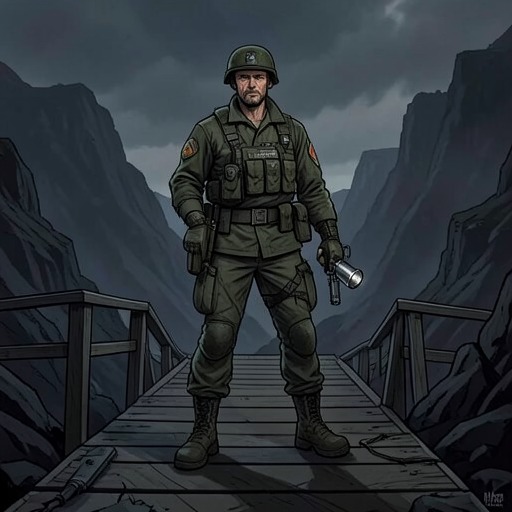
For Whom the Bell TollsBridge demolition explosives and equipment are the physical instrument of Robert Jordan’s mission to destroy a bridge in the mountain pass. The materials are not an abstract promise of sabotage: dynamite must be carried across the lines, hidden near its target, checked piece by piece, and placed so the bridge’s support will fail. Their route and configuration bind the operation to the terrain, while the notebook sketches translate a distant steel span into a precise engineering problem.
The explosives and their journey
At the mission’s outset, Robert Jordan wants the explosive concealed with the greatest possible security, no more than half an hour from the bridge. Anselmo answers that the hiding place can be reached downhill from where they are going, though reaching it first requires a climb. The exchange establishes the equipment’s double condition: it must remain close enough to be useful, but concealed and protected until the moment of action. Distance, slope, and secrecy are operational requirements, not incidental details.
The dynamite has already been brought through dangerous country. Anselmo says that the party crossed the lines in darkness and carried it over the mountains throughout the following day. At the cave, the old man’s pride in the load meets Robert Jordan’s insistence that it is intended for another purpose. When the armed man asks what he has brought, Jordan refuses to hand it over; asked what he will do with it, he says only that he will blow up a bridge. The equipment therefore carries a tension between its apparent availability to any fighter who can use dynamite and its specific assignment within Jordan’s mission.
A technical plan for the span
The target is a single-span steel bridge across a deep gorge, with a sentry box at each end and room for two motor cars to pass. From the hillside, Robert Jordan studies it in the remaining light and makes quick line sketches in his notebook. He does not yet calculate the charges. Instead, he identifies where explosive must be set to cut the span’s support and drop a section into the gorge, separating the structural question from the later calculation of quantity.
His notes preserve two possible methods. One is a controlled demolition using six charges, placed and braced to explode simultaneously; the other is a rougher approach with two very large charges on opposite sides, also detonated together. The plan is therefore not simply to apply force to the bridge, but to make the force act at the necessary points and at the same instant. The drawings make that reasoning shareable: when Robert Jordan shows them to the men in the cave, Primitivo says the sketch resembles the bridge itself, and Jordan explains the placement of the charges and why it should work. Andrés asks how they are to be exploded, prompting Jordan to explain the firing method as well.
Packing, inspection, and handling
At the cave, the equipment becomes legible through touch and inventory. Robert Jordan checks two packs beneath a wet, stiff canvas cover. One contains bundled blocks in sacks, with the sacks wrapped in a sleeping robe; he feels them by hand and reties the wrapping before closing the pack. The other holds the older exploder in a wooden box, a cigar box of caps, and the components and tools needed to prepare and connect the charge.
The smaller contents are carefully separated and secured: each cap is a little cylinder wrapped around with its two wires; the submachine-gun stock is disconnected from its barrel and wrapped in a leather jacket; two pans and five clips occupy an inner pocket. Coils of copper wire and a larger coil of light insulated wire sit with pliers and two wooden awls, which are used to make holes in the ends of the blocks. Robert Jordan’s recollection of packing wild-bird eggs as a boy gives the arrangement an exacting delicacy: dangerous components are handled as items that can be damaged or made useless by careless packing. After checking them, he locks the packs, buckles their flaps, covers them again, then lifts both and carries them into the cave, just able to manage their weight.
Equipment within a changing battlefield
The explosives’ practical meaning depends on more than the bridge and the device. The pass road below the forest connects the target to a mill and stream, while the bridge’s gorge and sentry positions shape where the demolition can be carried out. The same landscape that offers concealment also imposes approaches, sight lines, and exposed points. Later, Robert Jordan’s instruction about a machine gun makes that dependence explicit: rocks that ought to protect a flank can instead give cover to attackers, so a weapon must be set where its fire can cross open ground and strike from the side. The bridge plan, too, is inseparable from how the ground permits access and how the structure bears force.
The notebook sketches also become a means of passing technical knowledge to the group. The men are not merely shown a supply of dynamite; they are shown where it must go, why the supports matter, and how simultaneous firing can turn a collection of charges into a coordinated demolition. The exploder, caps, wires, awls, and blocks form a system whose parts have different tasks. A failure in placement or connection would matter as much as a shortage of explosive, so the equipment’s effectiveness depends on correct handling and on the group’s understanding of the plan.
Material limits and the mission’s exposure
The route and its surveillance complicate the ideal of a controlled operation. While Anselmo watches the snow-covered road by the sawmill, he sees a camouflaged Rolls-Royce pass without recognizing it as a General Staff car. He marks it on two sheets torn from Robert Jordan’s notebook, recording it as the tenth vehicle going uphill that day; six have gone down and four remain unaccounted for in his tally. Jordan would have distinguished the General Staff’s Rolls-Royces from the division staff’s other cars, but Anselmo records only a vehicle moving up the road. The scene shows how reconnaissance information can be preserved yet still lose significance when the observer lacks the right distinctions—a vulnerability relevant to any operation whose success depends on timing and concealment.
As daylight comes over the bridge, Robert Jordan again watches the span from the hillside. The sentry is visible in his box, warming his hands over a brazier made from a punched petrol tin; mist rises from the stream, and the bridge appears delicate and spidery across the gap. The contrast between that fine appearance and the load of dynamite, caps, wire, and firing gear underscores the mission’s central material logic: a large structure may be brought down not by indiscriminate force, but by a carefully assembled chain of components, placed against the points that hold it up. The equipment is thus both a burden to transport and the means of converting observation into action.