Demolition of the bridge
For Whom the Bell TollsThe Demolition of the bridge is the decisive fulfillment of Robert Jordan’s assignment: he destroys the steel span across the pass, severing a route the enemy might use, but the blast kills Anselmo, who holds the wire at the moment of detonation. The operation turns technical precision into irreversible loss. The bridge is successfully cut; the men who make that result possible cannot all leave the scene alive.
The Bridge as an Operational Problem
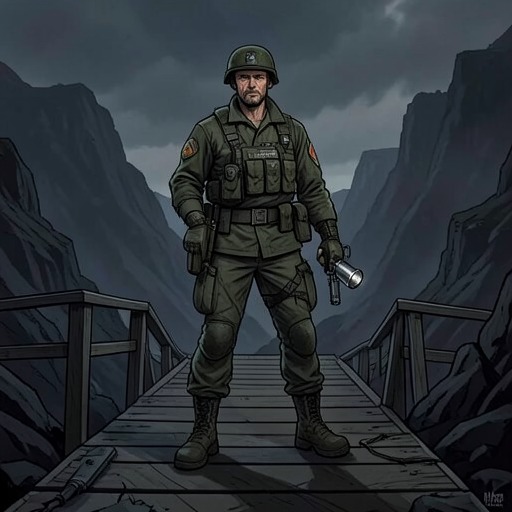
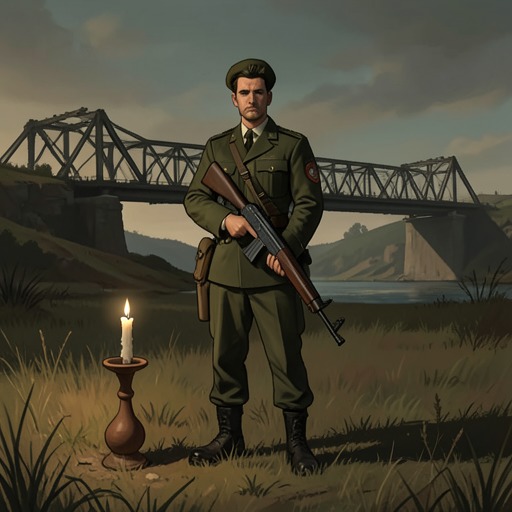
The bridge first appears as a structure set into a constricting landscape. From the pine-needled hillside, Robert Jordan can see the dark road winding through the pass, with a stream and mill below. When he and Anselmo approach to within fifty yards, the single-span steel bridge becomes legible in detail: sentry boxes guard both ends, and the span crosses a deep gorge where a brook runs far beneath it. Its position makes it a practical choke point, while the gorge gives the demolition a clear physical consequence: a severed span will drop into the gap and interrupt passage.
Robert Jordan studies the bridge methodically rather than treating the task as a simple act of destruction. He sketches the support points in his notebook and considers both a careful arrangement of several charges and a rougher method using two large charges on opposite sides. His later work follows that attention to structure. The bridge is not merely blown up; its girders, bracing, and the placement of each charge determine how the blast will break it.
The terrain also complicates the operation. Before the demolition, Robert Jordan has assessed defensive positions and warned that rocks meant to protect the flanks could instead shelter attackers. At the bridge, the gorge, road, sentry positions, and nearby firing posts shape the timing and exposure of the work. The landscape offers a route and a target, but it also leaves the demolition team vulnerable while the fighting continues around them.
Preparing the Charges
In the morning, Robert Jordan lies behind a pine trunk above the road and watches daylight reveal the bridge through mist rising from the stream bed. A sentry warms himself at a brazier in his box. The calm, precise view from the hillside gives way to urgent physical labor beneath the span: Robert Jordan climbs into the framework, where the girders are cold and wet with dew, carrying a coil of wire and pliers.
Anselmo passes down oblong blocks of explosive one package at a time. Robert Jordan places them against the steel, packs and braces them, then drives in freshly whittled wedges to hold each charge firmly between the girders. While he works, gunfire and grenades sound along the road and firing continues at the upper post. He does not abandon the technical sequence: he lashes two grenades side by side over the braced explosive, checks the fit, and wedges the combined charge firmly against the steel. The continued shooting makes the demolition a task performed under pressure, not in a cleared or secure work area.
For the firing mechanism, Robert Jordan checks that the grenades’ levers can spring free when their cotter pins are pulled. He wires a length of line to one ring, connects it to the outside grenade’s ring, pays out the coil around a steel brace, and brings the wire up to the bridge. He then tells Anselmo to take the line back to a high stone and hold it lightly but firmly, without pulling until the signal. The instruction makes Anselmo’s position essential: the blast depends on a correctly handled wire, and the old man is placed at the point from which it can be pulled.
Detonation and the Broken Span
As firing sounds from the bend below, Robert Jordan climbs back onto the bridge and pays out the wire while moving backward along the span. He keeps it clear of the ironwork as he passes the sentry box and continues up the washed-out gully toward Anselmo’s stone. The road below remains clear for the moment, but the approaching danger becomes concrete when Robert Jordan hears a truck and sees it coming down the slope.
With the truck behind him and the bridge ahead, Robert Jordan wraps the wire around his wrist, braces himself against its tension, and calls, “Blow her!” The middle of the bridge rises like a breaking wave. The blast rolls back over him as he dives face down into the pebbly gully; acrid smoke follows, then pieces of steel rain down. When the falling metal stops, the center section is gone. Jagged, bright-edged steel lies across the remaining bridge and road, while the truck has stopped roughly a hundred yards away and its driver and two companions run toward a culvert.
The command and the pull of the wire complete the operation in a single, irreversible action. The result is not a clean disappearance: the bridge’s central span has been torn out, and its wreckage remains scattered over the road. The approaching truck does not cross the bridge, but the demolition scene ends amid continuing danger rather than in a secured position.
Casualties and Immediate Aftermath
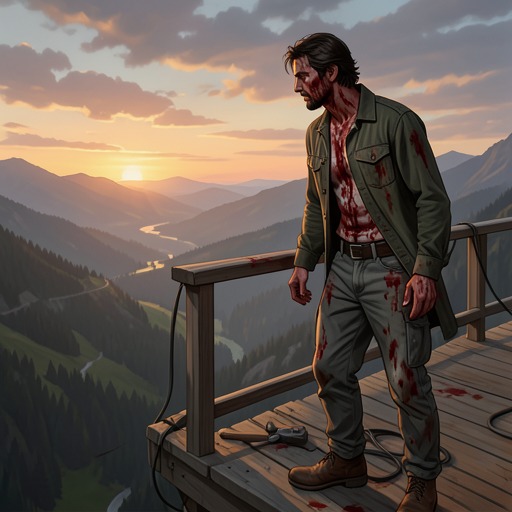
The blast’s cost becomes visible as soon as Robert Jordan rises. Fernando is still breathing, lying against the bank. Anselmo is face down behind the white marking stone, the wire still looped around his right fist. Robert Jordan kneels beside him and confirms that he is dead. He does not turn the body to inspect the injury; the fact of death is enough.
The wire that made the demolition possible thus also fixes Anselmo at the site of its consequence. He had been given the firing line to hold, and the bridge’s falling steel kills him there. Robert Jordan registers the old man’s small, gray-headed body and the worn soles of his rope-soled shoes, then picks up Anselmo’s carbine and the sacks, nearly empty, along with a rifle lying beside Fernando. He kicks a jagged piece of steel off the road and starts up the slope into the timber, carrying the weapons over his shoulder. He does not look back at Anselmo or across the bridge; firing continues around the bend, but his attention has narrowed to leaving the scene.
The immediate outcome is therefore mixed rather than simply victorious. The bridge is destroyed, and the truck’s occupants have been stopped from crossing it, but Anselmo is dead and Fernando remains wounded. Robert Jordan is coughing from the TNT fumes and feels numb as he retreats. The successful demolition secures its material objective while making its human cost impossible to separate from the achievement.
Significance of the Action
The demolition brings together the novel’s two scales of military action. At the level of engineering, success depends on reading the bridge correctly, placing charges against its supports, bracing them, and keeping the firing wire clear. At the level of human consequence, that same exactness ends in a command, a pull, a falling span, and Anselmo’s death. The operation’s outcome cannot be reduced to the technical fact that the bridge has been cut.
The sequence also makes the bridge a practical obstruction rather than an abstract symbol: its missing center interrupts the road through the pass, while the scattered steel and stopped truck show the immediate physical change. Yet the destruction does not end the surrounding combat. Gunfire continues, the men are exposed near the road, and Robert Jordan leaves with wounded Fernando and Anselmo’s weapons. The bridge is gone, but the costs and dangers of the mission remain with those who survive it.