El Sordo's band
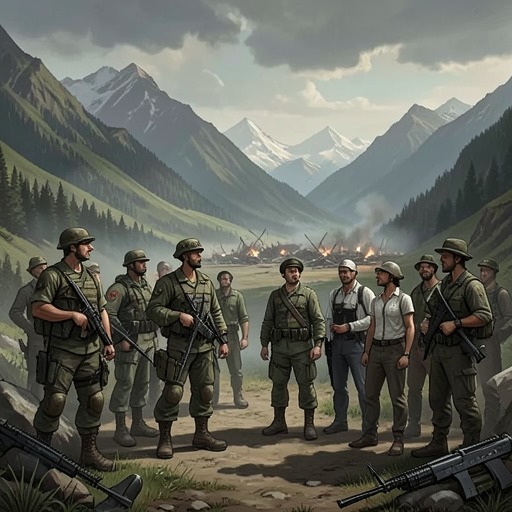
For Whom the Bell TollsEl Sordo's band is a neighboring guerrilla group led by El Sordo, valued by Robert Jordan’s allies for its practical judgment and prior service. Its role in the bridge operation shows how the mission depends not only on a demolition plan but on local cooperation, coordinated attacks, transport, explosives, and the ability to withdraw under pressure.
Identity and Local Standing
The band belongs to the country around the pass, where its members operate alongside Pablo’s group. Anselmo describes El Sordo as a good counterpart to Pablo, whom he distrusts, and says that the worsening situation makes cooperation with the local groups necessary. El Sordo is both a neighbor and a friend as well as a comrade; his recurring visits establish a relationship sustained by proximity and personal trust, not merely by the immediate demands of the bridge mission.
Before the operation is planned in detail, the group is already recognized as capable and useful. Pilar estimates that El Sordo has perhaps eight dependable men and expects to speak with him when he comes to the camp. She calls him practical and recalls his contribution to the train operation as exceptional. The band’s significance consequently rests on more than its numbers: it is a locally established force whose experience can be brought into a larger plan.
Strength, Supplies, and Limits
At the planning meeting, El Sordo reports that he has eight men. The figure gives the proposed assignment a concrete scale, but the conversation quickly shows that manpower alone cannot meet the operation’s needs. For withdrawal, the other group has seven men, two women, and five horses, while El Sordo has eight men and four horses. Robert Jordan asks whether he can obtain more mounts, given that the guerrillas will soon be leaving the neighborhood and will not need to preserve the same caution there. El Sordo can offer only uncertainty: perhaps he can find some horses, perhaps none, perhaps more than expected.
The shortage has a longer history. El Sordo says that in a year of war he has managed to have four horses, and the request for eight by the following day makes the gap between the plan and available transport unmistakable. The horses are not incidental equipment: they are part of the retreat arrangements, so their scarcity threatens the group’s ability to carry out the assignment and leave afterward.
El Sordo also brings explosives. He offers sixty sticks of dynamite, but cannot say what percentage they contain; he identifies it only as ordinary dynamite. His willingness to contribute is clear, while the uncertainty about the material’s strength leaves a practical question unresolved. The band’s resources thus arrive as a mixture of a definite quantity and limitations that the planners cannot simply wish away.
Role in the Bridge Operation
The agreed division of work assigns El Sordo’s eight men to cut the telephone line, attack and take the post at the roadmenders’ house, and then fall back on the bridge. Pablo’s group is to cut the line farther down, attack the post at the sawmill, take it, and also withdraw to the bridge. The parallel assignments make the two groups mutually supporting parts of one plan: each must interrupt communications and overcome a post before converging on the bridge.
El Sordo responds that his task is easy and does not ask for a written set of instructions. That confidence fits Pilar’s earlier assessment of his practicality, but the simplicity is relative to the narrow task described; the overall operation still depends on timing, reliable communications, explosives, and a viable retreat. The two attacks are designed around the road and its posts, not as isolated raids, but as measures supporting the bridge demolition.
The operation’s central timing constraint comes from Golz’s orders. The bridge is to be blown after the larger attack begins, so that reinforcements cannot come up the road. The order reflects a fragile military situation in which an attack might be altered, delayed, or canceled, and Golz insists that the bridge must not be destroyed prematurely. El Sordo’s post attack is therefore one component of a wider effort whose success depends on coordinating guerrilla actions with an offensive beyond the band’s control.
Operational Knowledge and the Terrain
The band’s work takes place in a landscape that dictates how the mission can be executed. The bridge is a single-span steel structure over a deep gorge, with a sentry box at each end; the road runs through the pass beside a stream and a mill. Robert Jordan studies the bridge from the hillside and sketches where charges could be placed to cut its support and drop part of the span into the gorge. That physical inspection makes the bridge a specific engineering problem, while the posts along the road turn control of the approaches into an equally important part of the plan.
The groups’ assignments exploit their position in the local area. El Sordo is expected to attack the roadmenders’ post and retreat toward the bridge, while Pablo’s group takes the sawmill post. The division links separate points on the road to a common objective. Yet the route is also a channel for movement by military vehicles and reinforcements: the bridge cannot be treated as a target detached from the traffic that may pass over it.
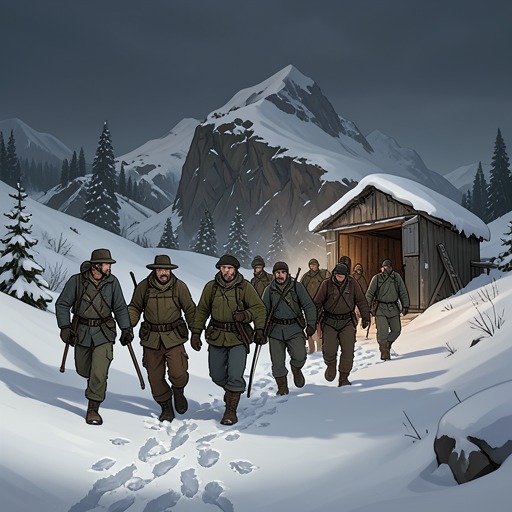
Anselmo’s observation post underscores the difficulty of reading that traffic. During a snowstorm, he watches a camouflaged staff car pass and records it among the day’s vehicles on sheets torn from Robert Jordan’s notebook. He counts cars going up and down but does not distinguish between vehicles serving the division and those of the General Staff, a distinction that Robert Jordan would have understood as significant. The episode exposes an intelligence limitation that applies to the wider operation: observation can establish movement without necessarily identifying its military meaning. Weather, visibility, and the observer’s knowledge all shape what the guerrillas can report.
The band’s assignment is also part of a larger network of possible local forces. Before the meeting, Pilar estimates that, with timely advice to other bands, fifty rifles of a certain dependability might be assembled. The qualification matters: this is not a guaranteed force, but a contingent one, whose reliability depends on circumstances. El Sordo’s group provides a more immediate and measurable contribution—eight men, four horses, and sixty sticks of dynamite—within a broader field of unevenly available support.
Coordination and the Limits of Command
The bridge mission depends on the passage of information as much as on the guerrillas’ actions. Robert Jordan prepares a dispatch for Golz and intends to send it with Andrés, explaining where the general can be found. The written plan and sealed papers are meant to carry an urgent message through the Republican lines, but Andrés encounters suspicion at the front before a battalion commander decides to help him onward. The episode shows that formal authorization does not ensure immediate movement: each link in the chain can slow or redirect the mission.
At another point in that chain, André Marty becomes convinced that Golz is communicating with the fascists and treats the dispatch as evidence of treachery. His suspicion is shaped by associations and grudges rather than demonstrated proof, and he has the courier and his companion detained. The narrative notes that the attack is already so far in motion that there is no one at the front with sufficient authority to cancel it; large military operations acquire an inertia that makes them hard to stop once begun. This distinction between the fate of the message and the momentum of the offensive sharpens the risk faced by the guerrillas: their actions are planned in relation to a larger attack, while the information meant to clarify that attack can be obstructed.
El Sordo's band is thus neither a self-sufficient force nor a passive extension of central command. Its local standing, experience, and willingness to cooperate make it valuable; its small size, uncertain access to horses, and limited knowledge of the explosives impose concrete constraints. The planned convergence on the bridge depends on collaboration between groups and on military coordination beyond their control, making the band’s practical competence essential but not enough to guarantee that the larger operation will unfold as intended.