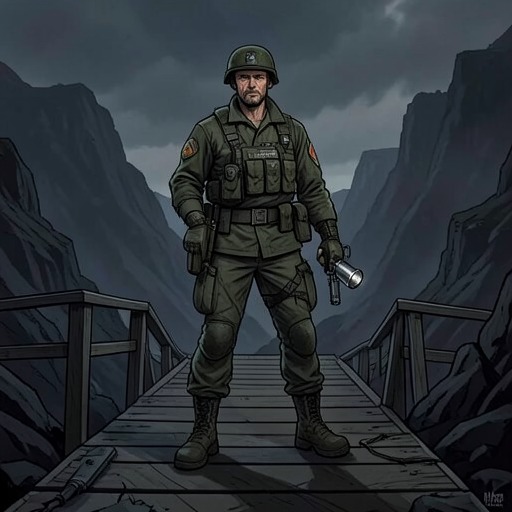
Golz
For Whom the Bell TollsGolz is the Republican general whose carefully timed attack gives Robert Jordan’s bridge-demolition mission its purpose and its most dangerous constraint. He orders Jordan to destroy the bridge only after the offensive begins, so that the road cannot carry reinforcements toward the pass; but Golz himself cannot guarantee that the attack will begin as planned or even retain the authority to cancel it. Through Jordan’s recollections, Golz emerges as a capable commander navigating a campaign in which orders, resources, and control are all uncertain.
Command and the bridge order
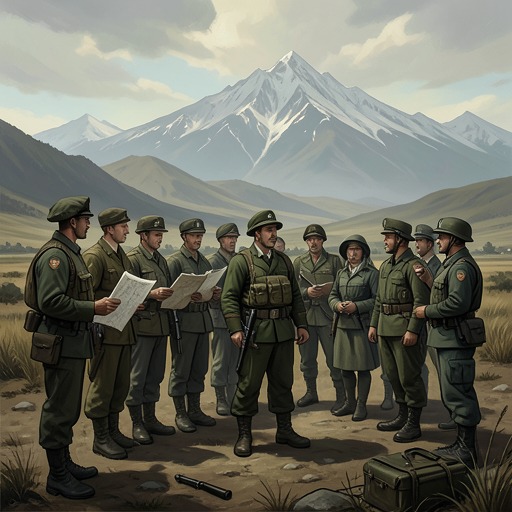
Jordan remembers Golz briefing him in an upstairs room outside the Escorial, with a map before them. The demolition itself, Golz explains, is straightforward; the difficulty lies in synchronizing it with an attack whose timing and execution cannot be taken for granted. Golz presses Jordan to understand that a stated date and hour are only a probability, not a certainty. Jordan must be ready, but he must not act until the attack has started.
The timing is a military necessity rather than a matter of convenience. The bridge is the only road over which the enemy can bring reinforcements, tanks, artillery, or even a truck toward the pass Golz intends to attack. If Jordan destroys it too early, the bridge might be repaired should the offensive be postponed. If he waits until the attack has begun, its destruction can deny that route when it matters. Golz therefore needs assurance not simply that the bridge can be demolished, but that it will be gone at the right moment.
Golz’s explanation also exposes the limits of his command. He asks what can guarantee that his orders will not be altered, the offensive annulled or postponed, or its start delayed. He makes the attacks, but does not possess the artillery he requests, and has not always received what he asks for even when it is available. Other people may interfere as well. The plan depends on his authority, yet the conditions required to carry it out are not fully in his hands.
Operational uncertainty and Jordan’s responsibility
Jordan accepts the order as a responsibility to be tested in action, rather than a plan he can reject in advance as impossible. He reasons that orders from Golz must be carried out because only attempting them can show whether they can be done. That acceptance does not remove his concern about the people involved. The guerrillas he must use are people he likes, and he knows that success may demand that he treat them as troops exposed to danger, not as friends he can spare from it.
The uncertainty grows more concrete as the operation approaches. Jordan realizes that Golz can make the attack but cannot cancel it himself: permission to do that must come from Madrid. The possibility that nobody there will wake in time, or that those who do will be too sleepy to think, turns command delay into a battlefield risk. Jordan also learns that enemy preparations have moved into place only after dark, too late for him to have reported them sooner. He considers whether apparent concentrations might be a feint for another offensive, but cannot settle what the enemy will do. Golz’s conditional plan thus meets a changing field of information that neither Jordan nor the general can fully master.
The difference between an order and its execution appears in the physical work at the bridge. Jordan studies the single-span steel structure across the gorge and sketches where charges should cut its support. Later, working with Anselmo, he places and braces explosive blocks against the girders, fastening them with wire and wedges while firing sounds from the nearby posts. The precision of the demolition contrasts with the uncertainty of the larger offensive: Jordan can control where the charges go, but not when the attack begins, what the enemy has prepared, or how events elsewhere will unfold.
Golz in Jordan’s reflections
Golz remains present in Jordan’s thoughts after the briefing, not only as the source of the order but as a point of comparison for what a life under irregular wartime conditions can contain. Jordan wonders whether Golz understands the intensity produced by urgency and lack of time, and whether the general’s experience has taught him to make a whole life within a brief interval. Jordan connects that thought to his own limited time with Maria, asking whether the circumstances make their intimacy seem singular or whether it is singular in itself. He does not resolve the question by reducing Maria to circumstance.
Jordan’s judgment of Golz is broadly admiring, but not uncritical. He regards him as a good general and fine soldier, while also believing that he has been kept in a subordinate position and denied a free hand. The coming attack is Golz’s largest opportunity so far, yet Jordan is uneasy about what he has heard of it. Golz’s ability and the operation’s vulnerability coexist: a competent commander can devise a plan without controlling the institution or battlefield conditions on which the plan depends.
Speech, comradeship, and the measure of success
The formal exchange between commander and subordinate briefly loosens when Golz turns from the order to a drink and jokes about the Spanish pronunciation of his name. Calling himself “Comrade Heneral Khotze,” he treats the awkwardness as a comic consequence of having chosen a name before coming to war in Spain. The joke does not erase the earlier tension; it gives the two men a moment of human ease within a conversation dominated by responsibility and uncertainty.
Jordan anticipates that Golz will be at the Hotel Gaylord after the attack and imagines showing him Maria if he is welcomed back. He also expects Golz to tease him about her, recalling that the general had spoken to him about having no girls. This imagined reunion gives success a personal measure alongside the military one: Jordan wants not only to have carried out the mission, but to return to a world where he can speak with Golz and share something of his life.
The general’s significance therefore lies in the tension between strategic clarity and practical fragility. His order is precise: wait for the attack, then destroy the one road through which reinforcements can reach the pass. Its execution depends on uncertain timing, incomplete information, and authority distributed beyond Golz himself. In Jordan’s recollections, Golz is both the capable officer who defines the task and the emblem of a wartime command structure in which even a good plan cannot guarantee control over what follows.