Guadarrama Mountains
For Whom the Bell TollsThe Guadarrama Mountains are the contested landscape that gives Robert Jordan’s bridge mission its practical constraints and its moral history. Forest cover and steep slopes shelter movement and concealment, while the road, pass, gorge, and bridge channel travel and military attention; the same mountains also hold the memory of an earlier Republican defense in which comradeship and discipline were tested under attack.
Terrain and Routes
At the opening of the mission, Robert Jordan lies on a pine-needled forest floor above the dark road winding through the pass. From that slope he can see a stream beside the road and a mill below, with water falling over its dam. This elevated view makes the landscape legible as an operational space: the forest offers concealment, while the road and its crossing form the route the operation is meant to interrupt.
The bridge comes into view as Jordan and Anselmo descend the final stretch through trees. It lies across a deep gorge, with a sentry box at either end; far below, a brook runs among rocks before joining the pass stream. Its single steel span is broad enough for two motor cars. The gorge makes the crossing a concentrated point in the landscape, and the bridge’s supports provide the precise structural targets Jordan studies for demolition.
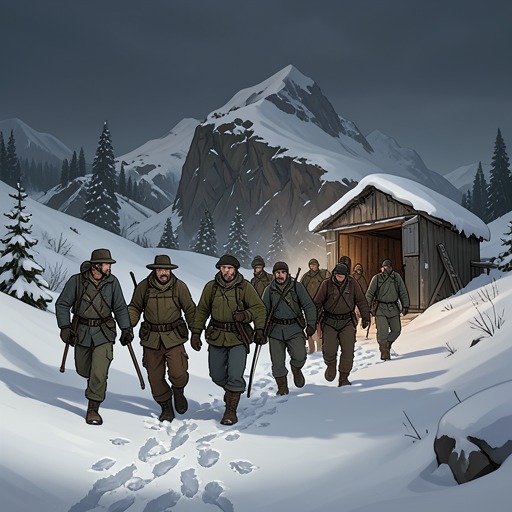
The mountains also govern observation and movement beyond the immediate bridge site. During a snowstorm, Anselmo watches the road from shelter beside a tree and records passing vehicles, but his tally does not distinguish ordinary divisional traffic from cars belonging to the General Staff. The episode shows both the value and the limits of a lookout position: the terrain permits surveillance, yet a view of the road alone cannot supply every distinction the mission requires.
The Bridge Mission in the Mountain Pass
Jordan’s task depends on timing as much as on terrain. He has been ordered to destroy the bridge only after the attack begins, so that reinforcements cannot travel up the road. The crossing is therefore not an isolated target: its military importance comes from its position on a route through the mountains and from the need to synchronize the demolition with the larger offensive.
The terrain shapes the work itself. From the hillside, Jordan first studies the bridge in the remaining afternoon light and sketches where charges should be placed to cut its support and drop part of the span into the gorge. Later, in daylight, he watches the bridge emerge against the mist above the stream. During the demolition, Anselmo passes down packages of explosive while Jordan places and braces them between the girders, securing the charges with wedges and wire. The mountain setting turns planning into a physical task carried out over the gap, with the stream far below and the road exposed to activity on either side.
The plan is vulnerable to events elsewhere along that same route. As Jordan works, firing and grenade explosions sound from below, while shooting continues at an upper post. At the same time, the Republican offensive cannot simply be cancelled by its field commander: permission must come from Madrid, and Jordan worries that the warning about enemy preparations has arrived too late. The bridge’s position makes it strategically valuable, but it also ties the mission to a wider chain of orders, intelligence, and combat that the people at the crossing do not fully control.
A Landscape of Earlier Fighting
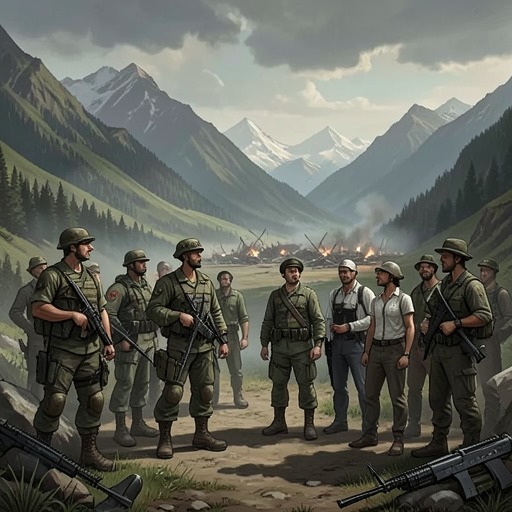
The Guadarrama Mountains are also the setting of Jordan’s recollection of earlier battles. He remembers Republican forces holding a slope of gray rocks, scrub pines, and gorse against attacks, bombing, and artillery. When the enemy tried to advance on the left through rocks and trees, defenders held a sanitarium even as opposing troops moved around both sides; a counterattack eventually forced them back behind the road.
That memory gives the mountains a meaning beyond their usefulness for concealment or defense. Jordan recalls the fear and confusion of shelling, the work of keeping a gun in action, and the sense that fighting there had joined people in the cause of the revolution. He also remembers the harsh enforcement of discipline against men who ran from their positions. In retrospect, the earlier campaign’s conviction survives, but it is shadowed by fatigue and by what Jordan has learned about war after the first months of fighting.
Across the mission’s present and remembered landscapes, the mountains distribute both advantage and risk. Trees and slopes allow scouts to move unseen; roads and crossings funnel traffic; rocks and buildings can protect one position while giving attackers cover against another. The setting is therefore not merely a backdrop to military action: its physical features shape the operation, while Jordan’s memories of fighting there measure the distance between the early ideal of comradeship and the harder knowledge acquired in war.