Horses
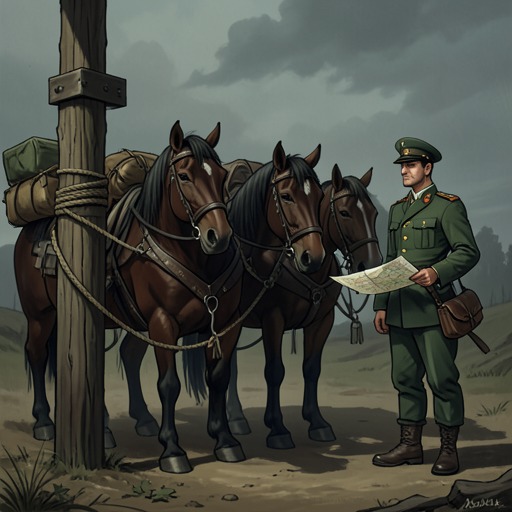
For Whom the Bell TollsHorses are the guerrilla band’s scarce means of travel, escape, and combat, but their role in the campaign is never purely logistical. They have bodies that tire, fear that affects their handlers, and lives that human plans may preserve or sacrifice. Across the novel, the shortage of mounts shapes operational choices, while individual encounters with horses reveal both the intimacy of care and the moral compromises imposed by war.
Military Necessity and Scarcity
When Robert Jordan negotiates for support from El Sordo, the need for horses immediately exposes the mismatch between the force required and the animals available. Jordan asks for eight men and four horses; El Sordo points out that he has only four horses for his own group, although he agrees to bring his animals and four more, making twelve in all. He also offers sixty sticks of dynamite. The exchange places horses alongside explosives as essential resources, but unlike equipment they are living and limited: they must be found, kept, and brought into the operation.
The shortage remains a practical problem as Jordan counts the people who may need to move. Four horses cannot carry even half the group at one horse per person. He calculates that some fighters might stay behind to hold their position while others escape, and considers how the animals must be divided among them. Pablo’s departure with a horse further complicates the count. Mobility is therefore not an abstract advantage: the number of mounts helps determine who can retreat and who must remain exposed.
The band’s efforts to acquire horses are precarious. El Sordo goes out to look for them, and Pablo says he will go to see the animals as well. In a later fight, El Sordo has stolen only three horses the previous night; one bolts when the men try to mount it bareback as the shooting begins. Two horses are dead on the slope and three more on the hilltop. The discrepancy between a plan’s requirement and the animals actually available is written into the action itself: horses can be stolen, lost, wounded, or killed before they carry anyone to safety.
Care, Fear, and Human Attachment
The horses’ presence also enters the story through tenderness and imagined freedom. Maria wishes that she and Robert Jordan had horses so that they could ride together, faster and faster, without outrunning her happiness. Her fantasy gives the animals a place beyond military transport: horseback riding figures a shared future and an unhurried joy that the surrounding campaign cannot guarantee.
Pablo speaks of horses with conspicuous affection, saying that he cares for them and considers them handsomer and more sensible than the people around him. His attachment does not remove the animals from the war’s practical demands; he is also involved in decisions about where they will be kept and how they will be used. The contrast makes care and use coexist rather than cancel one another.
During the fighting, Maria is assigned to remain with the horses. She cannot see the road or the bridge from the forest, and the firing and explosions unsettle her. She tries to calm the large white-faced bay stallion she has gentled and brought gifts to, but her own nervousness makes him nervous too. As she moves among the animals, patting and trying to soothe them, they become increasingly agitated. The scene makes fear reciprocal: the horses register the battle through sound and the behavior of the person tending them, while Maria’s inability to see the fighting does not spare her from its effects.
The material conditions of the operation also shape how horses are handled. After a late spring snowstorm, a rider arrives with wet snow packed around the horse’s hooves. When the horse plunges, the young rider slips and is dragged, and the horse is later brought back to the group. Jordan stops Pablo from putting the animal with the others: because it has left tracks into the camp, it must be ridden out again. Pablo agrees to take it away, hide it, and bring it back after the snow melts. The decision balances the animal’s immediate place in the group against the danger its tracks may create for everyone there.
The Horse as a Participant in Violence
The novel distinguishes between the practical use of horses and their exposure to violence as living beings. Robert Jordan says that he does not like killing animals, and reflects that the memory of an encounter with a bear can retain a kind of pride, whereas killing a man leaves nothing good. The contrast does not make the animals safe from the campaign: it marks the moral burden attached to killing, even as military necessity repeatedly puts horses in danger.
El Sordo’s last stand gives that danger a specific, costly form. With his automatic rifle, ammunition, and grenades carried on his horse, he rides toward a hilltop while Joaquín and Ignacio halt and fire to give him time to reach it. When the horse is hit and struggles up the final slope, El Sordo pulls it by the bridle. At the crest, he shoots it so its body will plug a gap between two rocks; he then fires from behind it as the attackers advance. The animal’s body becomes cover, its death serving the defense of the men and the weapon it had carried.
Afterward, El Sordo pats the dead horse’s shoulder where the rifle muzzle burned its hide. He remembers holding it as gunfire surrounded them and shooting it carefully at the point between its eyes and ears. The recollection refuses to reduce the horse to a tactical object: the memory of the deliberate killing sits alongside the immediate reason for it, and the tenderness of the gesture remains visible within the military calculation.
Horses as Tactical Infrastructure
Beyond their role as transport, horses shape what can be seen, concealed, and attempted. The bridge that Robert Jordan is assigned to destroy lies across a deep gorge, with a sentry box at each end; the approach runs through steep wooded ground. In such terrain, mounts can carry fighters and supplies toward an objective, but their tracks can also expose a hidden camp. After a snowstorm, Jordan insists that a gray horse whose hoofprints lead into the camp must be ridden back out. Pablo agrees to hide it and return when the snow has melted, turning the animal’s movement into a problem of concealment as well as care.
The same dependence appears in the group’s plans for withdrawal. Jordan orders Andrés to saddle and hold the horses, bringing them toward the woods behind the gap if firing begins, while the women are to hold them. His count of the people and available mounts makes the limit plain: not everyone can ride away. The horses are thus part of the operation’s tactical arrangement, but their scarcity determines which people may be able to escape and which may have to stay behind.
At El Sordo’s hilltop, the horse carries the automatic rifle and its ammunition until the animal is wounded and can no longer make the ascent without help. El Sordo’s effort to bring it to the crest gives him time to position the weapon; its body then becomes protection behind which he fires. This makes the animal’s contribution inseparable from the defense, while exposing the cost hidden inside the language of military resources: the horse’s labor, injury, and death are built into the fighters’ chance to resist.
Tactical Use and Tactical Exposure
The horses’ military value depends on terrain as much as on numbers. The bridge Robert Jordan is assigned to destroy is a steel span over a deep gorge, approached through steep wooded ground; the fighters must bring themselves, weapons, and supplies through a landscape that restricts movement and visibility. A horse’s tracks can be as consequential as its carrying capacity. After a spring snowstorm, Jordan insists that a gray horse whose tracks lead into the camp must be taken back out. Pablo agrees to hide it and return when the snow has melted, treating concealment as part of the animal’s immediate management and the group’s security.
Jordan’s instructions for a possible withdrawal make the limits of the herd explicit. Andrés is to saddle and hold the horses, bringing them to the woods behind the gap if firing begins, while the women remain to hold them. Jordan counts the people against the available mounts and recognizes that not everyone can ride away: some fighters may have to hold the position while others escape. The horses are therefore not simply transport waiting at the edge of the action. Their scarcity helps decide who can move and who may be left exposed.
At El Sordo’s hilltop, the same tactical dependence narrows into a single animal’s labor. The horse carries the automatic rifle and its ammunition as El Sordo rides toward the crest under fire. When it is hit and struggles up the final slope, he hauls it by the bridle; at the top, he shoots it so its body will fill a gap between two rocks, then fires from behind it. The horse first transports the weapon and then becomes cover. El Sordo later pats its shoulder and recalls the careful shot, holding together the necessity of his decision and the cost borne by the animal.