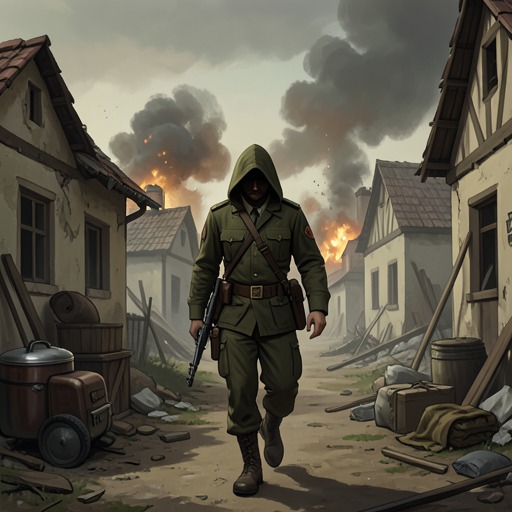
International Brigade
For Whom the Bell TollsThe International Brigades are the multinational force with which Robert Jordan serves in Spain’s civil war, linking his dangerous assignment to a broader struggle over military discipline, political purpose, and international solidarity. The novel presents them both as a fighting formation and as an ideal: a brotherhood united by commitment to the oppressed, yet vulnerable to command friction, political divisions, and the demands of an expanding army.
Identity and Military Role
The novel introduces Robert Jordan as a young American attached to an antifascist guerrilla unit in the Spanish mountains, while the publisher’s description identifies his wider service with the International Brigades. The Brigades connect the local work of guerrilla fighters to the Republic’s larger war effort. Jordan’s bridge assignment is one example of that connection: he is ordered to demolish a steel, single-span bridge after the attack begins, so that reinforcements cannot use the road. The timing is not incidental. The demolition is meant to obstruct enemy movement while the larger offensive is under way.
The bridge plan depends on cooperation between the Brigades’ military purpose and the mountain unit’s local knowledge and resources. Jordan has explosives and equipment in two packs, studies the bridge’s supports, and considers how charges can bring a section down into the gorge. El Sordo offers sixty sticks of dynamite, though he does not know their strength. In the execution, Jordan and Anselmo place, brace, and wedge explosive blocks against the steel girders. These details show a force whose operations rely not only on formal orders but also on field expertise, available matériel, and trust between people working across different military settings.
Solidarity and the Meaning of Service
The Brigades’ institutional life is measured against the spiritual intensity of their original purpose. Jordan recalls the International Brigade headquarters at Velazquez 63 as a place with a puritanical, almost religious atmosphere. Alongside the earlier headquarters of the Fifth Regiment, it could make service feel like a crusade—not a slogan, but a genuine sense of consecration to a duty toward oppressed people everywhere. That feeling created an absolute brotherhood among those taking part. It also made personal death seem less important than the work, except insofar as death would prevent a person from carrying out his duty.
Gaylord’s Hotel offers a contrast to that headquarters ideal. Jordan had once thought the hotel’s atmosphere bad for him because it was so unlike the disciplined, religious communism associated with Velazquez 63. Yet he comes to recognize that the hotel is also a place where he can learn about the war and its political realities. The contrast does not simply divide sincere commitment from corruption: the novel sets the Brigades’ shared cause beside bureaucracy, party conflict, and imperfect leadership, without erasing the reality of the solidarity Jordan experienced.
Discipline, Command, and Political Strain
The Brigades’ military contribution is associated with the defense of Madrid. Jordan considers Kleber, Lucasz, and Hans effective in that campaign, but also recalls that Kleber was removed from command and sent to Valencia after Miaja resented the publicity Kleber received. In Jordan’s account, a capable soldier’s role is limited by political and personal interference. He also considers Golz a good general and soldier who is kept in a subordinate position and denied a free hand. These judgments make the institution’s difficulties more than a matter of battlefield skill: authority and public standing can shape who is permitted to command.
The army Jordan sees developing is large but uneven. Karkov describes reliable and even magnificent elements associated with Modesto, El Campesino, Lister, and Durán, while warning that an army composed of good and bad elements cannot win unless its members reach a shared level of political understanding, know why they are fighting, and accept discipline. The new force is a conscript army being built without enough time to instill the discipline it needs under fire. Calling it a people’s army does not, in Karkov’s view, guarantee the cohesion of a true people’s army. His warning places the Brigades within a changing military system: their role is changing even as the Republic tries to build a much larger force.
Jordan’s reflections sharpen the distinction between holding ground, attacking positions, and manoeuvring an army in the field. He regards Lister as capable of forging a division into a fighting unit through severe discipline, but questions how such a commander will perform once dual controls are removed. The thought leaves the structure of command unresolved. The novel does not treat discipline as a simple virtue or political oversight as a simple obstruction; it shows the practical need for cohesion alongside uncertainty about who controls it and at what cost.
Political Authority and the Cost of Internal Conflict
The Brigades’ political setting includes coercive practices that sit uneasily beside their stated international brotherhood. A guard tells Andrés that, at the Escorial, his unit furnished firing parties for executions ordered by André Marty. The guard claims that Brigade members would not shoot their own comrades, especially the French, so Spaniards were assigned to carry out the executions; he says French, Belgians, and others of different nationalities were among those shot for political reasons. The account reaches the reader as a guard’s report, not as an independently verified institutional record, but it reveals how political discipline is experienced by those serving under it: as a system in which internal dissent can be treated as grounds for execution.
This episode complicates the ideal of a common cause without canceling it. The same organization can inspire a sense of brotherhood and participate in a political culture of suspicion and coercion. The novel’s presentation of the Brigades therefore resists a clean division between international solidarity and institutional violence. The ideal has emotional force for Jordan, but the organization’s practices and power struggles put pressure on what that ideal can mean in wartime.
Narrative Significance
The International Brigades widen the novel’s field beyond the guerrilla camp and the bridge. Through Jordan’s memories of Madrid, his assessments of commanders, and Karkov’s account of the army’s changing composition, the Brigades become a lens on the Republic’s attempt to turn conviction into military capacity. Their history in the novel is neither a simple tale of heroic unity nor a dismissal of the cause: genuine commitment persists alongside limited command authority, political interference, uneven discipline, and reported executions.
That tension is particularly important to Jordan’s mission. The bridge can be studied, equipped, and attacked according to a definite plan, but the success of the wider offensive depends on timing, communications, and decisions beyond the guerrillas’ control. Jordan recognizes that Golz cannot cancel the attack on his own and that permission must come from Madrid; he worries that the warning about enemy preparations was not sent sooner. The Brigades thus belong to both scales of the story: the intimate work of a small team and the larger, precarious machinery of an army. Their promise of shared purpose gives the fighting meaning, while their institutional limits show how little an individual operation can command of the whole war.