La Granja
For Whom the Bell TollsLa Granja is a place on the road network through which the novel’s military action and its consequences become visible. Set against a mountain pass, a gorge-spanning bridge, and the roads leading toward the town, it links the practical geography of Robert Jordan’s demolition mission with the movement of troops, messages, and casualties. Its significance lies less in a single encounter than in how the terrain channels observation and retreat—and brings the cost of combat into view.
Setting and approaches
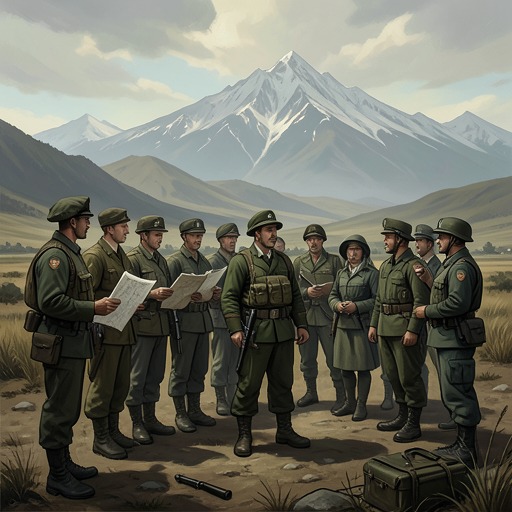
The landscape around the pass is defined by slopes, forest, road, and water. From a pine-needled hillside, Robert Jordan can look down on the dark road winding through the pass, with a stream beside it and a mill near the falling water of a dam. The view makes the route legible as both terrain and a line of movement, while the forest offers concealment from which it can be watched.
A short distance from the bridge, the path descends through trees toward a steel span crossing a deep gorge. The bridge is wide enough for two motor cars, with a sentry box at either end; far below, water runs through rocks toward the main stream. This physical arrangement gives the crossing its military value: it carries traffic through a constricted landscape, and its destruction is meant to prevent reinforcements from advancing along the road after the attack begins.
Roads, observation, and military movement
The road is watched as a source of information, but observation is limited by the observer’s position and knowledge. During a snowstorm, Anselmo shelters beside a tree and counts vehicles passing in both directions. He records a camouflaged staff car as the tenth vehicle to go up that day, with six having come down and four still up. He does not distinguish the General Staff’s cars from those belonging to the division holding the mountain line, so the count records traffic without revealing its full significance.
The novel also makes the distance between a place on a map and a destination in the field explicit. Anselmo knows that command posts at Navacerrada and Guadarrama occupy recognizable buildings, but Robert Jordan explains that Golz’s headquarters will be close to the lines and underground for protection from aircraft. Andrés must find it by asking for the right place and presenting Jordan’s sealed message. The route to La Granja belongs to a wider system in which roads, concealed command posts, and the timing of communications shape what can be known and done.
The cavalry column and the aftermath of combat
After El Sordo’s last stand, a Nationalist cavalry column rides down the long slope and out of sight into the timber. Lieutenant Berrendo leads it, with flankers and a forward point; riderless horses carry loads among the mounted men, and wounded soldiers travel with others walking beside them. The column then emerges onto the yellow road leading into La Granja. Dust rises around the riders, dead men tied across saddles, and the wounded.
Anselmo sees the column pass and recognizes El Sordo’s automatic rifle among the equipment. He does not initially know what a long bundle wrapped in a poncho contains. Later, when he returns to the hill where El Sordo fought, he understands what the bundle held. The road thus carries a partial report of the battle before Anselmo reaches its site himself: the weapon identifies the defeated group, while the concealed contents of the bundle make the enemy’s treatment of the dead legible afterward.
Berrendo’s thoughts complicate the column’s outward order. He considers the removal of the dead men’s heads barbarous, even as he recognizes the stated need for proof and identification and speculates that the remains may be sent to Burgos. He also imagines how additional weapons and a mortar might strengthen his force, then checks that impulse as he thinks of a dead comrade and begins a prayer. His passage through the landscape carries both military calculation and the private residue of action.
Place, distance, and war
La Granja’s narrative importance comes from the way movement through its surroundings joins operational purpose to human consequence. The bridge is studied as a structure to be cut from its supports; the road is counted as a route for vehicles and potential reinforcements; the town-bound road becomes the path along which the dead and wounded are carried. These functions coexist in one landscape, where the same lines of access that make military movement possible also expose its costs.
The surrounding geography also measures what the characters can and cannot see. Anselmo counts vehicles but misses the distinctions that matter to command; he sees the column’s weapon but only later understands its wrapped burden. La Granja is therefore not simply a destination. It is a point in a network of roads and sightlines where incomplete observation, delayed knowledge, and the physical aftermath of battle converge.