Maria
For Whom the Bell TollsMaria is a young woman whose recovery from violence unfolds alongside her growing relationship with Robert Jordan. Initially withdrawn and deeply distressed, she gradually regains the ability to speak, smile, and trust others; her intimacy with Robert Jordan gives her a future to imagine, while the demands of war eventually separate them. Her story holds tenderness and danger together: care can restore connection, but it cannot make the surrounding violence disappear.
Identity and Introduction
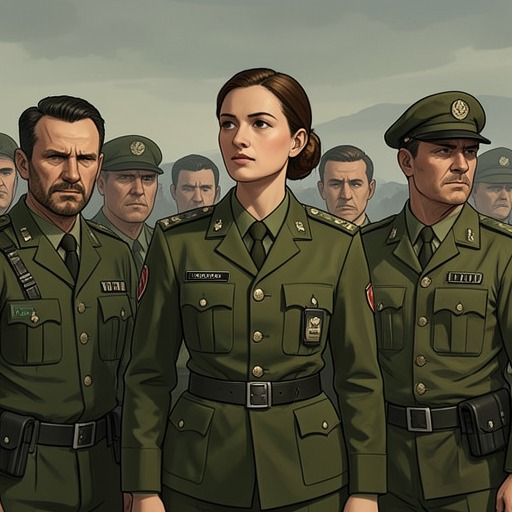
When Maria first comes out of the cave carrying an iron cooking platter, Robert Jordan notices her short-cut golden-brown hair and the unusual angle of her face. She greets him warmly, smiling and meeting his gaze. The brief encounter establishes both her presence in the group’s daily life and the care with which he responds to what he sees. She is not introduced through an account of her past, but through a moment of recognition: she offers a greeting, sets down the platter, and looks directly at him.
Maria’s age is given as three months in the immediate dialogue, a strikingly abbreviated answer that sits within the narrative’s disrupted wartime scale of time. The evidence does not explain the remark further; it does establish how compressed and uncertain ordinary measures of life can feel in the circumstances surrounding her.
Recovery and the Guerrilla Group
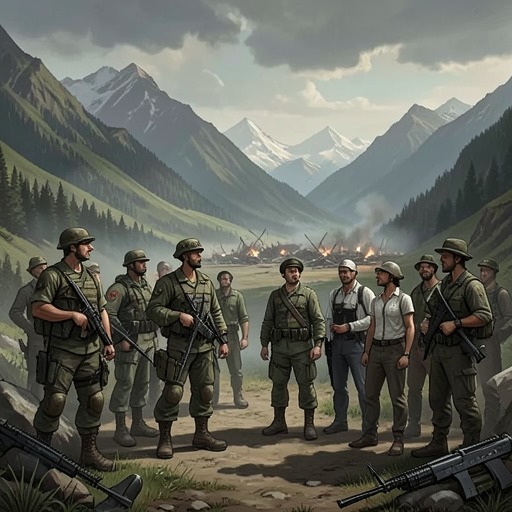
Rafael describes Maria’s condition when the group found her at the time of the train: she would not speak, cried continually, and shivered when anyone touched her. Her recovery is uneven but perceptible. By the time Robert Jordan meets her, Rafael says she has been much better lately and was fine that day. The change is visible in the contrast between her earlier withdrawal and the smiling young woman who greets a stranger.
The account of how Maria came with the group emphasizes the effort made to keep her alive and moving. When she could no longer continue, the older woman carried her; when the older woman could not carry her, Rafael did; and when Rafael could go no farther, Pablo carried her. The sequence makes her survival a collective act, though it also records how precarious and exhausting that care was. She is not simply taken in and left to recover: people repeatedly bear the burden of helping her onward.
Later, Maria participates in the camp’s routine of care for others. She brings food and supplies from the camp to the men at the gun: stewed hare with mushrooms, bread, wine, plates, cups, and spoons. She serves Agustín and Eladio, who have taken Anselmo’s place at the weapon. The scene places her recovery within shared work and ordinary sustenance, rather than limiting her presence to suffering or romance.
Love and Mutual Care
Maria and Robert Jordan’s closeness develops through gestures as much as declarations. She reaches for his hand and tells him she can hear everything; he touches her arm, and she smiles. In a mountain meadow, their fingers lock together. The narration presents this contact as an exchange of feeling that passes between them without requiring explanation, making physical closeness a sign of renewed trust and mutual attachment.
Their relationship also appears in practical acts. Maria offers to take Robert Jordan’s shoes and dry them in the smoke of the fire. On another occasion she comes out into the snow carrying a bundle, runs to him, kneels beside him, kisses him, and gives it to him. The actions are small in scale but reciprocal: she is not only someone receiving protection, but also someone who watches for him and offers care.
The tenderness is explicitly named when Robert Jordan calls her “rabbit” and tells her he loves her. Maria responds with a declaration of love and asks him to place his hand on her head. She then turns toward him, presses close, and cries. Their intimacy gives her a way to express attachment and vulnerability after a period when touch and speech had been difficult. Robert Jordan’s endearment becomes a recurring language between them, and Maria answers it with her own closeness and trust.
Trauma, Memory, and the Limits of Comfort
Maria’s recovery does not erase what happened to her. When she speaks of it, Robert Jordan holds her and asks her not to continue because he cannot bear the hatred that rises in him. His response reveals both the strength of his attachment and its limit: his wish to comfort her is entangled with anger at the violence she endured. The scene keeps attention on her continuing pain without making her trauma a resolved episode.
In the group’s broader moral world, violence is treated as necessary by some and still grievous. Pilar recalls the ugliness of killing and the need to act to preserve the Republic; Anselmo thinks that killing may require collective penance after the war; Robert Jordan tells himself that one can believe in people’s right to govern themselves without believing in killing. These reflections do not belong to Maria alone, but they frame the conditions in which her recovery and relationship take shape. The group’s care for her exists amid a conflict whose acts remain morally costly.
Separation and the Promise of Continuity
As the operation approaches, Maria and Robert Jordan speak as though their shared time is precious and limited. He tells her they will be together in what is happening that day; later, he says goodbye affectionately and promises to see her soon. These exchanges give their relationship an immediate horizon: affection is real, but the military task controls when they can be together.
When Maria reaches him again among the horses, they hold each other tightly. The reunion is followed by a more consequential separation. Robert Jordan tells her she must go, while insisting that he goes with her in a deeper sense: “As long as there is one of us there is both of us.” He asks whether she understands. The promise transforms parting from a simple abandonment into an assertion that their bond will survive physical distance, even as the immediate danger makes no reunion certain.
Maria’s final action in the supplied scenes is to obey the need to leave and prepare the horse. From below, Robert Jordan calls that he is all right and reports “Sin Novedad!”—no change or nothing to report. The reassurance reaches her while she is occupied with the horse, a practical task that carries her away from him. Their separation is therefore shown not as an abstract romantic ending but as a pressured movement through the landscape of the operation, with his voice briefly maintaining contact.
Narrative Significance
Maria’s arc is shaped by a contrast between enforced isolation and chosen attachment. The early report that she could not speak or bear touch is set against her later gestures of greeting, service, affection, and care. The narrative marks recovery not as a complete cure but as a return to relation: she can meet another person’s eyes, share a handhold, tend to practical needs, and imagine being together.
Her relationship with Robert Jordan offers neither a guarantee of safety nor a way out of war. Instead, the repeated language of love and the promise that one will carry the other in memory give personal meaning to a separation dictated by the mission. Maria is both a survivor who has begun to recover and an active participant in the fragile community around her. Her story makes tenderness visible without confusing it with protection from the forces that threaten it.