Pablo’s decline
For Whom the Bell TollsPablo’s decline is the erosion—and eventual partial reassertion—of a guerrilla leader’s authority. The group measures his present fear and withdrawal against the organizer who once planned a village seizure with precision. Yet decline does not mean disappearance: after refusing to join the bridge mission, he returns to the cave carrying an automatic rifle, a final image that makes his retreat look reversible and his place in the group unsettled.
Identity and Earlier Authority
Pablo’s deterioration is defined through a contrast between the leader his companions remember and the man they encounter during the bridge operation. Pilar tells Robert Jordan that he has seen only “the ruin that now is Pablo”; to understand what has been lost, she says, one would have had to see him on the day of the uprising. The language makes decline a change in capacity and standing, not a denial that Pablo once possessed either.
Pilar’s account of the village action gives that former authority specific substance. Pablo organized the seizure of the town and the assault on the Civil Guard barracks as connected operations: he had the fascists seized in their homes at the same time the attack began, preventing them from striking the attackers’ flanks or rear. Pilar calls this intelligent planning. Once the barracks fell, Pablo arranged the plaza with carts like a bullfighting enclosure, leaving the side toward the river open. His command had been both operational and public, shaping how the group controlled the village after its military success.
That achievement is inseparable from brutality. After the last four guards surrendered, Pablo shot them against a wall. Pilar describes him as very intelligent and very brutal: the two judgments belong together, because his effectiveness did not make his methods humane. The remembered organizer is therefore no uncomplicated heroic standard. His decline is measured against a formidable capacity to plan and command, but also against violence that was already central to his exercise of power.
Conflict over the Mission
At the outset, Pablo states a different definition of duty from Robert Jordan’s. Jordan explains that he has come under orders to carry out a military task and that the guerrillas can refuse to assist him. Pablo answers that what matters to him now is avoiding disturbance, and that his duty is to those with him and to himself. Anselmo sharpens the accusation: Pablo used to stand with the group, but now, since acquiring horses, he has become another capitalist. The exchange frames his withdrawal as a breach of solidarity, not simply a disagreement about tactics.
Pablo’s claim to command also comes under direct challenge. When he insists that he is in charge, Pilar answers publicly that he is not: the people have heard her, and she commands there. The confrontation exposes the distance between declaring authority and having others recognize it. Pablo threatens to shoot Pilar and the foreigner, but the threat does not settle the dispute in his favor. His authority has become contested inside the group, where Pilar’s open command matters more than his assertion alone.
The bridge mission turns that political fracture into action. In the snow outside the cave, Jordan asks Pablo to accompany him to the upper post on the road. Pablo refuses and says he will take no part. Jordan goes to find the position himself. The refusal is a concrete retreat from the operation, leaving the mission to proceed without the help of the man who once organized a complex assault. The snow and the cave entrance mark the scene’s immediate setting; they do not explain Pablo’s choice, which the evidence presents through his refusal rather than through an account of his inner reasoning.
Fear, Withdrawal, and Uneasy Standing
Pilar’s assessment of Pablo is bluntly temporal: he is “Worse every day.” El Sordo hears this as part of a wider deterioration in the war, where there is “much bad, very little good” and each day fewer good things remain. His response does not absolve Pablo or explain him away; it places Pablo’s worsening condition beside a world in which endurance and dependable leadership are becoming scarcer.
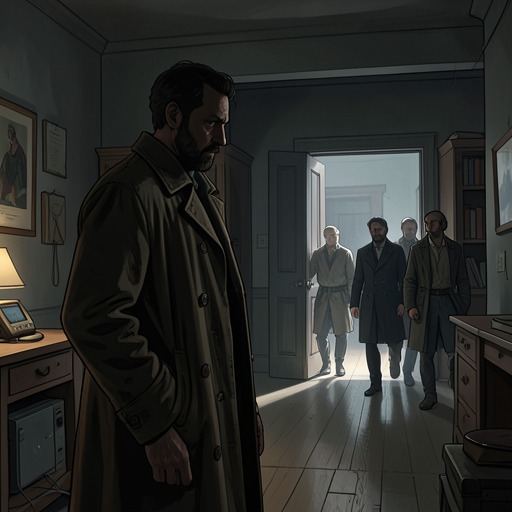
The narrative associates Pablo’s retreat with visible fear. When the party reaches the camp in falling snow, his eyes are red and bleary, and his voice sounds thick as he predicts heavy snow. He does not join the search for the upper post. Later, when asked how another man is, Eladio answers that he is afraid, adding that speaking of someone else’s fear reassures him. Pilar starts to speak to Jordan; then his attention shifts to the cave mouth, where Pablo appears holding aside a blanket, an automatic-rifle muzzle with its flash-cone jutting above his shoulder. This contrast places private fear, the group’s awareness of fear, and armed presence in the same sequence without making them equivalent.
Return and the Limits of Decline
Pablo’s return complicates any account of his decline as a steady disappearance from the group. Pilar reacts with disbelief when she sees him at the cave entrance. Pablo answers her astonishment with a calm “Me” and comes inside. The short exchange gives no explanation for where he has been or why he has returned, and it does not establish that he has resumed command. What it does establish is that the man who refused the bridge mission re-enters the group armed and physically present.
The movement from an asserted claim of command, through Pilar’s public challenge and the refusal to help with the road mission, to this armed reappearance leaves Pablo’s standing unresolved. His earlier organizational skill remains vivid in Pilar’s story; his present withdrawal remains consequential to Jordan’s task; and his return prevents the word decline from becoming a simple synonym for absence. The arc is instead one of unstable authority: the group has seen its former leader falter, has heard another member claim command, and must now reckon with Pablo’s return without any assurance that the conflict has ended.