Pablo's band
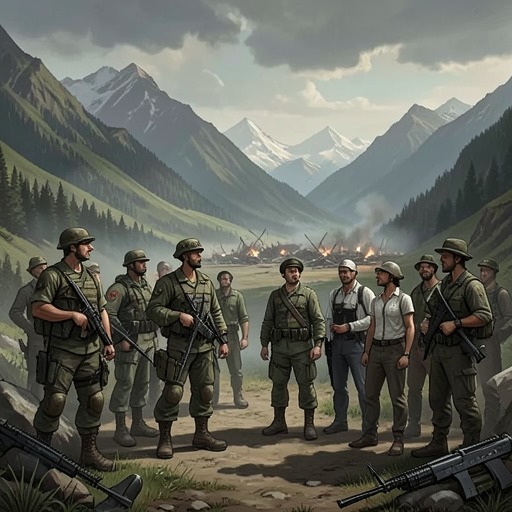
For Whom the Bell TollsPablo's band is the guerrilla group whose local knowledge, fighters, and resources make it central to Robert Jordan’s bridge-demolition mission. Its significance lies not only in whether its members will fight: the band’s changing leadership and uncertain commitment shape the operation’s feasibility, while its history reveals the contrast between Pablo’s former effectiveness and his later retreat from action.
Identity and Resources
Pablo is identified as the band’s leader, and the group’s standing is tied to its established presence in the territory. He argues that an operation near where the band lives is his concern, because a guerrilla group must survive in the place where it operates. His claim to local authority rests on experience: surviving for a year, he insists, requires knowing one’s business. Robert Jordan, by contrast, says he has come under military orders and must carry out his assigned task, whether or not Pablo chooses to help.
The band is small, and its strength is counted in people and animals. An early count gives seven men and two women. Later planning sets those figures beside the other group’s personnel and horses: Pilar counts seventeen people and nine horses in all, while El Sordo notes that his own party has fewer horses than needed. The numbers are not incidental. The mission entails movement, attack, and retreat in mountain country, so the band’s available people and transport constrain what the allied groups can attempt.
The horses also become a point of tension. When Robert Jordan’s heavy packs are set down near the corral, Pablo pushes one with his foot and calls it the source of trouble. The packs represent the explosives and the mission that has entered the band’s camp; the sight of the horses and Jordan’s familiarity with them helps prompt Pablo to speak more freely. His resistance is therefore attached both to the practical danger of the operation and to the prospect that an outside order will disturb the band’s precarious security.
Leadership and Earlier Actions
Pablo’s authority is complicated by a record of real military competence. Pilar recounts that he organized the seizure of fascists in the village at the same time as the assault on the Civil Guard barracks. By arranging the simultaneous actions, he prevented opponents from attacking the assault force from its flanks or rear. Pilar’s account presents him as an intelligent organizer, capable of planning an operation in detail, even as she judges him brutal.
The barracks assault demonstrates that earlier effectiveness. Pablo’s force surrounded the building in darkness, cut its telephone wires, placed dynamite beneath a wall, and called on the guards to surrender. When they refused, he blew open the wall at daylight. The attack resulted in two guards killed, four wounded, and four surrendering. This history gives the band a formidable past: its leader had once taken initiative, coordinated force, and brought an operation to its conclusion.
That past contrasts with the band’s diminished activity in the present. Anselmo says Pablo’s last raid was the group’s most recent action and that Pablo has done nothing since. The contrast helps explain why Pablo’s reputation and current authority do not settle the question of what the band will do next. Past competence is visible, but the present mission meets a leader preoccupied with keeping his people undisturbed.
The Bridge Dispute
When Robert Jordan raises the bridge operation, Pablo refuses to help. He says that neither he nor his people will go, and Jordan responds that he and Anselmo will proceed without the band. The refusal immediately turns a logistical problem into a conflict over command, obligation, and the band’s independence. Jordan has orders from the forces conducting the war; Pablo sees his primary duty as protecting himself and those with him.
Pilar’s opposition to Pablo makes the dispute an open contest for leadership. She declares herself for the bridge and against him, and challenges his assumption that he still commands the group. Pablo insists that he is in command, but Pilar tells him that the people recognize her authority. The exchange exposes a divide between formal or inherited leadership and the practical obedience the band is willing to give. The mission does not merely ask the group to follow an outsider: it forces the members to decide whose judgment will direct their own actions.
Pablo’s refusal does not end his connection to the operation. Later plans assign him a role in cutting the telephone line, attacking the post at the sawmill, taking it, and falling back toward the bridge. The proposed task gives the band a concrete part in the larger action, and it differs sharply from Pablo’s earlier declaration that he and his people would not go. The shifting plan reflects how unstable the alliance remains: the group’s involvement depends on decisions that are contested and subject to change.
Change and Operational Role
The band’s position is measured repeatedly against the terrain and the demands of the operation. The bridge is a single-span steel structure crossing a deep gorge, with a sentry box at each end. Robert Jordan studies how explosives could cut the span’s support, while the wooded slopes and road below provide routes for observation and approach. For the guerrillas, taking part in the plan means acting within a landscape where bridges, roads, posts, and lines of communication govern both attack and retreat.
The band’s wider military value also depends on learning and adapting. When Robert Jordan examines a machine-gun position, he explains that the rocks intended to protect its flanks would instead give cover to attackers, and that the gun needs a level field of fire and a position from which it can engage an enemy side-on. Agustín says the group has little experience fighting defensively except during the capture of its town. Jordan replies that they will learn together. The episode shows that the band is not simply a body of armed men: its usefulness depends on instruction, field conditions, and the ability to revise positions according to what the ground actually permits.
Pablo’s later return to the cave with a short automatic rifle marks a further reversal in his relation to the group and the mission. He appears after his refusal, carrying a weapon, and says evenly that he has returned. In light of the earlier dispute, his reappearance restores him as an active presence without erasing the conflict over whether he or Pilar commands. The band consequently remains a volatile ally: its people and resources matter to the operation, but its participation is shaped by internal authority struggles, practical vulnerability, and a leader whose actions have shifted from past initiative to refusal and renewed involvement.