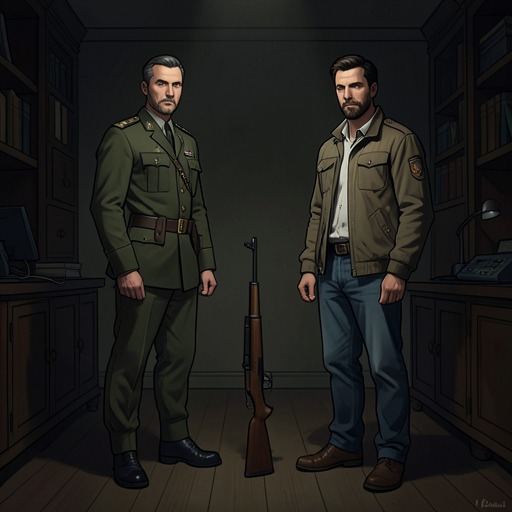
Pilar and Pablo’s conflict and alliance
For Whom the Bell TollsPilar and Pablo’s conflict and alliance center on the contested command of their guerrilla band and the danger Pablo poses to Robert Jordan’s bridge operation. Pilar openly challenges Pablo’s authority, and the band weighs removing him when his opposition threatens its plans. Yet Pablo later claims a place in the operation, turning their conflict into a wary, conditional alliance in which leadership is tested by actions rather than settled by declaration.
Authority and the Bridge Mission
Their struggle over command is already visible in the way Pablo describes his priorities. When Robert Jordan explains that he has come under orders and must carry out his duty, Pablo answers that his own duty is to protect those with him and himself. The disagreement is more than a clash of personalities: Jordan represents an operation directed by the wider war, while Pablo’s immediate concern is keeping his group undisturbed. The mission’s importance does not, by itself, persuade him to cooperate.
Pilar’s authority becomes explicit when she challenges Pablo in front of the others. He insists that he commands there; she counters that the people recognize her command, while making clear that Pablo may remain, eat, and share the work if he accepts the conditions she sets. Her declaration gives practical form to a shift in power: Pablo may still claim the title, but Pilar speaks as the person able to define the band’s terms.
Opposition and the Question of Removal
As the group discusses what Pablo might do, Pilar tells Robert Jordan that Pablo is capable of anything. The conversation turns from mistrust to the possibility of eliminating him. Pilar says she is now in favor of killing him, while Agustín also changes his position: he had opposed the idea but now considers Pablo dangerous to them all. The shift shows how Pablo’s resistance has changed the question from whether his conduct is objectionable to whether the mission and the group can safely proceed with him present.
The others do not treat removal as a simple decision. Agustín objects that one wrong does not justify another, and Pilar distinguishes Robert Jordan and Anselmo from the dispute because Pablo has not been their leader. Fernando then argues that holding Pablo prisoner is impractical and negotiation repugnant; he concludes that eliminating him would best protect the planned operations and the Republic. His formal argument casts a personal crisis as a matter of military security, but Pilar cuts off his extended reasoning and makes plain that his opinion has been heard.
Robert Jordan offers to carry out the decision if the group is agreed, saying he is ready to do it and will do so that night. This willingness brings the threat to a concrete point, but it does not produce an immediate confrontation. Pilar looks toward the cave entrance, and Pablo returns before the proposed action occurs. The timing leaves his fate unsettled at the very moment the group appears prepared to decide it.
Pablo’s Reversal and Conditional Alliance
Pablo re-enters while the discussion has been about him. The narration registers the unsettling speed of his change: having pushed his hostility far enough to make the others ready to act against him, he now becomes friendly and begins again as if nothing had happened. His return does not erase the group’s reasons for distrusting him; instead, it makes his changing position itself part of the danger.
Pablo says that he and Robert Jordan will have good weather for the bridge operation. Pilar immediately questions the word we, refusing to treat his participation as already accepted. Pablo answers that he has reconsidered and is with her in the bridge mission. When Agustín challenges this sudden agreement by recalling Pablo’s earlier statements and the confrontation between them, Pablo maintains that he is now with the group. His explanation ties the reversal to changing weather, an unsteady basis for trust that leaves the others questioning what his renewed commitment means.
Pilar watches him as if he were unfamiliar, still affected by the earlier discussion of blinding, and asks what has come over him. Her reaction preserves the distance between his declaration and her confidence in it. The alliance is real enough to alter the operation’s prospects, but it begins without reconciliation: Pablo says he is with them; Pilar’s questioning makes clear that his word has yet to restore trust.
A Partnership Measured by Action
The relation therefore moves through competing claims rather than a settled transfer of power. Pilar can speak for the group and help shape its decision; Pablo can still disrupt the mission, then offer to join it. The contrast between the two is not simply command against obedience. Pilar’s authority depends on the people’s recognition and the practical work of keeping the band together, while Pablo’s position fluctuates between self-protection, resistance, and renewed participation.
Later, during a conversation in the cave, Pilar begins addressing Robert Jordan and turns toward the entrance as Pablo appears holding a short automatic rifle. The sight of him entering with a weapon underscores that their relationship remains bound to the operation’s immediate risks, not merely to the words exchanged over command. The available evidence establishes his armed return but does not state what he intends to do with the rifle; the moment should not be mistaken for proof of either renewed hostility or complete reconciliation.
Significance
Pilar and Pablo’s alliance is consequential because the bridge mission depends on a band whose leader has first resisted the plan and whose authority has been openly challenged. Pilar’s assertion of command gives the group a basis for deliberation, while its discussion of killing Pablo exposes the cost of securing cooperation through force. His sudden return to the mission changes the practical balance without resolving the underlying conflict.
The relationship’s central tension is the gap between a declared alliance and dependable commitment. Pablo’s reversal offers the group a way forward, but Pilar’s disbelief and the earlier readiness to remove him prevent that reversal from becoming a clean restoration of trust. Their shifting positions make the bridge operation a test not only of military coordination, but of whether a divided group can act together when command itself remains contested.