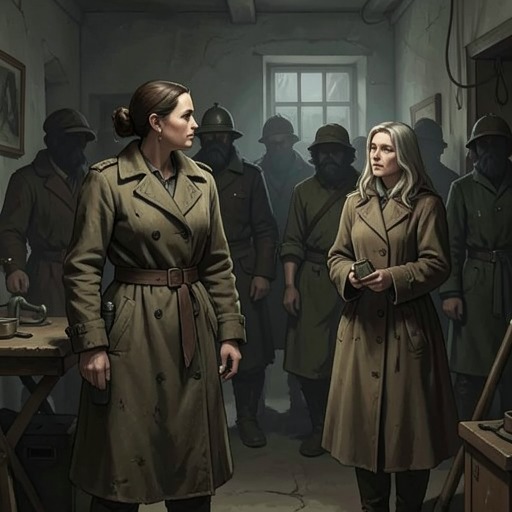
Pilar and Robert Jordan
For Whom the Bell TollsPilar and Robert Jordan’s relationship is a working alliance under pressure: she helps confront the timing and consequences of the bridge demolition, while he brings the operation’s military requirements and his own judgment to the group. Their cooperation is real, but it does not make Jordan the authority over the guerrillas’ future. Pilar’s anger when he presumes to advise them after the mission marks that boundary, and her eventual return to practical discussion shows how the alliance survives their disagreement.
Identity and the Work They Share
Their relationship takes shape around the planned destruction of the bridge. Pilar asks whether the moment of the explosion matters and presses the question of what happens if enemy troops are moving up. Jordan’s answer is unequivocal: timing is of the greatest importance. Their exchange establishes that Pilar is not merely present while he explains a plan; she is testing its demands against the situation the group must face.
Jordan recognizes the operation’s difficulty even as he describes its abstract simplicity. On paper, he explains, the bridge is destroyed when the attack begins so that nothing can come up the road. The difference between that clean sequence and the complications of carrying it out gives their cooperation its practical tension. Pilar’s questions focus on the conditions surrounding the plan; Jordan’s task is to make the demolition serve the attack.
Advice, Pride, and a Breach
Jordan privately realizes that he has made a social and tactical mistake. He believes he has told Spaniards they could do something better than they could do it themselves, when he should have flattered them rather than prescribe what they ought to do. He also thinks the guerrillas have accomplished little since the train raid organized by Kashkin, and wonders whether they might be shamed into going to the Gredos—or whether he himself might be driven out. These are Jordan’s judgments, not a neutral account of the group’s capabilities, and they help explain why his advice provokes resentment.
Pilar asks whether Jordan’s nerves are all right. He says they are, then tells her that after the bridge operation she would do well to go to the Gredos. The suggestion crosses from the immediate task into a decision about what the guerrillas should do when his own assignment is finished. Pilar responds with a torrent of curses. The deaf El Sordo shakes his head and grins as she continues, and Jordan understands that the exchange has somehow restored the group’s familiar footing.
Authority and Mutual Limits
After her outburst, Pilar drinks from the water jug and tells Jordan to stop instructing them about what they should do afterward. He can return to the Republic with his explosives; the people who remain in the hills will decide for themselves where they live and die. Her formulation makes the dispute sharper than a difference of military opinion: Jordan’s mission has an endpoint, while the guerrillas’ exposure and choices continue beyond it.
El Sordo attempts to soften Pilar’s bleak wording, urging her to say that they will live in the hills. Pilar refuses the distinction between living and dying, insisting that she can see the end clearly enough. At the same time, she tells Jordan that she likes him. Her affection does not cancel her rebuke; rather, the exchange shows that personal regard and resistance to his authority coexist. She accepts cooperation on the bridge without conceding control over the group’s future.
Cooperation After the Conflict
The disagreement does not end their practical collaboration. Jordan thanks Pilar for her aid and loyalty, and acknowledges the difficulty created by the timing of the explosion. El Sordo tells him not to dwell on that and insists that they are there to do what they can, though the operation is complicated. Jordan answers by contrasting that complexity with the plan’s simplicity on paper.
That return to the task gives the relationship its defining balance. Pilar challenges Jordan when his strategic confidence becomes presumption, while Jordan continues to recognize her help and loyalty as essential. Their alliance is neither effortless agreement nor a transfer of command: it depends on working together over the bridge while leaving the guerrillas’ longer-term decisions in their own hands.