Republican-controlled territory
For Whom the Bell TollsRepublican-controlled territory is at once a political hope and a contested military space: characters imagine reaching it as a way to belong to the Republic, while roads, mountain passes, checkpoints, and command delays determine what can actually be done there. Its significance lies in the gap between the promise of a shared cause and the friction of carrying out that cause across the landscape.
A destination imagined as the Republic
Pilar describes her desired destination not as the nearby Sierra de Paramera but as the Republic. When Robert Jordan says the journey is possible, she asks whether his people would go; he replies that they would if he told them to. Pilar is less certain about her own group: Pablo would not want to go, though she thinks he might be safer there, and she doubts that the younger members would agree either. The exchange makes Republican-controlled territory more than a point on a map. It is a possible future whose appeal must contend with the loyalties, fears, and differing wishes of the people expected to travel there.
El Sordo answers Pilar’s wish with confidence, saying that once they have won, it will all be the Republic. His response turns the destination into a collective political outcome rather than a private escape. Yet the phrasing also makes arrival conditional: the territory she wants is bound to victory in the war, not simply to a journey the group can undertake at will.
Terrain and military movement
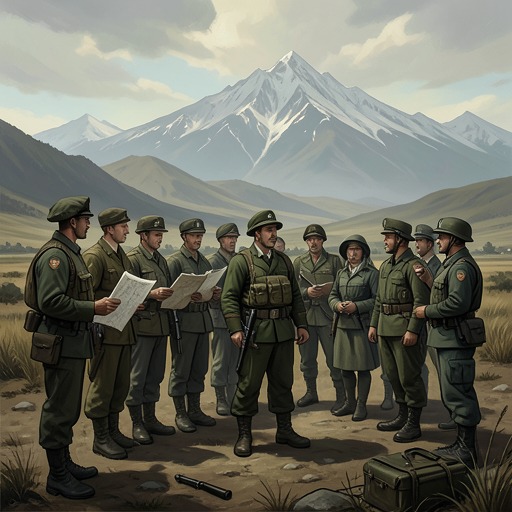
The territory is encountered through concrete features that shape movement and observation. From a pine-covered slope, Robert Jordan looks down toward a dark road winding through a pass, with a stream beside it and a mill below. The road is a route through the mountains, but also a place to watch and assess. Its terrain links the landscape’s ordinary features—forest, water, and mill—to the military task unfolding within it.
The bridge in the pass makes those constraints still clearer. It spans a deep gorge between steep slopes, with a sentry box at each end. From concealment among the trees, Jordan studies the steel span and sketches where explosives could sever its support. The gorge and the bridge’s construction determine how the demolition can be carried out; the surrounding height offers a vantage point, but the sentries and the approach must still be reckoned with. In this landscape, military geography is not a backdrop: it sets the terms of access, surveillance, and attack.
Weather and visibility also change the meaning of a route. During a snowstorm, Anselmo waits in shelter beside the road near the sawmill, weighing the order to remain at his post against the cold and the lack of unusual movement. He observes a camouflaged staff car pass but cannot identify its occupants or distinguish its significance from the other vehicles using the road. The episode shows how information depends not only on what moves through Republican-controlled territory, but on what a watcher can recognize and report from his assigned position.
Command, communication, and obstruction
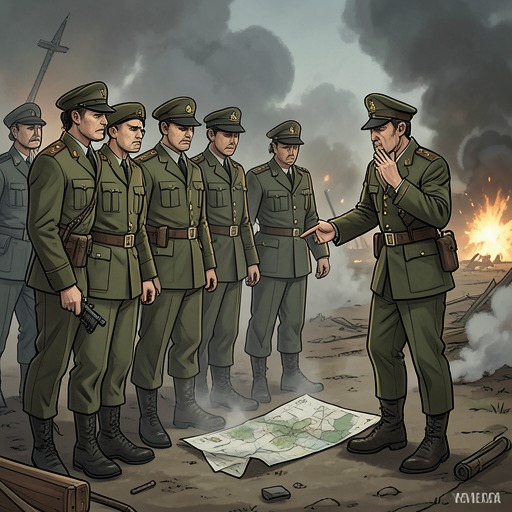
The same space that permits military movement makes coordination vulnerable. Golz explains to Jordan that an attack may be changed, annulled, or postponed, and that the necessary artillery and other support are not simply his to command. His account reveals the distance between issuing a plan and controlling the conditions required to execute it. Even a commander’s authority is limited by competing decisions and delays within the military structure.
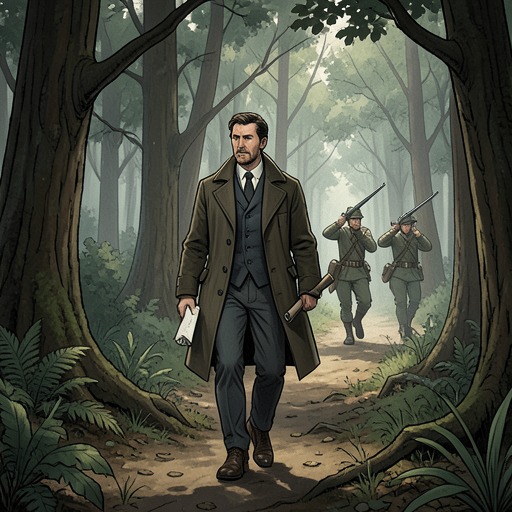
Jordan sends Andrés with a dispatch intended to reach Golz, but the journey through Republican lines is slowed by procedure and suspicion. Although Andrés carries a safe-conduct and a sealed message, a company commander questions his mission. A battalion commander then takes a more helpful approach and tries to hurry him onward. At headquarters, André Marty detains Andrés and the escort instead of allowing the urgent message to proceed. The narrative notes that the operation may already have acquired too much momentum to be stopped, but the delay exposes the risks in the chain of communication: a document can be authenticated and a messenger willing, yet still be held up by officials who control passage.
Jordan’s expectation that the message must reach its intended recipient reflects how dependent the operation is on accurate information arriving at the right time. Anselmo points out that a messenger may not understand the organizational terminology and needs the General’s name and whereabouts. The exchange distinguishes having a dispatch from successfully delivering it. Republican-controlled territory is thus traversed by both people and orders, and neither moves automatically.
Political promise and practical limits
The Republic is spoken of as a future in which the guerrillas’ present struggle will become part of a larger common cause. But the narrative places that hope beside factional suspicion, rigid orders, military bottlenecks, and the imperfect knowledge available to those on the ground. The landscape connects remote fighters with the army, yet it cannot ensure that their information or intentions arrive intact.
This contrast gives Republican-controlled territory its double significance. It is the political destination Pilar desires and the promised outcome El Sordo imagines, but it is also a network of roads, passes, posts, and headquarters where physical conditions and institutional decisions shape what is possible. The Republic appears not as a secure refuge already attained, but as an aspiration whose realization remains bound to military action and the uncertain passage of people and messages.