Robert Jordan’s broken leg and final predicament
For Whom the Bell TollsRobert Jordan’s broken leg and final predicament begin when a shell throws him beneath his gray horse during the retreat from the bridge. The fracture makes escape impossible, but not his participation in the fight: left behind above the road, he must decide whether to endure the pain and wait for an approaching officer, or die on his own terms before capture. The injury converts the operation’s apparent success into an isolated final action, governed by the steep ground, the exposed road, and the time his body can hold out.
The bridge and the terrain
The physical setting has been established from the start as an operational landscape, not simply a backdrop. From the pine-needled slope, Robert Jordan can see the road winding through the pass, the stream, and a mill below. When he and Anselmo approach the bridge, they find a single-span steel structure crossing a deep gorge, with a sentry box at either end. Robert Jordan studies its supports and sketches where charges can be placed to break the span. The bridge’s position above the gorge makes its destruction a military objective; later, the same road, slope, and timber dictate who can retreat and who remains vulnerable.
The landscape also shapes the campaign’s imperfect information. During a snowstorm, Anselmo keeps watch near the sawmill, where he knows the post’s dispositions and habits. A camouflaged staff car passes below him, its windows blued except for a clear half-circle; he records it as another vehicle going up the road. He does not recognize the distinction between ordinary divisional traffic and the higher command’s cars, a distinction Robert Jordan might have understood. This episode makes the road an observation line as well as a route, and shows how much military knowledge depends on what a watcher can identify from his position.
The same principle governs the defense. Robert Jordan points out that rocks meant to protect a machine-gun position’s flanks could instead give attackers cover, and that the gun needs a flat field of fire and a sideways angle on the approach. Agustín admits that the group has little experience fighting defensively, and Robert Jordan says they will learn together. The later retreat unfolds in this terrain of slopes, exposed road, and timber: it offers cover, but it also limits movement and sightlines. When Robert Jordan is injured, the slope that had enabled observation and action becomes an obstacle to evacuation.
The shell and the fracture
After the bridge is broken, Robert Jordan rides farther up the road until the bank becomes too steep. The bridge is visible from a new angle: the gap in its center, a small tank, a larger tank behind it, and trucks halted on the road. A shell bursts nearby, scattering earth and metal. As he rides toward the timber, another blast catches him; he ends beneath the gray horse, which is kicking as he tries to pull free.
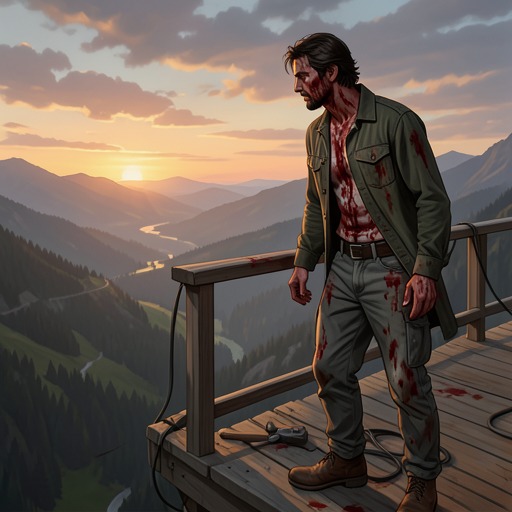
The damage is immediately specific. He can move to the right, but his left leg lies flat and seems to have acquired a sideways hinge rather than a normal joint. He feels the sharp thigh bone pressing against the skin. The horse stands over him, ribs heaving; after another explosion, it sits down beside him, and Robert Jordan hears the sound it makes. The injury is not left as an abstract wound: its instability, the bone’s position, the horse’s weight, and the continuing shellfire establish why he cannot simply stand and rejoin the retreat.
Primitivo and Agustín drag him by the armpits up the last part of the slope. A shell passes close enough that they drop him and fall flat; when the dirt and metal have scattered, they lift him again and carry him to shelter in the timber where the horses are. Maria, Pilar, and Pablo are there. Maria kneels beside him and asks what has happened; Robert Jordan answers that his left leg is broken. Pilar proposes binding it and points to a packed horse, ordering its load cut off so he can ride. Robert Jordan sees Pablo shake his head and nods back. The attempted practical solution meets an unspoken recognition that the broken leg makes riding untenable.
Pain, delay, and the decision to wait
As time passes, the leg begins to hurt badly. Robert Jordan attributes the sudden worsening to swelling after he moved and imagines that the cut thigh bone may have caused internal bleeding. He knows that if he loses consciousness, the enemy may revive him and question him. His reasoning is not calm detachment from death: pain is mounting, his strength is failing, and he considers ending his life before capture. He recalls his father’s course without wanting to repeat it, while acknowledging that he might have to do so if he cannot remain conscious.
The prospect of acting before the enemy arrives is set against a competing purpose. Robert Jordan tells himself that he could wait long enough to delay the pursuers, or perhaps get the officer, and that one action done well might matter. He has felt himself close to passing out several times and has held on; now he tries to hold on again, imagining his slipping awareness like snow beginning to slide on a mountainside. He makes a narrow, immediate decision: to last until the cavalry comes. The choice does not remove the pain or settle what he will do afterward; it gives his remaining time a task.
The waiting is bound to the landscape he has watched throughout the mission. At daybreak he lies behind a pine above the road and bridge, seeing the sentry warm his hands over a brazier in a wooden box. The mist lifts from the stream bed; the bridge appears fine and spidery through it, while the pine trunks, road, and forest floor become distinct in the growing light. Earlier, the bridge was an engineering problem to be solved with carefully placed charges. Now it is a broken crossing below him, and his view of it is inseparable from his own inability to move away.
The approaching officer
Robert Jordan’s luck holds long enough for him to see cavalry emerge from the timber and cross the road. The riders are looking for a missing trooper and horse; the missing pair have been gone since the previous morning. The cavalry is now close, and the road below contains long lines of vehicles. Robert Jordan takes in the scene, looks at the clouds, and touches the pine needles and the trunk beside him. These small acts register a return to the immediate world as he steadies himself behind the tree.
The officer approaching along the trail is Lieutenant Berrendo. He has ridden from La Granja after the first report of an attack on the lower post. Because the bridge has been blown, his men had to turn back, cross the gorge higher up, and come around through the timber; their horses are wet and blown from the detour. The destroyed bridge therefore remains consequential beyond its immediate target: it obstructs the pursuers’ route, but it does not stop them, and their altered approach brings Berrendo within reach of Robert Jordan’s hiding place.
Robert Jordan lies about twenty yards from the trail, behind the pine, with his submachine gun’s muzzle resting against the trunk. He waits until Berrendo reaches the sunlit margin where the first trees meet the green meadow. His hands must be kept steady, and he can feel his heart beating against the forest floor. The account ends with the officer still approaching and Robert Jordan still in position. It does not disclose whether he fires or what follows; the final predicament remains suspended at the instant when pain, restraint, and the possibility of one last act converge.
The meaning of the predicament
The injury changes Robert Jordan’s relation to the mission without making him cease to act. Before the shell strikes, he can read the bridge, plan its destruction, ride, and withdraw with the group. Afterward, his body is pinned to a place from which the road and bridge remain visible but escape is no longer practical. The military result has been achieved, yet he faces a new problem with no reliable solution: whether he can stay conscious, avoid capture, and use the remaining moments to affect what happens next.
The novel gives that predicament concrete physical measures rather than turning it into a distant symbol. The sideways movement of the broken thigh, the horse’s weight, the shell bursts, swelling, and pain all restrict his choices. At the same time, the pine shelter, the twenty-yard distance to the trail, the approaching cavalry, and the broken bridge shape what action remains possible. The ending places the reader beside a wounded man who has chosen to wait, but not yet learned whether the wait can make a difference.