Segovia
For Whom the Bell TollsSegovia is both a place on the military map and a measure of how far the Republican offensive might carry the men preparing to destroy a bridge in the mountain pass. The city gives Robert Jordan’s work its larger strategic horizon, but its name also enters a battlefield picture clouded by uncertain intelligence, vulnerable communications, and the possibility that the attack may not unfold as planned.
Strategic Setting
The bridge operation is tied to the timing of the offensive: Robert Jordan is told that the bridge must be blown only after the attack starts, so that reinforcements cannot advance along the road. The bridge itself lies across a deep gorge in a pass, with a sentry box at each end; its position makes the road a route that can be denied, but also a military channel whose use depends on what the offensive accomplishes. Segovia is not presented as the bridge’s immediate location. Rather, it marks the broader reach of the hoped-for advance beyond the pass.
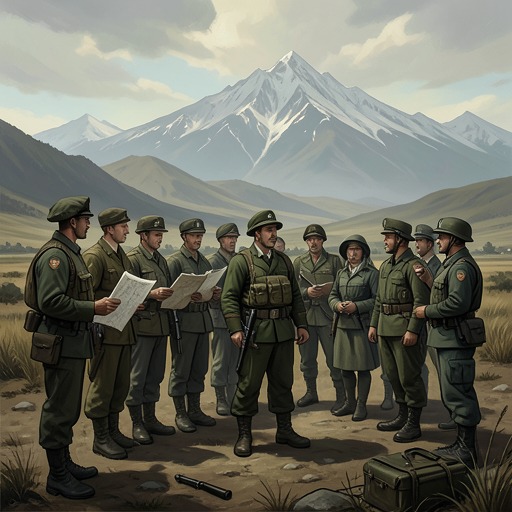
The landscape makes the operation concrete. From the pine-covered slope, Robert Jordan can see the dark road winding through the pass, a stream beside it, and a mill below. When he and Anselmo approach the bridge, the final descent runs through tree shadows; at fifty yards, they can see its single steel span over the gorge. The ground, road, watercourse, and bridge form a connected tactical space: observation and movement are shaped by slopes and cover, while the gorge concentrates the route at a structure that can be demolished.
Intelligence and the Limits of Observation
Anselmo’s watch on the road demonstrates how difficult it is to turn observation into useful intelligence. In a snowstorm he shelters against a tree near the sawmill, then records a camouflaged staff car among the vehicles passing the post. It is the tenth vehicle going up that day, with six having come down and four still expected upward. He counts traffic but cannot distinguish the ordinary cars of the division’s staff from the more significant vehicles of the General Staff. The narrative makes the gap plain: Robert Jordan, with the necessary knowledge, would have understood the difference, but Anselmo’s report can only mark a car going uphill.
That gap matters because the operation depends on a changing military situation rather than a fixed schedule alone. Robert Jordan reflects that preparations by the opposing side had moved up only after dark, too late for him to report them sooner, and that the attack might be compromised by what the enemy had prepared. He wonders whether the planes have warned the Republican side, whether reported Italian concentrations signal another offensive, or whether they are a bluff. Segovia belongs to this field of uncertain inference: the city is a possible objective, but the available signs do not settle what either army will do.
The Offensive and the City as an Imagined Outcome
In a private calculation, Robert Jordan imagines the Republican attack succeeding: aircraft destroy anti-tank guns, tanks make progress up the hills, and the brigade advances toward Segovia. He immediately revises the scale of his hope, telling himself he would settle for La Granja. The movement from the named city to the smaller objective gives the imagined victory a practical measure; it also sharpens the conflict between the offensive’s strategic ambitions and the limited ground that might actually be gained.
The thought does not release him from his assigned task. On the contrary, imagining success makes him certain that the bridge will still have to be blown. The attack’s planners need the road closed after their advance begins, and he sees no prospect that the order will be cancelled in time. Segovia thus helps explain the bridge’s strategic importance without turning the demolition into an abstract military exercise: the span is one element in a larger plan whose success may carry the advance toward the city, while the timing of the explosion must prevent the enemy from reinforcing along the same route.
Reports from Near Segovia
Later, Karkov hears a report that the Fascists have been fighting among themselves near Segovia. According to the man bringing the news, mutinies were put down with automatic-rifle and machine-gun fire, and Fascist planes bombed their own troops that afternoon. He says the news came from Dolores, whose visible exultation had impressed him. The report presents internal disorder on the opposing side as a possible advantage for the Republic, but it remains a report relayed through several people rather than an event shown directly.
That distinction sustains the novel’s tension between hopes formed at a distance and the hard conditions of action in the pass. Robert Jordan must make decisions with incomplete information; Anselmo’s road count, the uncertain preparations, and the later account of fighting near Segovia each offer a fragment, not a complete operational picture. The city therefore functions less as a fully depicted destination than as a point where plans, rumors, and battlefield possibilities converge. Its significance is measured in the decisions made far from it: whether the offensive can advance, whether the bridge must be destroyed, and whether the available knowledge is enough to act.