Sierra de Gredos
For Whom the Bell TollsSierra de Gredos enters the story as a hoped-for destination beyond the immediate demands of the war: a place where the fighters might fish and build a life if they survive the operation at the bridge. Its imagined future stands in contrast to the snowy, strategically exposed mountain country in which the guerrillas are presently struggling to observe, fight, and endure.
Setting and Geographic Contrast
The mountain landscape around the pass is defined by steep slopes, pine forest, a road, and a stream descending through a gorge. The bridge itself spans that gorge in a single steel span, with sentry boxes at either end. From the hillside, Robert Jordan studies the structure and sketches where explosives might be placed to break its support. The terrain is therefore not merely scenery: elevation, sight lines, roads, and the narrow crossing shape the military task.
The pass is also a place of changing weather and limited shelter. During a snowstorm, Anselmo waits behind a pine near the sawmill, cold and reluctant to abandon his post before Robert Jordan relieves him. A camouflaged staff car passes below, but Anselmo records only that another vehicle has gone up the road; he lacks the distinctions that might make the traffic militarily significant. His position offers observation, but not comfort or full knowledge.
A Possible Future Beyond the Operation
Sierra de Gredos appears in a fighter’s private imagining of life after the bridge action. He recalls that the streams there are good for trout and crayfish and hopes that he and Eladio might go there. The prospect is practical and modest: a place to spend summer and autumn, not an abstract promise of victory. Yet the thought immediately encounters the range’s severe winter, which would make a year-round life difficult.
That seasonal qualification keeps the hope provisional. The imagined return to ordinary pursuits depends first on the war being won, and even then the cold remains part of the calculation. Gredos thus gives the fighter a concrete image of what survival might permit—streams, fishing, and shared time—without making that future certain.
Landscape, Conflict, and Human Limits
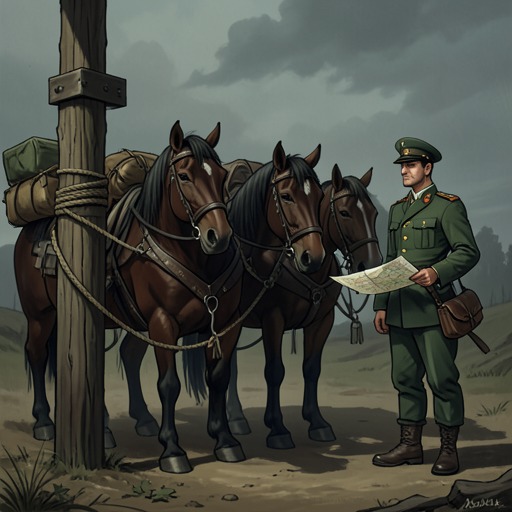
Elsewhere in the mountain fighting, terrain imposes immediate costs. El Sordo reaches a hilltop while under attack, bringing an automatic rifle and ammunition as companions cover his ascent. When his wounded horse can go no farther, he kills it so its body can help fill a gap between rocks and support the defensive position. The episode sets the practical demands of combat against the moral unease elsewhere expressed about killing animals and people: in this terrain, animals are companions and essential resources, but their bodies can also become part of a position.
The landscape’s strategic usefulness does not make it secure. Robert Jordan observes that rocks intended to protect a machine-gun flank can instead give attackers cover, and he explains that the weapon needs a flatter field of fire and must be aimed across the approach. The lesson is that a defensible position depends on reading the ground correctly; the same slopes and rocks can shelter one side or expose it to another.
Narrative Significance
Gredos is not presented as a place the characters reach during the action covered here. Its importance lies in the contrast between a real, dangerous mountain environment and a remembered or anticipated landscape of streams and seasonal possibility. While the bridge, road, snow, and exposed hills organize the fighters’ present responsibilities, the thought of Gredos gives one of them a specific future to hope for—and makes clear how much remains contingent on surviving the war.