Spanish Nationalists
For Whom the Bell TollsThe Spanish Nationalists are the force against which the guerrillas define their military struggle, but the novel does not allow that opposition to settle the moral questions of violence. They appear as a military threat, as people whom Anselmo can recognize as poor men much like himself, and as the victims of a Republican village’s planned seizure and subsequent mob violence. Their role therefore links the practical demands of war to the political and ethical costs of acting in its name.
Identity and the Conditions of Conflict
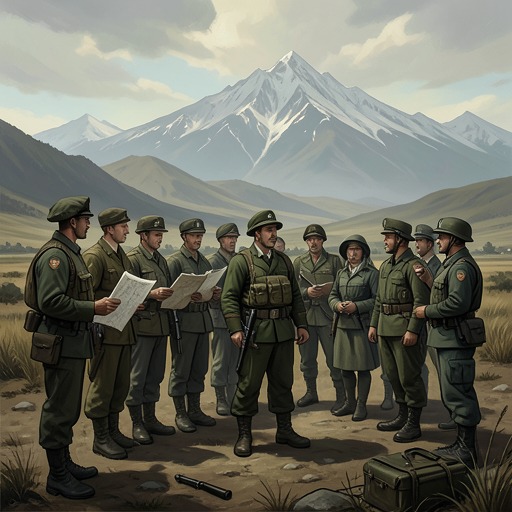
The evidence presents the Spanish Nationalists through the Republicans’ perspective and through the circumstances of combat rather than through an account of their institutions or command structure. At the sawmill, Anselmo watches Nationalist soldiers from a position in the snow. He knows they are Galicians from their speech and understands that they cannot desert because their families would be shot. He imagines that, absent orders to challenge travellers and demand papers, he could approach the mill and be welcomed. What separates the men, he thinks, is the orders they obey—not an essential difference between them.
That recognition does not remove the threat. Anselmo expects that the soldiers at the post will be killed the following night, and Robert Jordan later identifies the sawmill post, along with a second post at the roadmender’s hut below the bridge, as targets. For the guerrillas, Nationalist posts are military obstacles to be suppressed as part of their operations; for Anselmo, the men inside remain human beings whose deaths are difficult to reconcile with his opposition to killing.
Military Opposition and Political Stakes
The Nationalists’ attack is part of Robert Jordan’s remembered experience of the war in the Guadarrama hills. His recollection describes Republican forces holding a road under bombing and artillery fire, then resisting an attempt to advance through the rocks and trees. When the position was threatened from both sides, the Republicans defended a sanitarium before a counterattack drove the Nationalists back. The memory explains why Jordan’s understanding of combat includes discipline and military necessity, even as its human cost remains present.
The threat is also political. Primitivo argues that wealthy landowners would revolt against taxes on large estates and land, as the fascists have revolted against the government when their interests were threatened. His argument places the Nationalists within a struggle over property and government, not only a series of battlefield encounters. The possibility of revolution in Jordan’s own country leads Primitivo to suggest that Jordan may one day have to fight there as well.
The military campaign depends on orders whose execution cannot be taken for granted. Golz fears that an attack may be changed, annulled, postponed, or begun too late, and says that even the artillery he requests is not under his control. His complaint does not describe Nationalist organization, but it clarifies the situation in which Republicans confront them: the enemy is a military force, while Republican efforts to meet it are vulnerable to delays and interference within their own side.
Violence, Captivity, and Republican Practice
The novel sets the planned suppression of Nationalist posts beside Anselmo’s moral resistance to killing. He has killed before and expects that he may have to do so again, yet regards killing a person—even a Nationalist—as sinful. Rather than advocating the extermination or imprisonment of enemies, he imagines making them work alongside the poor, sharing their conditions of sleep and food, so they might understand how other people live. Jordan answers that such enemies might survive to enslave them again. Anselmo nevertheless maintains that killing teaches nothing and that violence breeds renewed hatred.
Pilar’s recollection of the village seizure gives this conflict a different, more troubling shape. Pablo first organized the capture of Nationalist supporters: he had the streets into the plaza blocked with carts, and the fascists were held in the town hall. They had been seized at home when the attack on the Civil Guard barracks began, a measure that kept them from attacking the guerrillas from the rear or flank. After the barracks fell, four guards were executed. Pilar recalls that the Republicans had won the town, but the killing left her shaken; she had considered the deaths ugly yet necessary to preserve the Republic.
The broader violence against the captives did not remain an orderly act of political justice. The plaza was arranged for the townspeople to participate in killing the prisoners, but jeering and intoxication displaced the intended order. When Don Guillermo came forward, a drunkard imitated his wife’s cry, and the crowd attacked him. Pilar’s response changed: what she had initially understood as a collective sharing of guilt became repugnant as drunkards took over and some participants left in protest. Later, the crowd surged against Don Anastasio Rivas, a Nationalist supporter and wealthy grain buyer who also lent money at high interest. He was killed in the crush, after which the lines had become a mob. The episode makes Republican violence against Nationalist enemies part of the novel’s examination of revolutionary legitimacy, not a clean moral contrast with fascist violence.
Memory, Judgment, and the Limits of Division
Anselmo’s memory of the Otero raid further complicates the categories of enemy and comrade. It was there that he first killed: while he restrained a sentry, Pablo attacked the sleeping post with bombs. Anselmo recalls the sentry’s resistance and his own participation without presenting the act as uncomplicated triumph. He also remembers Otero as an example of Pablo’s former effectiveness, contrasting that earlier commander with the diminished man he believes Pablo has become.
Jordan’s private reflections after hearing of the violence inflicted on Maria likewise resist an easy division between Nationalists and Republicans. He condemns deliberate cruelty, but recognizes that Republicans have also done dreadful things. His thoughts move between accusation, historical judgment, and an admission that he cannot fully understand Spain or forgive everything he has heard. The novel does not erase political responsibility by making violence equivalent; instead, it shows how commitment to the Republic, military necessity, class conflict, and revenge can coexist with acts that undermine the cause they are meant to serve.
The Spanish Nationalists thus matter not only as the enemy facing the guerrillas at posts and on contested roads, but as the opposing side that exposes the fragility of wartime moral distinctions. Anselmo’s recognition of shared poverty and his refusal to regard killing as instruction stand against the operational demand to destroy enemy positions. Pilar’s account, meanwhile, shows a Republican attack on Nationalist captives turning from planned participation into drunken collective violence. Together these accounts make the conflict’s stakes military and political, but also ethical: defeating an enemy does not by itself determine whether the means of victory are just.