The compromised Republican offensive
For Whom the Bell TollsThe compromised Republican offensive is the moment when a carefully timed attack ceases to be a surprise: intelligence reaches the command too late, and the operation proceeds against an enemy already prepared for it. Its danger lies not in a single tactical mistake but in the collision of terrain, delayed communication, divided authority, and the inertia of a military system that can set an attack in motion more readily than it can halt one.
Plan and Conditions
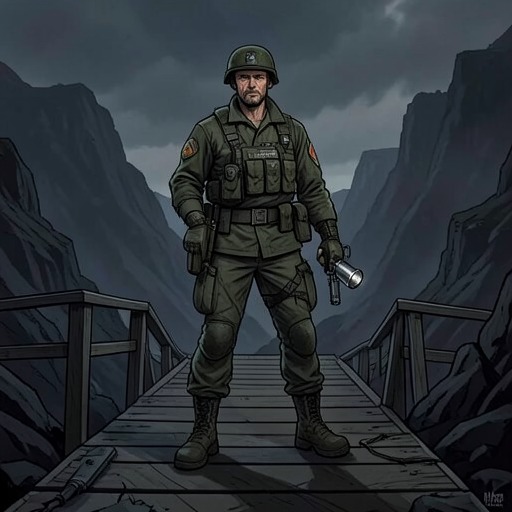
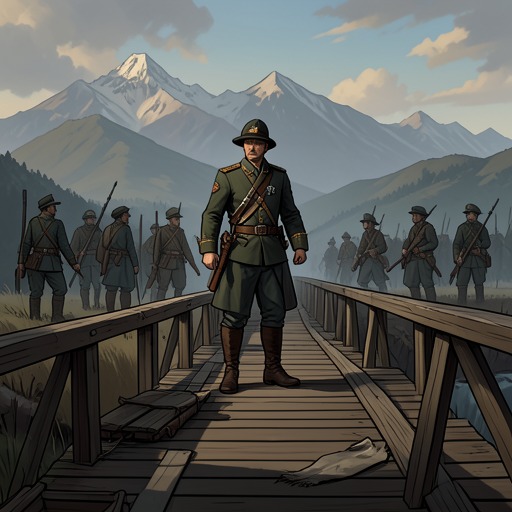
The attack depends on coordination between the offensive and the destruction of a bridge. Golz orders that the bridge be blown only after the attack begins, so that reinforcements cannot move up the road. The timing is essential: demolishing it earlier would not serve the stated purpose, while waiting leaves the bridge and its approaches relevant to the enemy’s movement. The bridge itself spans a deep gorge on the pass road, giving the operation a specific geographic bottleneck to control.
The plans also depend on information gathered locally. Anselmo watches the road from a post near the sawmill and records passing vehicles, but he cannot distinguish ordinary division traffic from the cars of the General Staff. The observation is diligent but incomplete: the number of vehicles going up the road does not, by itself, tell him what their movement means. Meanwhile, Robert Jordan later reports that the enemy has moved material into position shortly before the attack. The possibility that the enemy has learned of the operation thus becomes an urgent intelligence problem, not an abstract concern.
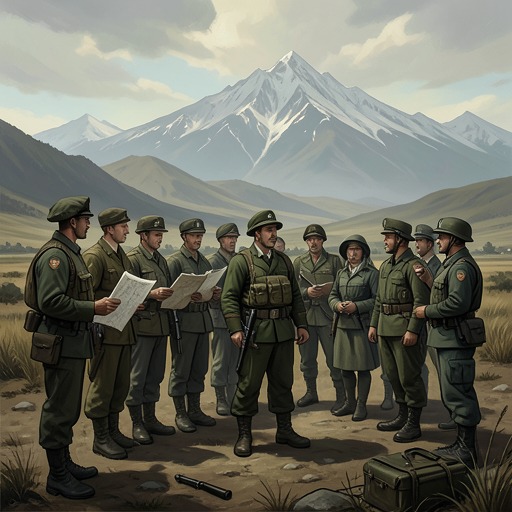
The attack’s command arrangements make that warning difficult to act upon. Golz explains that an attack may be changed, postponed, or cancelled by others, and that he cannot assume his orders will remain in force. He can make an attack, but does not possess all the artillery he requests or full control over the forces and decisions needed to execute it. Permission to cancel must come from Madrid. The plan’s vulnerability is therefore organizational as well as tactical: the people who have the most immediate information do not necessarily have authority to change the operation.
Warning and Delay
Robert Jordan’s report describes enemy preparations made after dark, when movement on the road was less likely to be spotted by aircraft. He considers whether the apparent concentration might be a feint connected with a possible offensive elsewhere, but the available information does not resolve the uncertainty. His reasoning registers both the scale of the risk and the narrowness of the window in which a warning could still matter.
Jordan writes a dispatch for Andrés to carry to Golz and gives directions for finding him. The journey becomes part of the military problem: Andrés and Gómez must carry the information through a chain of command, and their progress is interrupted when André Marty holds them at headquarters. Marty has Jordan’s dispatch in his pocket while he studies the attack orders on a map. The delay exposes the gap between possessing intelligence and transmitting it to someone able to respond.
The narrative does not claim that an unhindered journey would certainly have changed the outcome. It stresses instead that the attack has acquired institutional momentum: by the time the message is moving, there may be no one at the front with sufficient authority to cancel it. Large military operations resist sudden reversal once underway, just as they require effort and coordination to initiate. The obstruction matters, but it belongs to a wider failure of timing and command rather than serving as a guaranteed single cause.
The Attack Proceeds
At headquarters, Duval reads Jordan’s dispatch repeatedly and tries to reach Golz by telephone. Recognizing the danger of sending troops into a surprise attack against an enemy that is waiting for them, he considers taking responsibility for holding the operation up. Yet he also cannot be certain whether the attack is meant to draw enemy forces elsewhere, and the orders do not tell him that it is a holding attack. His hesitation is a response to incomplete information, not evidence that the warning is unimportant.
Duval attempts to contact the relevant command posts and considers cancelling the air operation. Before he can settle the question, he hears the planes. The arrival of the aircraft gives the loss of surprise a decisive form: the scheduled offensive is proceeding, while the intelligence warning has not produced a timely change. Golz, who has heard the dispatch, understands that the enemy is no longer positioned as the plan assumes.
Golz watches the planes arrive in formation and recognizes what the attack might have achieved under different conditions. With surprise intact, the bombing could strike the ridges, tanks could advance, and his brigades could move through the positions they were meant to overcome. He takes pride in the planes and in the possibility embodied by the operation, yet knows the defenders can return to their weapons after the aircraft pass. The same display that represents military capability also makes the missed opportunity visible: the machinery is present, but the conditions needed for its success have been lost.
Consequences and Significance
Golz accepts that there is nothing to be done at that point. His response distinguishes the operation’s intended design from its probable execution: the attack may still take place, but not as the surprise assault imagined in the plan. The enemy’s preparations mean that the ridges are not simply waiting to be struck; defenders can survive the bombing by withdrawing or taking cover, then return to their positions. The offensive’s risks have changed even as its timetable continues.
The episode places Robert Jordan’s bridge mission inside a larger, fragile system. Jordan can assess the bridge, prepare the demolition, and send a warning, but neither technical competence nor accurate reporting guarantees that a high-level operation can be adjusted. At the bridge, Anselmo helps pass down explosive packages as Jordan places and braces them; firing elsewhere on the road interrupts the work without immediately stopping it. The local action continues alongside the offensive whose wider conditions have become compromised.
The state is therefore defined by a tension between precision and inertia. The bridge has identifiable supports, the attack has a specified sequence, and the road’s movements can be observed; nevertheless, information is partial, messages are delayed, and authority is dispersed. The planes arrive on schedule, but schedule is no substitute for surprise. The compromised offensive turns that discrepancy into the central military fact: an operation can be executed as ordered and still have lost the conditions that were meant to make it effective.