The destroyed bridge
For Whom the Bell TollsThe destroyed bridge is the broken center span of the steel crossing that Robert Jordan is ordered to demolish, a tactical obstruction achieved at the cost of lives and amid a Republican offensive whose conditions have already changed. Its destruction fulfills the mission’s central purpose—preventing movement along the road—while the bodies beside the wreckage make plain that a successful demolition is not a clean or isolated victory.
The bridge as target and strategic constraint
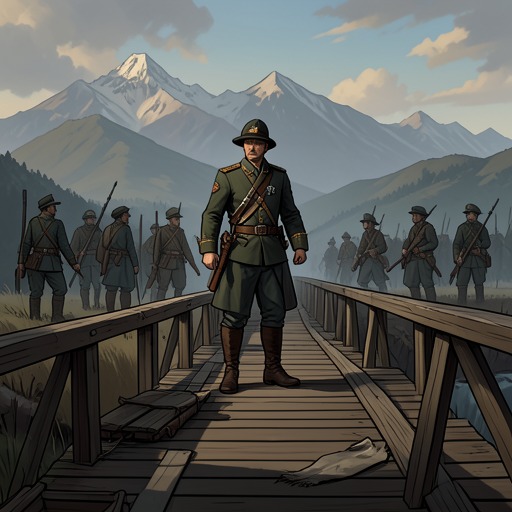
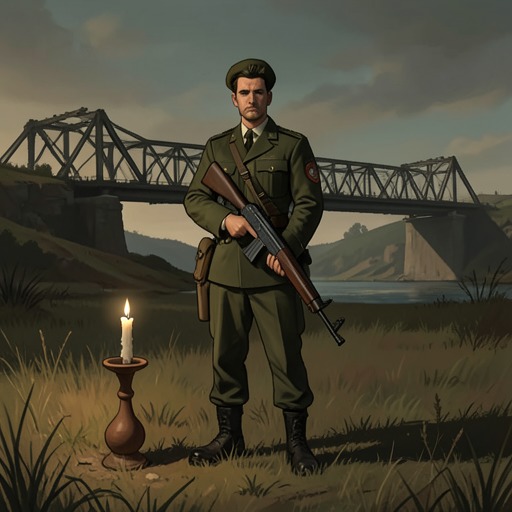
The bridge spans a deep gorge on the pass road. When Robert Jordan first studies it, the single steel span is broad enough for two motor cars, with a sentry box at either end; far below, a stream runs among rocks and boulders. From the hillside he sketches where charges might cut the span’s supports and send part of it into the gorge. The structure is at once a precise engineering problem and a point of military control: if the road is blocked, reinforcements cannot use it.
That purpose determines the timing. Robert Jordan asks when the bridge is to be blown, and Golz instructs him to wait until the attack has started, but not to delay beyond that point. The demolition is intended to prevent reinforcements from coming up the road, not merely to destroy a crossing. The distinction matters because the operation depends on coordination between the attack and the blast, while the bridge itself must be rendered unusable quickly enough to affect movement on the road.
A plan under pressure
The mission’s strategic premise becomes increasingly uncertain. Robert Jordan considers that the attack cannot be canceled without permission from Madrid, and worries that the people with authority may not be reached in time. He has learned that the opposing forces have prepared to meet the attack, but the preparations appeared only at night, too late to report before they became visible. He also wonders whether the planes overhead signal an actual offensive or a diversion. The bridge is therefore marked for destruction under a plan whose timing remains fixed even as its assumptions are in doubt.
The practical limits of the operation surface in the available explosives and communications. El Sordo offers sixty sticks of ordinary dynamite, without knowing their strength, and brings additional supplies for the discussion. Elsewhere, Gomez insists on his safe-conduct while moving through a disrupted road-control scene; the paper does not simply clear the way, and he is told to take it elsewhere as the men redirect traffic around a wreck. Such details place the bridge operation within a larger landscape of shortages, interrupted movement, and imperfect control rather than a frictionless military design.
The blast and its immediate aftermath
At the bridge, Robert Jordan and Anselmo work with the explosive blocks, wedges, wire, and grenades, bracing the charges against the girders. Firing and grenade explosions sound from below while they work, and Robert Jordan pauses over the noise before continuing. He finishes the charges on one side, crosses the iron trestling, and works on the other, trying to keep the demolition orderly even as gunfire continues around the operation.
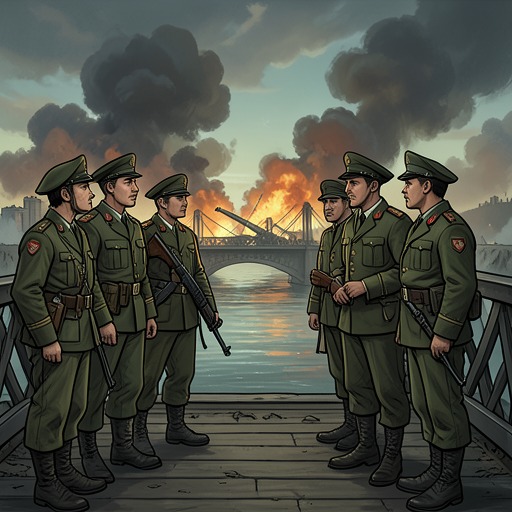
When he hears a truck approaching, Robert Jordan pays out the wire across the bridge and pulls it taut from the road. He calls to Anselmo to set off the charge. The center of the bridge lifts in the blast, then settles as fragments of steel rain down. Afterward, the missing middle section leaves the stream visible through the torn opening; jagged, bright-edged steel is scattered across the roadway. The truck stops about a hundred yards away, and its driver and two passengers run toward a culvert.
The blast has also killed men on the Republican side. Fernando is still breathing when Robert Jordan looks toward him, but Anselmo lies dead behind a white roadside marker, the wire still looped around his fist. Robert Jordan checks him and recognizes that he is dead without turning him over to inspect the wound. The shattered crossing thus records not just the intended destruction of the road but the cost paid by the men who carried out the task.
Consequences and meaning
After the explosion, Pilar reminds Robert Jordan that the bridge is blown. His answer—that he forgets nothing—sits beside the immediate burden of tending to the survivors and registering the dead. Later, as aircraft pass overhead, he looks down at the wreck and sees the stream through the gap where the center section has fallen. The bridge is visibly destroyed, but the gunfire below has been going on since before the blast, and the planes are now bombing farther up at the pass. The demolition does not silence the battle or resolve the wider danger.
The broken span also gives physical form to the mission’s tension between a successful act and an uncertain strategic result. The road is blocked as ordered, yet the offensive’s prospects are compromised by late intelligence, doubts about enemy movements, and the fixed command structure that makes cancellation difficult. In the final image of the bridge, the crossing is neither intact nor simply erased: its center hangs as torn steel over the stream, a road severed by deliberate action and a battlefield consequence that cannot be separated from the lives lost beside it.