The massacre crowd’s drunkenness and moral breakdown
For Whom the Bell TollsThe massacre crowd’s drunkenness and moral breakdown marks the collapse of an attempted political execution into uncontrolled collective violence. In Pilar’s account, an operation initially arranged by Pablo as an orderly act against the village’s fascists becomes a drunken mob’s assault, exposing how quickly a claim of shared responsibility can be overtaken by cruelty, spectacle, and disorder.
Organization and Intended Order
Pablo had planned the seizure of the fascists and the assault on the Civil Guard barracks together. Before attacking the barracks, he arranged for the fascists to be taken from their homes, preventing them from striking his group from the rear or flanks. In the plaza, street entrances were blocked with carts, and the captives were held in the Ayuntamiento. The arrangement made the square resemble a space prepared for a public bullfight, but its purpose was the execution of political opponents.
The earlier execution of four surrendered Civil Guards supplied a grim contrast to what followed. They knelt against a wall and Pablo shot them one by one; Pilar describes the killings as ugly, but without the cruelty that later overtook the plaza. Her distinction is not an absolution: she understood the shootings as a necessity in the struggle to preserve the Republic, while still recognizing their moral weight. The later crowd would exceed even this already grave standard.
Liquor, Mockery, and the Breakdown of Restraint
After the executions began, liquor taken from the fascists’ club circulated among the crowd. Bottles of anis and cognac were passed around, while others drank from leather wineskins; people who had not initially been drunk began drinking after the emotional intensity of the killings. The crowd’s conduct shifted as intoxication and excitement fed each other. A man summarized the atmosphere as a thirst caused by killing, while the drinking became part of the violence’s social momentum rather than a pause from it.
The attack on Don Guillermo Martin shows how that change swept aside distinctions among the targets. He was a fascist, but Pilar says there was otherwise little against him: he had sold the flails used in the executions, and his habits at the club did not, in her judgment, warrant death. She believed he might have been allowed to leave had the insults, earlier spectacle, and drinking not altered the crowd. When a drunkard imitated his wife’s voice, Don Guillermo rushed toward him in tears and was beaten by the crowd. Some villagers left their places in the execution lines after this, a visible protest against the proceedings; the vacated spaces were taken by jeering drunkards.
Pilar’s own response changes with the scene. She had initially accepted Pablo’s organization and believed that, if the fascists were to be executed, the people should share responsibility. She hoped to share in the benefits of the town’s victory as well as its guilt. After Don Guillermo’s death and the arrival of the drunkards in the lines, she felt shame and disgust, withdrew from the square’s organized formation, and sat beneath a tree. The episode thus distinguishes participation chosen as political responsibility from participation engulfed by an increasingly uncontrolled crowd.
From Lines to Mob
The formation continued to dissolve. In the arcade, two men lay on their backs, passing a bottle between them and shouting slogans for anarchy and liberty. A peasant dismissed their cries as drunkenness rather than belief, and another said they understood and believed in nothing. Their slogans, detached from discipline or purpose, underline the gulf between revolutionary language and the conduct unfolding around them.
When Don Anastasio Rivas was pushed out of the Ayuntamiento, the crowd did not allow him to join the lines. It surged toward him together, and after he fell, the people piled over him until he was dead. Pilar describes what remained not as a line of participants but as a mob. The distinction is decisive: the planned arrangement had depended on collective structure, but the crowd’s shared movement now produced an attack that no longer followed the procedure Pablo had set in motion.
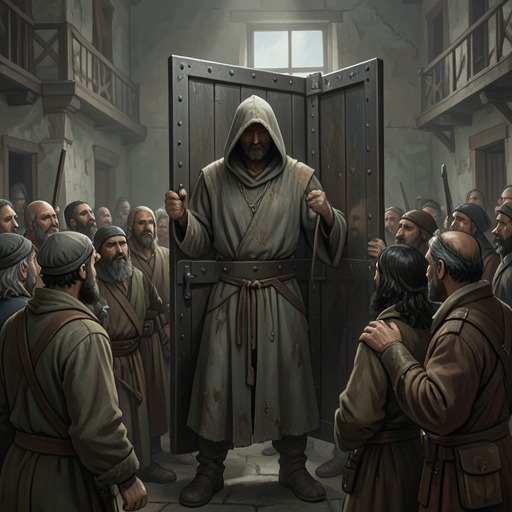
The pressure then turned toward the Ayuntamiento, where the remaining prisoners were inside. The mob shouted for the doors to be opened, while Pablo sat in the hall and appeared not to respond to the noise. Some villagers pressed forward to enter and finish the killings. Pilar, standing on a chair to see through a barred window, witnessed the crowd’s assault inside; she was knocked down when the chair broke and could see people pressing through the doorway. Her account presents the interior violence as an extension of the same loss of restraint, not as a restoration of the orderly lines.
Aftermath and Moral Significance
The violence did not end with the crowd’s assault. A drunken man poured liquid over Don Anastasio and tried to light it; another man struck him with a flail, after which he lay beside the victim without getting up. Don Anastasio and the other dead were later placed in a cart and taken to the cliff, where they were thrown over that evening after the Ayuntamiento had been cleared. Pilar’s account of the aftermath includes her retrospective judgment that the town would have been better served had the most disruptive drunkards been removed at the beginning, though she emphasizes that the participants did not understand the danger at the time.
The disorder also had an immediate political consequence: there was too much drunkenness to hold the planned meeting that night, so it was postponed until the next day. The uprising’s attempt to organize a new order was interrupted by the violence carried out in its name. Pilar’s memory of the scene therefore sets revolutionary necessity against excess and shows how the claim that everyone should share guilt can become a cover for brutality once the group’s restraints fail.
The episode resonates with the novel’s wider moral debate about killing. Anselmo regards killing even an enemy as sinful and imagines teaching opponents through shared labor rather than execution; Robert Jordan, by contrast, treats killing as a necessity of war. Pilar occupies neither position without qualification: she can accept killing as necessary to preserve the Republic, yet recoil when an organized act turns cruel and indiscriminate. Later, Robert Jordan reflects on atrocities committed by both sides, but his thought that one side acted deliberately prevents him from dissolving the difference between them. The crowd’s breakdown gives those tensions a concrete form: political purpose may explain violence, but it does not erase the moral consequences of how people carry it out.