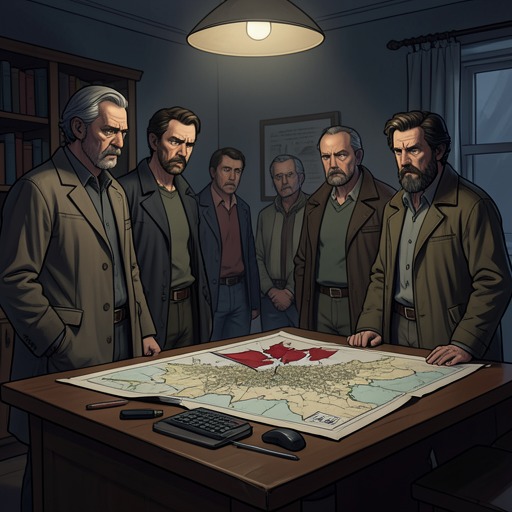
Thirty-Fifth Division
For Whom the Bell TollsThe Thirty-Fifth Division, commanded by General Golz, is the formation whose attack gives Robert Jordan’s bridge-demolition mission its timing and purpose. Its operation is meant to break through the ridges beyond the pass, but the novel shows the division’s plans colliding with restricted authority, uncertain intelligence, and a changing battlefield.
Command and Operational Role
At the pass, Captain Gomez identifies himself as an officer of the Sixty-Fifth Brigade and asks a sentry for the headquarters of General Golz, commander of the Thirty-Fifth Division. The exchange places the division within a larger chain of command: even an officer carrying an urgent safe-conduct must locate the right headquarters before he can deliver his business. The scene makes the division’s command structure tangible not as an abstract label but as a route through guarded doors and dispersed offices.
Golz’s attack is the condition on which Jordan’s demolition order depends. The bridge is to be blown only after the attack begins, so that reinforcements cannot advance along the road. The timing is therefore exacting: Jordan must wait for an offensive whose start he does not control, then destroy a key crossing before enemy movement can exploit it. The bridge’s single steel span over a deep gorge makes it a clear physical choke point, but the operation’s success depends on coordination beyond the demolition team.
Preparations and Constraints
Golz describes the limits on his command: he makes the attacks, but the artillery is not his to allocate, and requests are not reliably fulfilled even when the equipment exists. He warns Jordan that interference is a persistent feature of the operation. The division’s authority is thus real but incomplete; the plan depends on resources and decisions controlled elsewhere.
The offensive’s timing also constrains what information can be acted upon. Jordan worries that the enemy has moved matériel into position to meet the attack, but those preparations began only at dark, when movement was less likely to be spotted by aircraft. He recognizes that he should have warned Golz sooner, yet the preparations were not visible earlier. His concern broadens to the possibility of another Italian offensive and the uncertainty of whether reported concentrations are a genuine threat or a bluff. The division’s plan is therefore shaped by intelligence that arrives late and cannot settle what the enemy intends.
The distinction between planning and execution recurs in the division’s movements on the mountain road. Anselmo, keeping count of traffic, marks a camouflaged Rolls-Royce passing uphill but does not recognize it as a General Staff car. He records the vehicle as one of ten going up that day, alongside six that have come down and four still expected. The detail exposes an intelligence gap: the traffic count is accurate, but the observer lacks the knowledge to distinguish ordinary divisional vehicles from those of higher command.
Attack and Battlefield Reality
As daylight comes, Golz watches the division’s aircraft approach in formation. He takes pride in the planes, which have been transported from the Black Sea, assembled at Alicante, tested, and sent into action. In his envisioned sequence, the bombers strike the ridges, tanks advance up the slopes, and his two brigades follow through the breach. The plan is coherent in its stages and depends on surprise; Golz imagines the troops moving beyond the ridges if each part of the operation works as intended.
That confidence is shadowed by his admission that the attack cannot simply be cancelled at his own discretion: permission must come from Madrid. Jordan, meanwhile, fears that the preparations made to meet the offensive have compromised its advantage and wonders whether warning can still reach the command in time. The planes’ arrival offers a powerful image of the division’s intended strength, but it does not erase the uncertainty about surprise, authority, or coordination. The Thirty-Fifth Division’s story in the novel is consequently one of organized military capacity under pressure from the very systems and circumstances that its plan must depend on.