Ivan Gross's post-stroke condition
Forever...Ivan Gross's post-stroke condition is presented through concrete limits and continuities: he walks with a cane and struggles to find words, has stopped handling legal cases, yet still goes to the office every day. His condition alters how he moves and works without removing him from the routines and relationships that define his life.
Effects on Work and Daily Life
Ivan Gross and Hallie Gross practice law together in New York City. Since his stroke, he has no longer handled cases, but he continues to go to the office daily. The contrast is important: his professional role has narrowed, while his habit of showing up remains. The account gives no suggestion that recovery or a return to casework is expected; instead, it marks both the change in his responsibilities and the persistence of his ordinary routine.
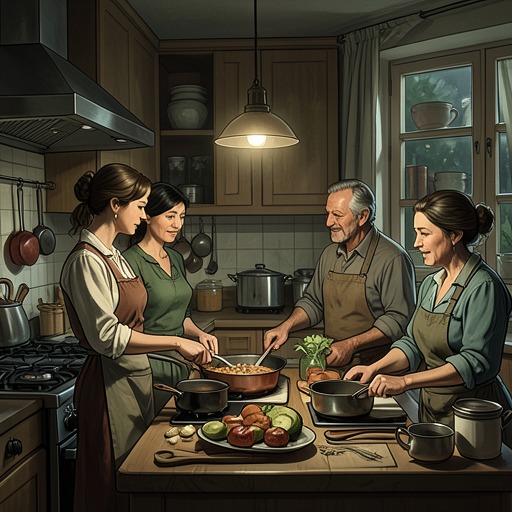
At home, his physical and communicative difficulties appear in small, recognizable actions. He walks with a cane and sometimes cannot get the words he wants. During the family’s cooking, he wanders into the kitchen, lifts the lids from pots, and sniffs inside. The gesture places him within the household’s activity even as his stroke makes other kinds of participation harder.
Family Responses
Katherine's mother was very close to Ivan Gross while growing up, and watching him struggle to finish even a simple sentence is painful for her. She finds it hard not to supply the words he cannot readily produce. Hallie Gross, by contrast, treats him as she always has, as though nothing were wrong. Their differing responses show how the effects of the stroke are lived not only by Ivan Gross but also by the people around him: one daughter feels the visible loss keenly, while his wife’s familiar manner preserves continuity in their interaction.
The condition also reshapes Katherine’s understanding of old age. As a child, she feared the elderly people she encountered and felt relief when her maternal grandmother died because the family no longer had to visit the place that frightened her. Later, when Ivan Gross became ill and she visited him in the hospital, she recognized that he, too, was old, but her love for him meant she was not afraid. She connects that recognition to her request to work in geriatrics. His illness thus becomes part of the experience through which she distinguishes fear of old age from care for an older person she loves.
Presence and Significance
The text does not reduce Ivan Gross to the stroke’s impairments. It records difficulty plainly—his cane, his halting speech, and the cases he no longer handles—while also showing him continuing to attend the office, entering the kitchen, and remaining central to his family’s emotional life. These ordinary actions keep the condition from becoming only a medical description: they show how changed capacities coexist with ongoing participation and affection.
At a family table, Hallie Gross says that Katherine glows, and Ivan Gross answers slowly, "To me, Katherine always glows," before raising his glass to love. The line makes his slower speech part of the moment without making it the moment’s whole meaning. His condition is present in the measured delivery; so are his warmth and attention to Katherine. Across these scenes, the stroke marks a real change in his abilities, but the novel also insists on what remains recognizable in him.