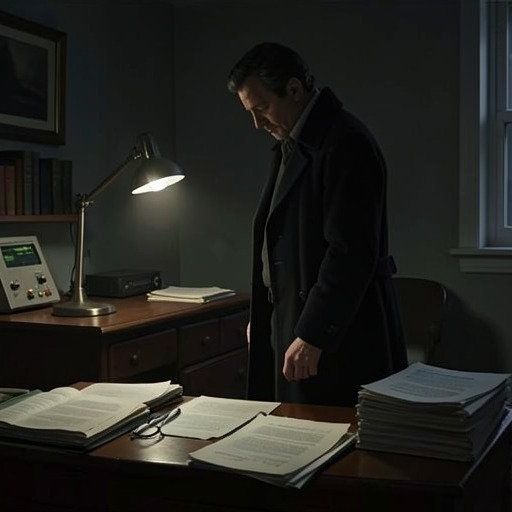
Ardenti’s briefcase
Foucault's PendulumArdenti’s briefcase is the portable archive that brings Colonel Ardenti’s supposed Templar Plan into the story—and then vanishes, leaving the characters to turn an absence into evidence. It carries a handwritten paper associated with Provins and a photocopy of Ardenti’s message, but neither the briefcase nor its contents can settle what is authentic, what has been copied, or what the papers mean. Its importance lies as much in that uncertainty as in the documents it contains.
The briefcase and Ardenti’s research
When Ardenti recounts his military career and his later work as a researcher, he produces a voluminous file from a leather briefcase. He describes years of writing up his findings, and his presentation connects the case with his attempt to turn those findings into a book about the Templars. The case is not just luggage: it is the container that makes his private research available to an audience, including Belbo and Casaubon.
Ardenti’s papers include a handwritten sheet he says he found among the books of the late Ingolf. He recalls noticing “Provins 1894” in its margin and concludes that Ingolf had brought the original parchment to Paris and that the sheet was a copy. Ardenti takes it without telling Mademoiselle Ingolf, then presents a photocopy of the message to his listeners, explaining that he does not want further wear to damage the original. The chain of custody is already uncertain: the paper was found in Ingolf’s book, interpreted by Ardenti as a copy of a lost original, and shown to the group in another reproduction.
Copies, originals, and interpretation
The question of what counts as an original becomes explicit when Casaubon points out that Ingolf’s paper was not the original parchment. Ardenti replies that when originals no longer exist, the last copy is the original. The exchange defines the evidentiary problem attached to the briefcase: the documents do not arrive as a secure, independently verified archive, but as layers of attribution and reproduction, accompanied by Ardenti’s own account of how he obtained them.
The message’s meaning is no more stable than its material history. Ardenti reads its dates and numerical references as indications of a Templar scheme extending from the medieval period into the twentieth century, but admits that he does not know what the plan was and suggests that it was never carried out. Belbo treats Ardenti as a possible mythomaniac, and Casaubon regards the story as one lunatic’s belief in another’s old tales. Yet the photocopy remains at the publishing office after Ardenti fails to appear for an appointment with another publisher. The text is thus detached from its claimant and left behind as an object others can inspect, doubt, or recast.
Disappearance and the police inquiry
After Ardenti’s disappearance, De Angelis asks what documents he had been carrying. Belbo recalls a brown briefcase; Casaubon remembers it as red. De Angelis cannot resolve the discrepancy and says that the case is no longer in the room. The visitors who searched the room may have taken it, he reasons, and he makes it the focus of the inquiry. Since money remained in Ardenti’s jacket, De Angelis concludes that money was not what the visitors sought. The missing case, rather than the unexplained cash, becomes the most concrete lead the witnesses can supply.
De Angelis proposes that Ardenti may have used his publishing offer to pressure Rakosky and that the briefcase might have contained material for blackmail. He also considers whether Ardenti was threatened and fled with the case, or whether he was killed and it was stolen. These remain competing hypotheses, not established facts. The case’s disappearance helps sustain the uncertainty surrounding Ardenti himself: no body or recovered archive resolves whether he escaped, was abducted, or was killed.
Narrative significance
The briefcase links a tangible object to a widening interpretive spiral. Ardenti’s papers encourage Casaubon to reread historical texts as encoded messages, while the Rosicrucian manifestoes later become, in his reading, a coded account of the same supposed Plan. He approaches them with mistrust, assuming a hidden grid because the texts appear contradictory. The briefcase’s documents therefore do more than offer clues: they help establish a method in which gaps, copies, and ambiguities invite further decoding.
That method has consequences beyond Ardenti’s episode. As the characters’ theory expands, the missing case and uncertain papers become part of a larger world in which identities and sources seem to confirm one another, even when their foundations remain doubtful. The briefcase is at once a carrier of supposed evidence and a reminder that the evidence reaches the characters through acts of selection, copying, concealment, and interpretation. Its disappearance leaves the archive unfinished—and makes the absence itself available for the Plan to absorb.