Casaubon
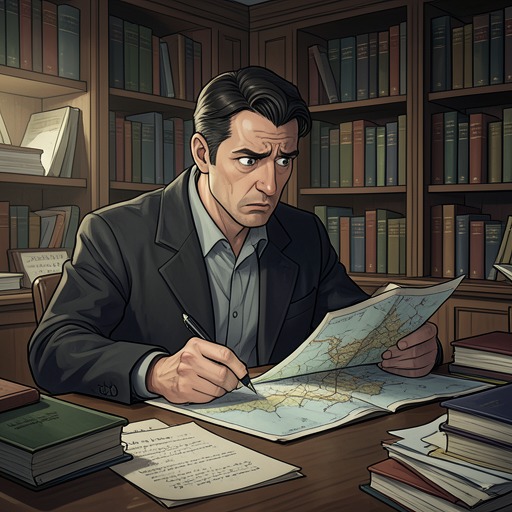
Foucault's PendulumCasaubon is the narrator and interpretive center of Foucault’s Pendulum, a historian whose study of the Knights Templar begins in a commitment to documents and ends amid a conspiracy he knows is fabricated yet can no longer escape. His career as a researcher, his collaboration with Jacopo Belbo and Diotallevi, and his relationship with Lia trace the gradual entanglement of skepticism, imaginative pattern-making, and fear. By the end, he understands that the Plan has no underlying message, but the knowledge does not free him from those who believe he possesses its secret.
Identity and Historical Formation
Casaubon first approaches the Templars as a subject for medieval history. While working on his thesis, he resolves to confine himself to what can be documented rather than what rests on opinion. The order’s history initially provokes political indignation: he sees its members as having been condemned on evidence that could scarcely be called conclusive. But his research also teaches him to distrust the occult enthusiasts who continued to search for the Templars after their execution, claiming their survival without proof. His position is initially uncompromising: if the Church dissolved the order, then the historical Templars could no longer exist; anyone claiming that they did must mean something other than the original order.
That thesis brings Casaubon into contact with Jacopo Belbo at Pilade’s in 1972. He produces 250 typed pages on the Templar trial and assembles a bibliography of more than a hundred books, although he ultimately reads only about thirty. The discrepancy between his substantial scholarly work and his selective reading suggests a practical, imperfect researcher rather than an all-knowing authority. More importantly, the subject that first gives him a defensible historical method also becomes the route by which he encounters the Plan and the very secret-hunting outlook he once rejected.
Work, the Plan, and the Growth of Paranoia
Casaubon’s professional life develops around the collection and connection of information. After returning from Brazil, he recognizes that he can turn his learning into a cultural investigation business, acting as a private investigator of obscure references. He imagines answering translators’ questions by searching libraries and following bibliographical clues. In practice, he accumulates cross-referenced index cards, linking one subject to another through chains of association. His rule is that no piece of information is superior to any other: the power lies in keeping everything and discovering connections. That method is useful for research, but it also contains the mechanism by which a pattern can be found almost anywhere if the searcher is determined enough.
After about two years in business, Casaubon is pleased with his work and is enjoying himself. He has also met Lia. Yet his informational habits become more consequential when he and Belbo begin working with material that can be arranged into a hidden historical design. At first, Casaubon’s involvement in the Plan seems contingent: he later reflects that he could have been elsewhere on the day he was in Belbo’s office, but insists that the fact of his presence has made him what he is. The Plan enters his life through an encounter that appears accidental and acquires significance retrospectively, as if coincidence itself were evidence.
Casaubon helps construct the historical connections by searching his files. When the group considers a supposed failed meeting between English and French Templars in 1584, he finds that England and France were using different calendar dates. He proposes that the difference could explain how the two sides missed one another, and extends the chain through John Dee’s work on calendar reform and his later associations. The chain is presented as a discovery made through diligent research, but its power depends on treating a plausible connection as confirmation of a larger story. The episode reveals both Casaubon’s genuine skill at finding historical context and the danger of applying that skill without a reliable test for when a connection is merely suggestive.
Belbo, meanwhile, develops a richer private narrative than he admits to his collaborators. Casaubon later realizes that Belbo was writing extensively in Abulafia, combining quotations and personal myths while presenting only a bare outline of his ideas to the others. Belbo did not tell them that he was using their work to test his own talent for fiction, or to place himself within a larger story he was reshaping. Casaubon’s later knowledge therefore complicates his earlier impression that the Plan arose simply from shared research: one of its central participants was secretly making a literary work out of the material.
The danger becomes immediate when Belbo calls from Paris, speaks urgently, and says that the Plan is real and that the Templars are after him. He believes they have tricked him into coming to Paris because they think he has the map, and says they expect him at the Conservatoire at midnight on Saint John’s Eve. Belbo tells Casaubon to keep the police out of it and directs him to read the files on his computer, including everything that has happened over the previous month. Casaubon is thus drawn from researcher and collaborator into the role of a witness trying to reconstruct what happened to Belbo. In the museum after dark, he tries to steady himself by treating its noises as ordinary signs of an old building, while recognizing that he is there to learn how a man who had spent his life running away tried to stop.
Relationships and Competing Grounds in Reality
Casaubon’s relationship with Lia supplies a life outside the system of historical clues. In Brazil, he meets Amparo, whom he describes as beautiful, Marxist, Brazilian, enthusiastic, and disenchanted. Their relationship places him in a world he experiences as politically and culturally charged; on returning to Italy, he feels that he hardly knows who he is and reflects on how distant he had been from events at home. His later memories of Amparo also become a point of comparison when he tries to distinguish an experience that may have had a real effect from the explanation attached to it.
Casaubon eventually meets Lia and becomes her partner and the father of their child, whom they initially call the Thing. As Lia’s pregnancy comes to term, he neglects the Plan when he can and stays with her. He wants to participate in the birth rather than wait outside as a detached onlooker, but Lia reminds him that the decisive work will be hers. She declines to learn the baby’s sex in advance, preferring surprise. These domestic details contrast with the Plan’s appetite for advance explanation: the child is allowed to remain unknown until birth, while Casaubon’s conspiracy-minded research repeatedly tries to make the unknown fit an existing pattern.
After the birth, Lia struggles with the responsibility of caring for the baby and cries that she will never manage. Casaubon stays home with her, aware that he cannot breast-feed and is not qualified to take over that work. During the same period, he spends long hours reading about telluric currents. The scene places two kinds of attention side by side: practical care for Lia and the child, and renewed absorption in occult explanations. His presence at home does not end his search for hidden systems; it runs alongside it, making the contrast between intimate life and abstract speculation sharper.
Skepticism, Interpretation, and the Confession of Error
Casaubon’s narration is marked by an ongoing argument with his own explanations. At one point he recalls his earlier sense of being displaced and his pursuit of an ideal moment of moral choice, questioning whether he had avoided conflict because of cowardice or because it did not belong to his generation. This self-scrutiny resembles his historical method in one respect: he tries to examine the evidence for his own conduct. Yet he is also capable of turning a lack of action into a story about missed opportunities, showing how the urge to interpret reaches beyond the Templars and into his account of himself.
His final reassessment gives Lia’s reading of the Provins message decisive authority. He accepts that she has correctly identified it as a laundry list: there were no Templar meetings at the Grange-aux-Dîmes, no Plan, and no message. He explains how he and the others transformed the list into a puzzle by crossing concepts and events rather than words. Their first rule is to connect concepts by analogy, on the assumption that almost anything can be linked to anything else. Once the method is made explicit, the Plan’s apparent coherence becomes evidence not of a secret organization but of the ingenuity and appetite of its interpreters.
The distinction matters because Casaubon does not simply dismiss every experience that fed the conspiracy. He considers the possibility that something happened during the ceremony at Saint-Martin-des-Champs even if his confused understanding of it was unreliable. He recalls a comparable distinction in Amparo’s experience: she did not accept that she had been possessed by Pomba Gira, yet knew that something had affected her at the Umbanda gathering. Casaubon can therefore separate an event from the explanation placed upon it, but he does not consistently manage to keep that distinction steady when fear takes over.
Ending and Narrative Significance
Casaubon ends in hiding, convinced that the people he calls “They” are searching for him and believe he possesses the map. His rational conclusion that there was no Plan does not dissolve his fear; he expects that telling his pursuers there is no map will only make them want it more. He also recognizes that his own behavior has been shaped by the very pattern he now rejects: the Plan had been made to explain the dinosaurs and the peaches, to turn what could be encountered directly into a system that promised hidden meaning.
His thoughts turn to Lia and their child, Giulio, whom he calls his philosopher’s stone. Casaubon imagines that the boy may find a small, immediate paradise in ordinary things, as he once found a sense of the Kingdom in a peach. The contrast offers a possible alternative to interpretive mastery: not a new secret to decode, but an experience that does not require the Plan. Still, Casaubon cannot return to the secure domestic world he longs for. His final recognition—that there may be nothing to understand—coexists with the fear that others will continue to demand a revelation from him. As narrator, he is both the analyst who exposes the Plan’s construction and the man whose own habits of connection have made it difficult to escape.