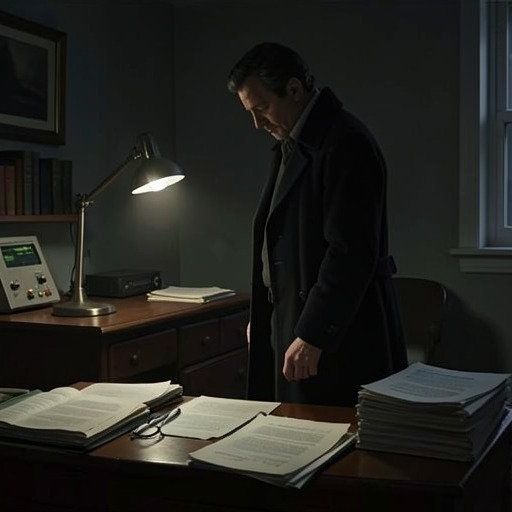
Colonel Ardenti
Foucault's PendulumColonel Ardenti enters as a decorated soldier, a collector of Templar lore, and a practiced storyteller whose identity proves as unreliable as the historical mystery he brings to Jacopo Belbo and Casaubon. The police later identify him as a fugitive collaborator and suspected fraudster, turning his apparent authority into a warning about how readily a persuasive narrative can disguise its source.
Identity and Introduction
Ardenti introduces himself to Belbo with a handshake and gives only a nod to Casaubon, whom Belbo presents as an assistant. He is dressed in a blue civilian suit, white shirt, and pearl-gray tie, but his appearance carries the theatrical traces of a military past: slicked-back black hair, a bald crown crossed by fine strands, a tanned and deeply marked face, and a thin scar running from lip to ear through his mustache. His polished presentation suggests authority while inviting scrutiny of the story behind it.
When Belbo asks whether he is still on active service, Ardenti calls himself retired, or perhaps in the reserves, and insists that he is older than he looks. He claims to have fought in four wars. His account gives that claim a carefully shaped chronology, presenting each reversal as another chapter in a life of service and defeat.
Military Past and Self-Presentation
Ardenti says he began as a volunteer lieutenant in Ethiopia, became a volunteer captain in Spain, and later served as a major in Africa before the abandonment of the colonies. He cites a Silver Medal, then describes choosing the losing side in 1943 and losing everything except his honor. He says that he began again in the ranks of the Foreign Legion, rose to sergeant in 1946 and colonel in 1958 under Massu, and retired after De Gaulle’s leftists took over.
The military résumé doubles as a performance of principled misfortune. Ardenti repeatedly casts himself as a man who backs losing causes, then contrasts that history with the apparent success of his later business life. After moving to France, he says, he established an import-export firm in Marseilles with friends he had made in Algiers. He now has an independent income and can pursue his hobby: research whose results he has written up over several years.
The Templar Research
To support his scholarly presentation, Ardenti produces a voluminous file from a leather briefcase. Belbo guesses that it is a book about the Templars. When Ardenti later presents a photocopy of a text, he says that he wants to spare the original further wear, not that he distrusts the others. Casaubon points out that the copy he had seen belonged to Ingolf and that the parchment was the original. Ardenti answers that when originals no longer exist, the last copy is the original.
That exchange condenses the uncertainty at the heart of Ardenti’s material. The file appears to promise access to a hidden historical design, yet the status of its text depends on a chain of copies and on Ardenti’s own account of what counts as an original. His assurance is both a defense of the document and a demonstration of how easily claims about evidence can shift under examination.
Aliases, Fraud, and Narrative Role
De Angelis later tells Casaubon and Belbo that Ardenti was not the visitor’s real name, although he possessed a legitimate French passport. Police had tentatively identified him as Captain Arcoveggi, who had been sentenced to death in absentia in 1945 for collaboration with the SS; De Angelis says that he sent people to Dachau. In France, Ardenti had also been tried for fraud and narrowly escaped conviction.
The police suspect that Ardenti had at one point used the name Fassotti. Under that identity, he allegedly persuaded a small industrialist in Peschiera Borromeo that the legendary Fascist gold reserve of Dongo remained at the bottom of Lake Como. Fassotti claimed to have located it and asked for several tens of millions of lire to hire divers and obtain a powerboat; after receiving the money, he disappeared. De Angelis presents the identification as an idea rather than a certainty, preserving some ambiguity even as the pattern of aliases and alleged deception undermines Ardenti’s self-portrait.
Ardenti’s Templar dossier thus arrives attached to a speaker whose own history is assembled from declared service, concealed identity, and suspected invention. His role is not simply to introduce a mystery but to make the reliability of its messenger part of the mystery: the reader must weigh the allure of a grand historical explanation against the compromised and shifting credentials of the man offering it.