Conservatoire ritual and Belbo's death
Foucault's PendulumThe Conservatoire ritual and Belbo's death bring the novel’s fabricated historical Plan into a deadly present: an assembly seeking confirmation of its beliefs ends with Lorenza dead and Belbo hanged by the Pendulum. The sequence turns symbolic interpretation into physical violence, while Casaubon’s escape and later discoveries leave the event suspended between the conspirators’ explanation and Belbo’s own long-standing imagination of the Pendulum.
The ritual’s demand for an answer
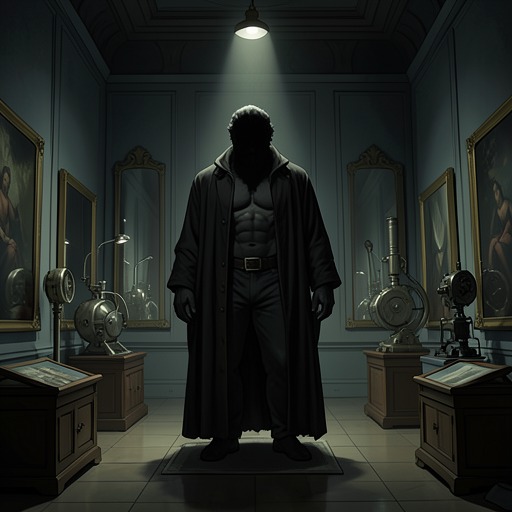
The gathering takes place in the Conservatoire, before the Pendulum and among an assembly divided between initiates and the faithful. Aglie leads Lorenza into the ritual space, where she appears dazed and is brought to the brazier. He then addresses the gathering: its members have been summoned because, after six hundred years of error, they have found someone who knows. The meeting, he says, should have occurred on June 23, 1945, and he calls on Colonel Ardenti to explain what the prisoner claimed to have learned from him. Ardenti steps forward, but the Pendulum marks a boundary between him and the others. The ritual is thus also an improvised inquiry, with the group treating its own elaborate history as a mystery that can be solved by questioning a supposed witness.
The assembly’s costumes, titles, and ceremonial language give its claims an air of authority, but the scene’s central action is an attempt to make a captive account for the Plan. The Pendulum stands at the center of both the ceremony and its supposed system of knowledge. Its presence appears to organize the gathering; before long, its actual movement will determine the outcome in ways no ritual formula controls.
Lorenza intervenes
As the crowd presses toward Belbo, Lorenza breaks away from the men holding her and steps in front of him with her arms open, attempting to stop the assembly. She protests that the gathered people cannot do this. Her intervention interrupts the ritual’s division between observers, officials, and victim: rather than remain part of the ceremonial display, she acts directly to shield Belbo.
Aglie moves to restrain her. Madame Olcott attacks him, knocking him aside, and Pierre rushes at Lorenza with the dagger he carries. The narrator does not see the blow itself; when Pierre moves away, Lorenza is lying at Belbo’s feet, and Pierre declares that the human sacrifice has been accomplished. Her death is not the planned, orderly culmination of the rite so much as the result of a sudden struggle within the crowd. Yet the participants immediately absorb it into the ceremony’s language, treating the violence as confirmation of what they came to enact.
Belbo’s death and the Pendulum
In the turmoil, the acolytes push into the circle around the Pendulum. Someone, whom Casaubon thinks may be Ardenti, is thrown against the table supporting Belbo. The table slides away, and the Pendulum begins to swing violently. Its wire tightens around Belbo’s neck and lifts him into the air; the sphere’s oscillation carries him across the choir. The group’s attempt to force an answer has now produced a death that the narrator witnesses from within the crowd.
The movement of the Pendulum transforms the scene into a terrible image of the Plan’s power over its makers. The crowd retreats to the edges of the space to watch, and the person managing the oscillation pushes Belbo’s body, prolonging the motion. Casaubon describes the configuration as a pattern traced in the air, with the sphere, the wire, and Belbo’s body moving in related but distinct arcs. What the assembly treats as a supernatural sign is also a mechanical event set in motion when the table is displaced. The novel makes the distinction consequential without making it simple: physical causation explains the swing, but not the beliefs and decisions that brought Belbo beneath it.
Escape and retrospective meaning
Amid the confusion, Casaubon reaches the open pedestal of the statue of Gramme, climbs down a narrow ladder, and follows a spiral stone staircase into a sewer. He chooses the largest conduit rather than the darker branches, and understands his movement away from the Conservatoire as an escape from its enclosed world. He leaves carrying a single image: the figure made by Belbo’s body in the choir. At the time, he cannot identify what the image signifies.
Later, at Belbo’s country house, Casaubon finds a letter answering a question about how a Pendulum would behave if a second weight were hung at another point along its wire. He infers that Belbo had been thinking about the Pendulum’s possible motion for a long time, imagining it as both Sinai and Calvary. This discovery does not make the ritual’s claims true or establish that Belbo planned his death. Instead, it complicates the apparent division between an invented Plan and an accidental catastrophe: Belbo had mentally rehearsed a configuration that became real through the crowd’s violence, though he had done so without knowing that his imagination might anticipate the event.
Earlier histories of courage and belief
The Conservatoire scene is shadowed by earlier episodes in which Casaubon and Belbo confront action, political commitment, and the temptation to interpret experience through a pattern. At a Milan march against fascist conspiracies, Casaubon attends but stays at the edge rather than joining a group. He later questions whether he avoided danger because the conflict did not belong to his generation, and whether he wanted to test himself against an imagined decisive moment. His reflections give the final gathering a history of missed opportunities and retrospective self-judgment: the desire to know what one would have done is not the same as having acted when the opportunity arrived.
Belbo’s wartime memories offer a related contrast. He recalls a period when political sides seemed clearly marked and a bullet was simply a bullet, unlike the equivocal disappearance of Colonel Ardenti. Yet Casaubon recognizes that Belbo had also been a spectator, watching other people make history. The assembly at the Conservatoire tries to replace that uncertainty with a master explanation spanning centuries. Its fatal end exposes the cost of treating an interpretation as a certainty that authorizes action. Belbo dies in the very symbolic structure the conspirators have assembled, while Casaubon’s later account preserves both the ordinary physical mechanism of the death and the troubling fact that Belbo had imagined something like it before it occurred.