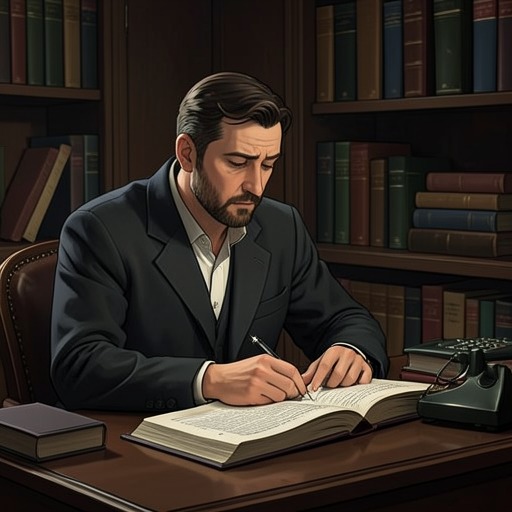
Dorn Tiko
Foucault's PendulumDon Tico, the bandmaster at the Salesian parish hall, shapes Jacopo Belbo’s childhood through music and a consequential act of instruction. He recognizes Belbo’s sense of rhythm and asks him to return to the bombardon, making him responsible for holding the band together; Belbo accepts the sacrifice, but never gets to play the trumpet he wanted.
Identity and Setting
Don Tico taught Belbo to play in the band at the Salesian parish hall, a building with a yard and soccer field that Belbo and his companions can see from the terrace. Belbo remembers the place as the setting of Mass, catechism, games, and the band’s rehearsals. He never learns whether “Tico” was the bandmaster’s surname or a nickname, and says he never returned to the parish hall.
The Band and Belbo’s Ambition
The band consisted of boys between ten and fourteen. Its younger members played toy clarinets, fifes, and soprano saxophones, while the older boys carried the tubas and bass drum. Their khaki tunics, blue trousers, and visored caps made the ensemble a dream to Belbo: he wanted to belong to it. Don Tico said the band needed a bombardon, so Belbo began on the bass horn rather than the trumpet he hoped to play.
The Sacrifice and Its Consequence
After a performance, Don Tico told Belbo that Annibale Cantalamessa and Pio Bo had spoiled the evening by losing time, joking, and missing their entrances. He described the bombardon as the band’s rhythmic conscience and soul, comparing the band to a flock: the instruments were sheep, the bandmaster their shepherd, and the bombardon the faithful, snarling dog that kept them together. Because Belbo had a good sense of rhythm, Don Tico asked him to return to the instrument and keep the two boys in time, promising that he could play trumpet once they managed on their own.
Belbo says he owed everything to Don Tico and agreed. At the next holy day, the trumpets stood and played the opening of “Good Start” before Cecilia, who was again in the front row; Belbo remained in the darkness among the bombardons. The two boys never learned to play independently, and Don Tico’s promised opportunity never came. After the war Belbo returned to the city, abandoned music, and never learned Cecilia’s last name.
Narrative Significance
Don Tico’s request turns Belbo’s musical longing into a story about service and deferred recognition. The bombardon is technically less showy than the trumpet, yet Don Tico makes it essential: it supplies the rhythm that allows the other instruments to succeed. Belbo accepts that supporting role out of gratitude, but the promise attached to it remains unfulfilled. Recounted years later as Belbo looks toward the parish hall, the episode gives concrete form to a pattern of desire redirected into the background, where the work matters but the hoped-for moment of visibility never arrives.