Foucault’s Pendulum
Foucault's PendulumFoucault’s Pendulum is both a working instrument in the Conservatoire and the physical center of the Plan that Casaubon, Jacopo Belbo, and Diotallevi construct. Its regular swing offers a genuine demonstration of natural law; the conspiratorial interpretation layered onto it turns that regularity into a supposed map to the world’s navel. When Casaubon encounters the Pendulum in the choir, his response marks a decisive change: he begins to believe that Belbo’s game may have disclosed a truth rather than merely invented one.
The instrument and its apparent certainty
The Pendulum hangs from a long wire fixed into the choir ceiling. Its sphere swings with an even, measured rhythm, and the period of its motion depends on the square root of the wire’s length and on pi. Casaubon perceives the mathematical relations as more than an explanation of motion: he imagines them as a conspiracy among point, plane, number, root, and circle, a harmony that binds the instrument’s visible movement to an encompassing order.
The motion is sustained by a magnetic device centered in the floor, which sends its command to a cylinder hidden inside the sphere. Rather than invalidating the Pendulum’s apparent constancy, the mechanism enables it to continue. Casaubon describes the ideal of perpetual oscillation in terms of a weightless, unstretchable wire, a vacuum, and the absence of air resistance and friction. The contrast between actual apparatus and ideal law becomes fertile ground for the Plan: a concealed mechanism can be made to seem not an ordinary explanation but the means by which a timeless principle manifests itself.
The Pendulum’s scientific operation is not erased by the characters’ mystical reading. It is precisely the instrument’s calculable movement that lends their reading its persuasive force. Its apparent stability stands against the flux of the world, while its motion supplies a material sign that can be assigned an ever-expanding significance.
Casaubon’s encounter in the choir
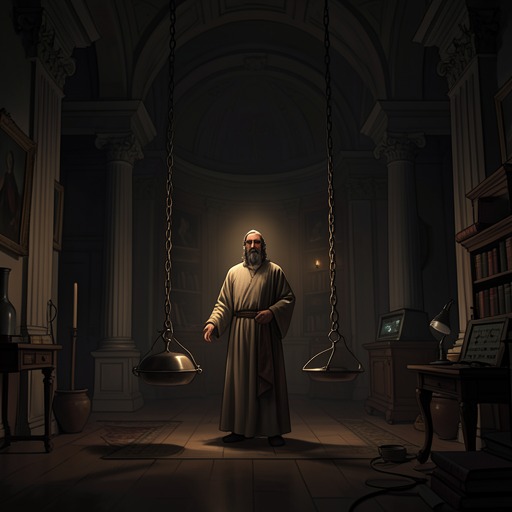
Casaubon first sees the Pendulum hanging in the choir, where the last sunlight glints on its copper sphere. He imagines what its tip could inscribe if it grazed damp sand spread across the floor: a slowly widening pattern, at once a radial figure, a star, a mystic rose, and a record of migrations across immense stretches of time and space. His vision links distant places and peoples, from Tasmania to Greenland and from Samoa to Novaya Zemlya, to the imagined center at Agarttha. The instrument becomes not merely something that moves, but a storyteller whose repeated trace compresses millennia into each measured swing.
The scene also places Casaubon’s revelation beside another visitor’s incomprehension. A woman dismisses the Pendulum as none of her concern, while Casaubon regards it as the one stable refuge from change and feels that the encounter demands reverence. He watches in fear and awe and concludes that Belbo was right about the instrument. What he had previously treated as aesthetic raving and as the product of a diseased imagination now appears to him as possible evidence. If Belbo understood the Pendulum, Casaubon reasons, perhaps the Plan and the Universal Plot are true as well. His conviction that he was right to come on the eve of the summer solstice makes the visit a turning point in his growing credulity.
The narrator later recognizes the danger implicit in that response: an experience of the numinous can unsettle the mind. Casaubon tries to redirect his attention to the vault and its architecture, but finds that admiring the structure while neglecting the Pendulum would be like drinking at the stream instead of at its source. The instrument has become the privileged point from which the whole setting seems to acquire meaning.
From physical motion to the Plan
The Pendulum enters the group’s reasoning through its location. Belbo points out that it is housed in the Conservatoire, an institution the characters connect to Francis Bacon and the House of Solomon described in New Atlantis. Casaubon objects that the instrument itself was installed only in the previous century and proposes that they leave it out of their historical reconstruction. Belbo resists this exclusion by comparing its shape to John Dee’s Monad Hieroglyph, a talisman said to concentrate the wisdom of the universe. The resemblance gives the group a bridge from an established symbol to a modern device, even though resemblance alone does not prove a historical connection.
Casaubon subsequently supplies the Pendulum with a function in the Plan. Drawing on a text about the hermetic secrets of cathedrals, he recounts a story in which builders at Chartres supposedly used a plumb line suspended from a vault’s keystone to infer the Earth’s rotation. The group incorporates that claim into a Templar history, recasting Galileo’s trial as an effort by supposed Templar infiltrators to silence someone who might reveal their secret before the Plan’s fulfillment. In this account, the instrument’s scientific associations become evidence within an invented political and historical narrative.
The group also associates the labyrinth beneath the Pendulum with a stylized image of subterranean currents. They interpret the labyrinth as a possible chart of telluric tides, connecting it to the Chartres labyrinth and to such images as a solar clock, compass card, vein system, and serpent’s trail. The Pendulum’s swing is thus made to point beyond itself toward an underground network that the Plan’s interpreters imagine running through the world.
The proposed locator of the world’s navel
The group’s most elaborate use for the Pendulum is as a device for locating the Umbilicus. Casaubon proposes replacing the abstract labyrinth on the floor with a map of the world: at a particular hour, the point touched by the Pendulum’s tip would mark the hidden center. Belbo immediately exposes a problem in this scheme. If the Pendulum’s swing crossed from Copenhagen to Cape Town at midnight, the map would not by itself determine whether the answer lay in Denmark or South Africa. The proposed sign needs a rule that tells the interpreters how to read it.
Casaubon answers by combining the Pendulum with a second sign: a ray of sunlight. He imagines a clear, uncolored spot in a choir window, preserved for centuries near the meeting of two lead cames, so that the first pure ray on a designated morning falls beneath the instrument. At the stroke of dawn on June 24, Saint John’s Day, the ray would intersect the Pendulum, and that point of intersection would identify the Umbilicus on the map. If clouds obscure the sun, the group’s imagined procedure simply waits until the next year. This elaborate solution makes the location depend not on the Pendulum alone but on the conjunction of place, hour, calendar, window, sunlight, and swing.
The scheme remains tied to Paris. Casaubon notes that the Pendulum’s cycle varies with location: in some regions it completes a circle in thirty-six hours, at the North Pole in twenty-four, and at the Equator the cycle does not vary with the season. A calculation devised at Saint-Martin-des-Champs therefore could not simply be transferred to Palestine. The characters treat the historical control of Saint-Martin-des-Champs, followed by the installation of the Pendulum there after Foucault’s experiments, as a chain of clues supporting their theory. Their proposed sequence is that a final meeting in Jerusalem would assemble a message, after which six groups would meet in Paris on the following June 23 to learn the Umbilicus’s location and set out to conquer the world.
Scientific instrument, conspiratorial sign
The Pendulum’s importance rests on a double status. It is an observable machine whose motion can be described mathematically, and it is a surface onto which the characters project a design encompassing secret societies, hidden geography, and world domination. The Plan does not need the instrument to cease being scientific; its factual regularity is what allows the speculative interpretation to feel compelling. A real mechanism is turned into a sign, and each additional association—Dee’s emblem, the labyrinth, the sunlit floor, the map—makes the sign appear to confirm the others.
That transformation also explains the instrument’s narrative force. Casaubon’s first reverence at the Pendulum prepares him to accept the larger conspiracy, while his later contribution to the locator mechanism shows how readily he can convert fragments of historical and architectural lore into a coherent apparatus. The Pendulum seems to promise a fixed point amid change, but the certainty it offers belongs to the interpreters’ constructed pattern. Its swing is real; the world-conquering message assigned to it is the Plan’s invention.