Hermetic interpretation and mystical correspondences
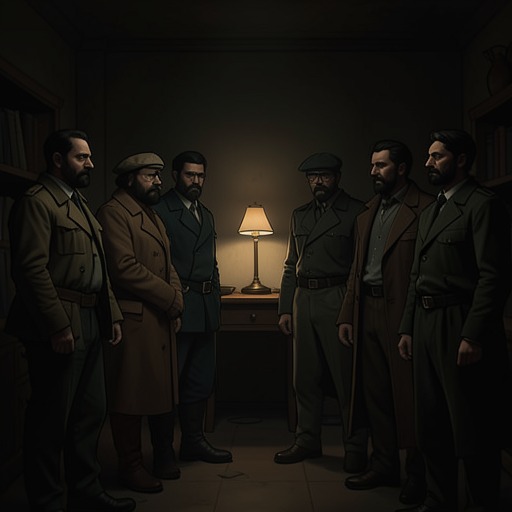
Foucault's PendulumHermetic interpretation and mystical correspondences are the novel’s name for a way of reading in which no fact remains merely itself: everything may point beyond its literal meaning toward a hidden order. The principle first offers a playful method for connecting disparate materials. Its danger is that it does not merely discover patterns; it trains its practitioners to suspect that patterns must be there, until constructed correspondences blur the distinction between metaphor and fact. The Plan becomes the extreme consequence: a nonexistent conspiracy that others recognize as real because it gives their scattered beliefs a shape.
From Templar Legend to Universal Connection
The method’s appeal is visible in the familiar story that a band of Templars escaped arrest in France in 1307 in an ox-drawn hay wain, reached Scotland, and entered a Masonic lodge at Kilwinning. The tale presents the supposed survival of the Templars as an explanation for the continuity of secret societies and their inherited guardianship of the secrets of the Temple of Solomon. The narrator dismisses this as a repeatedly copied story without foundation, comparing its logic to treating Puss in Boots’s claim to serve the Marquis de Carabas as proof that the marquis exists. A connection can be made to look like evidence when repetition substitutes for independent support.
The same interpretive reflex reaches far beyond Templar history. De Angelis explains that a secret society might plot to spread the rumor that a universal plot exists, while also offering a more ordinary account of conspiracy thinking: people blame hidden enemies for failures they cannot explain, and dictatorships need an external enemy to unite followers. The hermetic formulation that everything is connected therefore has a political counterpart. It converts confusion into a story of agency, with a concealed actor available to bear responsibility.
The narrator’s research into metals makes that conversion personal. While arranging illustrations, he sees a cylindrical stove, an egg-incubation chamber, and an athanor as variations on a maternal womb or dark uterus. Historical figures he had learned to regard as agents of scientific enlightenment appear to have worked both in laboratories and in occult traditions. He begins to distrust the very teachers who taught him to doubt, and catches himself admiring supposed numerical correspondences between the Great Pyramid and the Earth’s distance from the Sun, or parallels between Celtic and Amerind mythologies. Houses, shop signs, clouds, and library engravings all become candidates for a deeper story concealed beneath their surface.
The Practice Becomes a Habit
The change is not simply an argument the narrator accepts; it is a habit of attention. After imagining a car’s power train through the Tree of the Sefirot, he reports being prepared to see symbols in every object. Once suspicion has become the starting point, an ordinary object no longer needs to announce a meaning. The interpreter supplies the possibility of a second meaning and then searches for clues to confirm it.
Belbo states the operational principle: a fact becomes important when connected to another, because the connection changes its perspective and seems to disclose a Secret. The rule is to suspect, and even a traffic sign warning against littering can be made to carry a subtext. A driver’s manual accordingly turns into a possible metaphor of creation, with the dashboard as surface reality and the Tree of the Sefirot as the hidden structure beneath it. The example shows the method at work: the object is not discarded but recruited, its practical use retained as a veil for an imagined deeper message.
The group’s governing axiom makes the process deliberately limitless: if even one fact in the universe failed to reveal a mystery, hermetic thought would be violated. Casaubon adds that the Templars have something to do with everything. In this framework, refusing a connection becomes a failure of interpretation rather than a reasonable limit on it. Minnie Mouse can enter the system alongside theology and history, because the method has no category of fact that is simply irrelevant.
The narrator’s journey to Tomar marks a further turn. He had begun to reread the Provins message and earlier Templar material as a game of construction, but the real castle of the Portuguese Knights of Christ suddenly seems to supply the message’s missing location. Tomar becomes, in his inference, the first meeting place of a six-hundred-year Templar Plan, and he decides the document must be studied again. Yet he also recognizes the method’s premise: the object is not to discover the Templars’ secret, but to construct it. The insight does not stop the construction; it shows how consciously the search can make its own object.
From Compilation to Conviction
As the three investigators trade their fantasies, they initially understand that their associations are unwarranted and that they are parodying the Diabolicals’ reasoning. But the work of gathering material between their meetings changes them. They connect everything automatically, until the distinction between pretending to believe and believing becomes difficult to maintain. The narrator describes their differing degrees of involvement: he becomes addicted, Diotallevi corrupted, and Belbo converted. Their shared loss is the ability to tell the similar from the identical and the metaphorical from the real.
The narrator’s own experience reinforces that progression. He believes himself less affected because he remains close to Lia and their child, and thinks of himself as someone who controls emotion rather than being controlled by it. That confidence does not undo his earlier surrender to mystical correspondences: Lia temporarily draws him back toward ordinary life, while the surrounding interpretive practice continues to reshape what he notices. The book thus presents the habit as more than an eccentric theory. Repeated imaginative performance changes the interpreter, even when the performance began in irony.
The group’s most elaborate interpretation shows how far the method can reach. A repeated question about the wedding at Cana becomes, in their account, the key to a claim that Jesus was not crucified, that the Templars therefore rejected the Crucifix, and that Jesus—not the Grail—came to France among the cabalists of Provence. Jesus becomes a metaphor for the King of the World and the founder of the Rosicrucians; Mary Magdalene becomes his bride, and the marriage becomes a concealed explanation for the search by Illuminati for the eternal feminine. The narrative presents this as their interpretation, not as established history. Its internal connections are the product of compilation: each claim supplies a bridge to the next, while the resulting chain is mistaken for confirmation.
The Plan’s Rules and Its Social Reality
Lia’s later explanation makes the mechanics explicit. The Provins message is a laundry list, not evidence of Templar meetings or a genuine Plan. The group had treated it like a crossword puzzle, filling empty squares with concepts and events, but its connections followed rules unlike the shared letters of an actual crossword. First, concepts connect by analogy, and there is no immediate way to determine whether an analogy is good or bad because everything is connected to some degree. A chain can run from potato to apple, snake, doughnut, life preserver, bathing, sea, ship, and onward until it returns to potato. Second, if the chain ultimately holds together, the return is taken as confirmation. Third, the connections must not be original: prior repetition makes them seem obvious and therefore true.
Those rules turn association into a closed proof system. The analogies provide movement, the return to the starting point provides apparent closure, and familiar links lend borrowed authority. Because the method can absorb almost any subject and reinterpret disconfirming absence as a clue not yet understood, it is difficult to refute from inside its own terms. The accumulating web feels less like a hypothesis than a world in which every object has been assigned a place.
The Plan’s invention then acquires consequences beyond its inventors’ intentions. People seeking a place in history or a way to explain their beliefs encounter the Plan and recognize fragments of their own muddled mythology in it. The three have invented something nonexistent, but its readers decide that they have belonged to it all along. Once others act on the supposed design, the narrator observes, it exists in a consequential sense; those convinced by it begin searching for its map. The passage distinguishes a plan’s historical truth from its social force: fabrication does not become evidence, but belief can make the fabrication operative.
The Secret Without Content
The novel’s account of conspiracy explains why an all-encompassing design can feel necessary. Frustration encourages people to invent an enemy plot and then organize a counterplot; the imagined opponent can even collaborate by seeming to desire what the accuser attributes to it. A secret promises relief from uncertainty, or salvation through the mere possession of hidden knowledge. Yet the promised disclosure cannot satisfy that desire. Once revealed, the secret seems small, and another layer is immediately demanded.
The alternative is the empty secret: not a final piece of information but an endless sequence of significations, like an onion made entirely of peel. Initiation, in this account, consists in never stopping the process. A secret without content cannot be disproved by the failure to produce a decisive answer, because its value lies in remaining out of reach. This idea clarifies the nocturnal confrontation before the Pendulum. Belbo claims to possess a secret, and the others’ desire to extract it gives him power over them. The more he denies having it, the more convinced they become that it must be real; if it were false, they reason, he would disclose it.
The search for the secret has bound the seekers together despite excommunications, internal conflicts, and coups. At the moment when they seem close to learning it, they fear both disappointment and the end of secrecy itself. Aglie hopes that Belbo will whisper the secret to him alone, preserving his own aura as the immortal Saint-Germain; the postponement of Aglie’s symbolic death depends on the postponement of disclosure. The interpretive system therefore sustains itself not by solving the mystery but by keeping it alive. Its final irony is that the secret’s apparent power comes from having no verifiable content at all.