Liberation of Italy (1945)
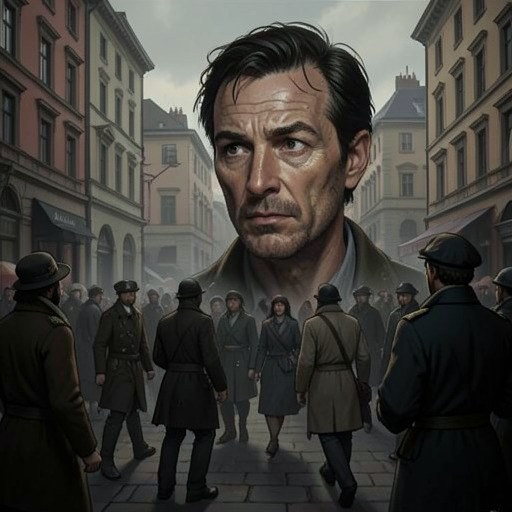
Foucault's PendulumThe Liberation of Italy in 1945 enters the novel through a local battle remembered by Jacopo Belbo and reconstructed by Casaubon. In the final spring of the war, partisan forces and Fascists are caught in a sudden clash in a town that had seemed to live by tacit boundaries and temporary accommodation. Belbo’s recollection makes liberation both a public historical turning point and a private test of courage: he takes part for an instant, but is pulled away before he can claim the choice as his own.
Background and the Gathering Forces
By the end of April 1945, German forces had been routed, the Fascists were scattering, and the unnamed town was firmly in partisan hands. After a final battle there, partisan brigades gathered and waited for a signal from Radio London before setting out for Milan, where an insurrection was expected. The chronology is presented through Belbo’s damaged text, which Casaubon says he is reconstructing rather than simply rereading.
The arriving forces were visibly distinct. The Garibaldi Brigades, commanded by the popular, black-bearded Ras, wore improvised uniforms with red kerchiefs and stars and carried whatever weapons they could obtain, including old shotguns and captured submachine guns. The Badoglio Brigades wore khaki uniforms and blue kerchiefs, carried new Sten guns, and received Allied supplies in nighttime parachute drops. Each evening for two years, a British reconnaissance plane called Pippetto had passed at eleven, though no one understood what it could be reconnoitering in a landscape without visible lights.
Belbo’s later account describes the local balance before the fighting. The partisans, local men who knew the fields, woods, hedgerows, passes, caves, and shelters, came down from the hills in spring; the Fascists, largely outsiders, stayed in town and ventured out on raids. In winter, snow and the exposed plain made it dangerous for partisans to remain below, so the Fascists regained control there. On the eve of liberation, the Fascists hesitated to return to the city, while the partisans held back, apparently expecting events to resolve matters soon. Radio London’s reassuring coded messages grew more frequent. The uneasy arrangement failed when the partisans came down before the Fascists had left.
The Battle in the House
The first signs of danger were mistaken for play. Belbo recalled that his sister came in from the terrace saying two armed men were playing tag. The family had already learned to treat gunplay as a familiar local hazard: on an earlier occasion, a bullet had struck a tree beside which his sister was leaning, apparently without her noticing. She was told to come indoors when men played with guns, and she returned to announce that they were playing again. This time, a volley followed.
The sound of the fighting escalated from shotguns to automatic rifles, possibly hand grenades, and finally machine guns. Belbo, his sister, and their mother crouched under the sink until his uncle Carlo crawled along the corridor to warn that they were too exposed and lead them to another wing. The family then sought shelter in a cellar among wine barrels. In the middle of the danger, Adeline Canepa—estranged from Belbo’s uncle for years—was treated as a human being again, and the two men shook hands. The emergency briefly displaced a longstanding division, though the old silence between them returned once the immediate danger had passed.
The outcome became clear by sound and a question from outside. As the gunfire faded, the family heard a partisan ask, in dialect, whether any supporters of the Italian Social Republic remained nearby. The Fascists had left; later, Belbo’s father and grandmother returned, while the partisans pursued fugitives toward the hills. The family understood that their side had won. The day’s danger had produced a decisive reversal, but the victory reached Belbo largely from the safety of the cellar and the house.
Belbo’s Moment of Action
Belbo described the day as the one heroic deed of his life, yet his memory resists a simple story of personal heroism. He had entered the action only briefly, risking a ricocheting bullet, before his uncle pulled him away. Belbo later recognized that he had not chosen freely: he had let his uncle remove him. The victory was real, but his own part in it seemed to him as momentary as an interruption in a film, when a figure wanders into the wrong story and is sent back out again.
The contrast reaches beyond the battle itself. Belbo remembered the town’s wartime days as sweet because they seemed to offer a truth unavailable in his later life: a bullet was a bullet, and one ducked or was hit; the opposing sides were marked in red and black; a corpse was unmistakably a corpse. During the later years in which he navigated the Diabolicals’ falsehoods and wrapped disillusion in fiction, this apparent moral and physical clarity became a private refuge. Casaubon sees that the memory’s sweetness does not mean Belbo had been an active maker of history. Even in those days, he had often watched other people’s memories—and the birth of histories he would not write.
Liberation as a Test of Courage
Casaubon connects the partisan battle to his own behavior at a later march against fascist conspiracies in Milan. The march was unpermitted, and its route crossed a city divided by tacit territorial boundaries: the demonstrators occupied the area beyond Largo Augusto, while Fascists held Piazza San Babila and nearby streets. The police watched so long as neither side crossed those limits. Casaubon went to the demonstration but stood among the reporters, editors, and artists at the edge of Piazza Santo Stefano instead of marching with a group.
He questions whether this was a moral decision or another attempt to test himself against an imagined moment of decisive opportunity. He wonders whether he stayed away because the conflict did not belong to his generation, then admits that his excuses cannot erase an earlier cowardice. His reflection sharpens the difference between choosing an opportunity and staging a test meant to prove what one might have done. The liberation memory thus carries a double charge: for Belbo it is the one day he could call heroic, though he was removed from the action; for Casaubon it exposes the lifelong danger of waiting for courage to become certain before acting.
The event’s force lies in that unresolved gap between historical victory and personal agency. Liberation ends the Fascist hold on the town, but the remembered scene offers no uncomplicated triumph for Belbo: he has won, with help from his uncle and even from circumstances shaped by the retreating enemy, while still feeling that he did not truly choose. Later, when the Plan turns history into a web of supposed hidden connections, the old memory of red and black sides remains an image of a world that once seemed legible.