The Body as the Source of Archetypes
Foucault's PendulumThe Body as the Source of Archetypes is Lia’s materialist account of why myths and symbols recur across cultures: people do not need a concealed, universal code to explain their similarities, because they share bodies and the experiences those bodies make possible. She develops the argument while Casaubon’s work for Manutius is drawing him into increasingly compulsive pattern-finding. Her explanation turns the Diabolicals’ abstractions inside out, locating the supposed archetypes not in a hidden realm but in ordinary physical life.
An Alternative to the Diabolicals’ Search
Lia first identifies a change in Casaubon’s habits. He had once gathered facts like seashells; now, she says, he is recording them like lottery numbers. His growing involvement with the Diabolicals is not simply pleasurable curiosity but a passion that could make him ill. The distinction matters: the same act of collecting material can shift from open-ended inquiry into a drive to find confirmation.
Casaubon is already wondering whether the abundance of analogies might have a reason. Lia answers by pointing to his files and then to herself: the material he and his colleagues treat as discoveries is already present in the body. Her claim is not that images never repeat, but that repetition needs no secret transmission. Shared physical existence can produce similar ways of imagining and organizing experience.
The Body and Symbolic Space
Lia builds her case through contrasts that can appear opposite yet both feel persuasive. Inside and below carry value because the body is a place of nourishment, growth, and birth; cavities, tunnels, and labyrinths matter because they resemble bodily interiors. Above and outside also acquire value through ordinary experience: standing upright, climbing for fruit, and avoiding falls make elevation seem preferable to descent. In her account, such associations arise from practical bodily life, not from an occult contest between spiritual forces.
She uses fire, cold, and height to show how a symbol can gather more than one bodily rationale. Fire warms and cooks, while cold can preserve food; a person imagining wisdom preserved for ages might therefore place it both high on a mountain and inside a cavern, perhaps in enduring cold. The resulting symbolism can look like a coherent esoteric map, but Lia traces its elements to familiar experiences and needs. She also explains the imagined authority of the East through an ancestral posture of waiting for the sun to rise after waking in darkness.
Return, Circles, and Numbers
Lia connects the sun’s dependable return with the value people place on recurrence. A circle offers a way to return without retracing a straight route, and it also lets participants in a ceremony see the person at its center. She extends this practical explanation to circular movement, serpents, and ritual arrangements: the circle is easy to use and makes the central action visible. The recurrence of circular forms across cults and myths can therefore arise from shared human routines rather than proof of a single hidden source.
Her account of sacred numbers likewise begins with the body. One and two are suggested by bodily features and pairs; three becomes mysterious because the body does not present it as an obvious set of three, while the joining of two people can produce a third. Four is legible in the limbs of many animals and in the posture of young children; five and ten are available through counting fingers. Even the ten commandments receive a deliberately mundane explanation: ten is convenient for finger-counting, whereas twelve would exceed the two hands. Lia also points out that bodily counting can encode gendered assumptions: she contrasts the six features counted on a male body with seven on a female one, and observes that traditions shaped by male rule may privilege seven while neglecting the difference.
Rivers, in Lia’s explanation, are significant not because they run horizontally but because they contain water, which connects them to bodily life. The claim completes her method: apparent universal symbols can be linked to shared physical conditions, while their meanings are made through familiar human uses and perceptions. Rather than treating a symbol as an isolated clue, she returns it to the body that makes it intelligible.
Intimacy, Pregnancy, and the Argument’s Consequence
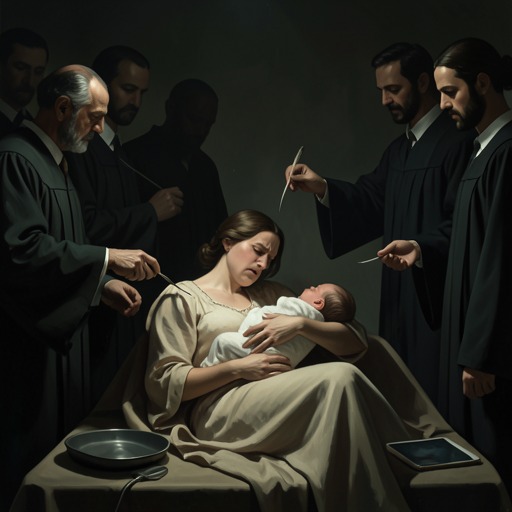
Lia’s explanation is also grounded in her relationship with Casaubon and in her pregnancy. She places her own body, and the child growing within it, at the center of her argument; Casaubon listens with respect, and they make the phrase “discovering archetypes” their private name for moments of intimacy. The theory is not delivered as a detached lecture: it emerges from a shared life that gives her account of fertility and bodily knowledge immediate force.
The pregnancy becomes explicit when Lia tells Casaubon she is pregnant. In retrospect, this news reinforces the contrast between a living body and the Diabolicals’ abstract correspondences. Lia argues that a person seeking significance in images such as ovens, caves, and hidden chambers need not search for a remote message: an alchemical oven can evoke the body that makes and nourishes life. Casaubon’s colleagues, by contrast, have spent years assigning such forms to an esoteric system. Her explanation replaces their interpretive distance with bodily familiarity.
The Limits of the Counter-Explanation
The novel does not present Casaubon as permanently protected by Lia’s account. He later reflects that the three collaborators trained themselves to connect everything with everything else. What began as parody became habitual, and the boundary between pretending to believe and believing grew difficult to maintain. He regards his daily contact with Lia and the baby as having left him less affected than the others, but also describes himself as becoming addicted to the game. Lia’s bodily explanation supplies a strong counterweight to the Diabolicals’ universalizing interpretations; it does not erase the pressure of repeated analogy.
That tension makes the concept central to the book’s treatment of interpretation. The Diabolicals assume that resemblance points outward to a concealed plan; Lia points back to the conditions of embodied life that can make separate cultures produce similar images. Her account offers a way to explain connections without turning them into evidence of a secret society or master design. The contrast is ultimately not between symbols and no symbols, but between meanings rooted in shared human experience and a pattern-making habit that treats every resemblance as confirmation.