The Empty Secret
Foucault's PendulumThe Empty Secret is the principle that an imagined mystery can exert extraordinary power precisely because it has no final content. In the novel, the search for a secret promises to explain frustration and offer salvation, but every answer becomes merely another sign in an endless chain. The narrator’s eventual recognition that the Provins message was a laundry list does not dissolve the consequences of belief: the fabricated Plan has become History for those who pursued it, and the secret they imagined helps bring about Jacopo Belbo’s death.
A Secret That Promises Salvation
The secret begins as an answer to dissatisfaction. A plot, the narrator reasons, must conceal something that would dispel frustration and lead to salvation—or make knowing itself salvific. But any secret that is actually disclosed risks appearing small. The desired object is therefore not simply hidden information; it is an explanation imagined to be large enough to redeem the seeker’s life. The promise sustains the search, while the expectation of a final revelation makes fulfillment impossible.
The novel sets this appetite against religious mysteries that are already available in public form. The narrator recalls the doctrines and practices of Christianity—the Incarnation, love of one’s neighbor, the Eucharist, and the Trinity—as teachings that people might have accepted as sufficient. Instead, they continued to search for lost knowledge, treating accessible doctrines as veils over something deeper. The pattern exposes a paradox: the more direct a proposed answer becomes, the more readily it is dismissed as trivial, while a further, more hidden answer is presumed to exist.
The Endless Chain of Interpretation
The Empty Secret is not a concealed final item waiting at the end of interpretation. It is an interpretive process that keeps postponing any endpoint. The narrator illustrates this with a chain of associations: an orchid signifies the testicles, which signify a zodiacal sign, an angelic hierarchy, a musical scale, and relations among the humors. Each association points onward rather than settling meaning. The universe becomes an onion made entirely of peel, its center everywhere and nowhere; initiation is the practice of continuing along that endless path.
This logic echoes the method used to construct the Plan. Concepts are joined by analogy, and a chain is accepted if it comes around to its starting point. Potato can connect to apple by shared qualities, then to a snake by biblical association, and onward through increasingly remote likenesses until the chain returns to potato. The connections are not required to be original: their prior repetition makes them seem obvious and therefore true. The resulting system can feel comprehensive without establishing that its links disclose a real hidden design. Its apparent completeness is produced by the rules of association themselves.
The narrator had once helped turn a document into a grand interpretation. Ingolf’s transcription contained illegible passages, which he supplied with conjectures and presented as a restored text. Later, seized by the possibility that the message’s Castle of the Ordonation meant Tomar, he stopped laughing at Colonel Ardenti’s claims and imagined a six-hundred-year Templar Plan beginning there. He then recognized the crucial distinction: the task was not to discover the Templars’ secret, but to construct it. These episodes show the method moving from an empty or damaged text to a confident history through the interpreter’s own additions.
From Fabricated Message to History
The narrator ultimately accepts Lia’s explanation: the Provins message is a laundry list, there were no Templar meetings at the Grange-aux-Dîmes, and neither the message nor the Plan existed as historical fact. The list had served as an empty crossword whose unfilled squares could be populated with concepts and events. Unlike an ordinary crossword, the game did not require shared letters; it permitted connections through analogy, a chain that closed upon itself, and associations already made by others. The apparent proof arose from the structure of the game, not from evidence of a surviving conspiracy.
That correction does not make the Plan inconsequential. The narrator distinguishes the nonexistent document and telluric currents from the history created by the act of deciphering. As the plane passes over Mont Blanc, the passengers crowd to one side to see a formation they have been told reflects those currents. The narrator now suspects that the currents, like the Provins message, do not exist. But the story of the Plan as the three men reconstructed it has become History: their invented interpretation has shaped real belief and real action. The distinction is central to the concept. The secret is false as a historical fact, but the search for it is not false in its consequences.
Belbo and the Power of Refusal
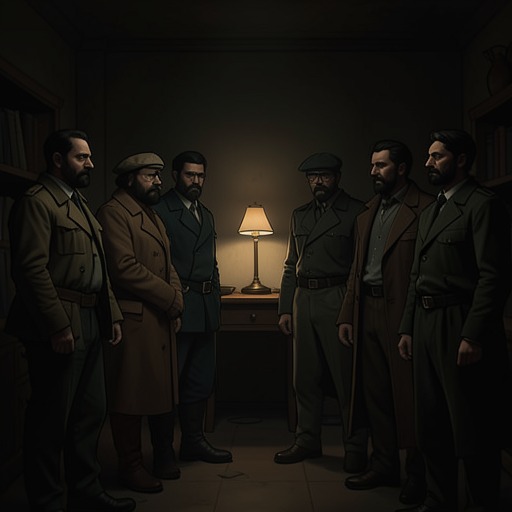
The Empty Secret becomes most dangerous when the supposed secret is attributed to Belbo. He claims to possess one, and that claim gives him power over the people gathered around the Pendulum. They try to wrest the secret from him; the longer he refuses to disclose it, the more valuable and convincing it seems. His denials do not weaken their belief. They become further evidence to his captors that the secret must be real, since they imagine that a false secret would have been revealed.
The search for the secret has held the group together across excommunications, internal conflicts, and coups. Now, when revelation seems close, its members confront two threats: the answer may disappoint them, and making it public would abolish the mystery that gives their pursuit purpose. Aglie has an additional stake. If Belbo speaks to everyone, Aglie loses the mysterious authority that supports his charisma; if Belbo confides only in him, he can continue to inhabit the identity of Saint-Germain, the immortal. The narrator reads Aglie’s attempt to extract a private confession, followed by his theatrical provocation, as a way of forcing Belbo into a definitive refusal. Belbo’s stubbornness and sense of the ridiculous overcome even the fear of death.
The others choose to kill him rather than surrender the desire that the secret sustains. They may lose the map, but they can continue searching for centuries; by killing Belbo, they preserve the appetite that holds their group together. The outcome gives the concept its grimest demonstration: the secret need not contain anything to command sacrifice. Its power lies in being withheld, and in the belief that its disclosure would end both the search and the community built around it.
Meaning Without a Final Revelation
The narrator’s conclusion does not replace the Plan with a newly discovered master secret. It identifies the secret’s emptiness as the mechanism that made it compelling. The conspirators had been offered something empty—and, more radically, the narrators knew it was false—yet the promise of hidden meaning awakened their desire. A secret without content cannot be conclusively disproved by inspection, because there is no stable content to inspect; nor can it be possessed or exhausted by revelation. This makes it invulnerable in the very way a supposed repository of knowledge would not be.
The concept also clarifies the novel’s distinction between interpretation and proof. Analogies may be imaginative, and a fabricated account may acquire consequences, but those consequences do not certify its premises. The narrator’s earlier movement from amused skepticism toward belief, and then back toward Lia’s explanation, shows how the interpreter can become an agent of the construction being interpreted. The Plan’s recurrence across historical narratives and secret societies offers the comfort of a pattern, but recurrence and familiarity can be manufactured by selecting and connecting material under permissive rules.
At the novel’s close, the Empty Secret remains more troubling than a simple debunking. The narrator wonders whether existence is so empty and fragile that it can be endured only through the illusion that one is searching for its secret. Amparo’s earlier words return as an unresolved consequence of that thought: if there is no redemption, people may be slaves who ask for a master. The novel does not convert this fear into proof of a hidden order. Instead, it leaves the reader with the cost of wanting one: the pursuit can furnish meaning and belonging, but it can also turn invention into conviction and conviction into violence.