Tres, Templi Resurgentes Equites Synarchici
Foucault's PendulumTres, Templi Resurgentes Equites Synarchici is the secret order imagined as the ultimate power behind the Templar tradition and the world’s competing esoteric societies. Its grand claim to unite spiritual knighthoods across faiths turns the trio’s fabricated Plan into an organization its adherents experience as real. At the Conservatoire, its initiatory theatre culminates in a demand that Belbo surrender a secret; the order’s power rests less on any demonstrated structure than on its followers’ need to believe that one exists.
Origins and Supposed Purpose
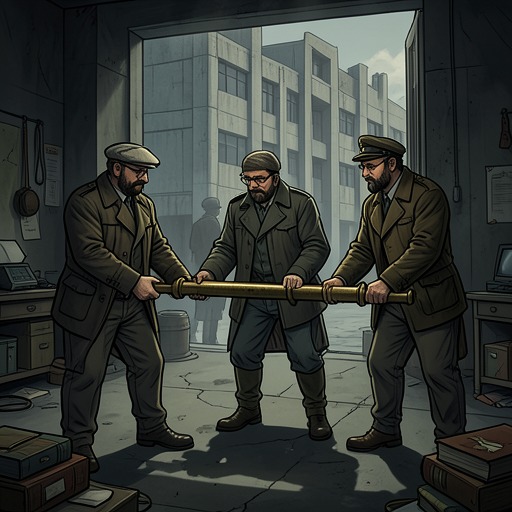
The order enters the trio’s speculations as a way to reconcile otherwise disconnected histories. In their account, the Assassins of Alamut reappear amid Islamic revival, while the Templars supply a model of spiritual knighthood; Tres is assigned the task of healing the division between knighthoods of different faiths. Even within that fantasy, its purpose is unstable: it might heal the rift, or exploit conflict and confusion. The supposed world-historical explanation is another link in the Plan’s expanding chain, not evidence of an independently verified organization.
The Plan’s appeal depends on its promise to make history legible. A secret society with branches throughout the world is imagined as plotting to spread the rumor that a universal plot exists. That formulation makes the theory resistant to disproof: belief in a conspiracy and belief that the conspiracy is itself a planted rumor can be absorbed into the same account. When even a single fact is allowed to remain unexplained, the trio jokes, Hermetic thought has been violated; the Templars must therefore have something to do with everything. The joke expresses the rule by which the imaginary order grows.
The Order’s Claims and Ritual
At the final gathering in the Conservatoire, the order is announced as the One Order, the Unknown Order: those present are told that, until the previous day, they did not know they belonged to it, although they had always belonged. The initiation reverses the usual promise of entry into a known society. Membership is presented as an identity that preceded awareness, revealed by the ceremony rather than chosen through a verifiable history.
The presiding voice condemns rival lodges and occult groups as profaners and usurpers, then demands that anyone initiated into an order claiming obedience to Unknown Superiors or Masters of the World renounce that affiliation. The names invoked range across Masonic, Rosicrucian, occult, and political traditions. Against that crowded catalogue, Tres declares itself the single true observance: a triune, trinosophic, most secret order of Synarchic Knights of Templar Rebirth. Its supremacy is asserted through ritual denunciation, not established by evidence about its origins, membership, or operations.
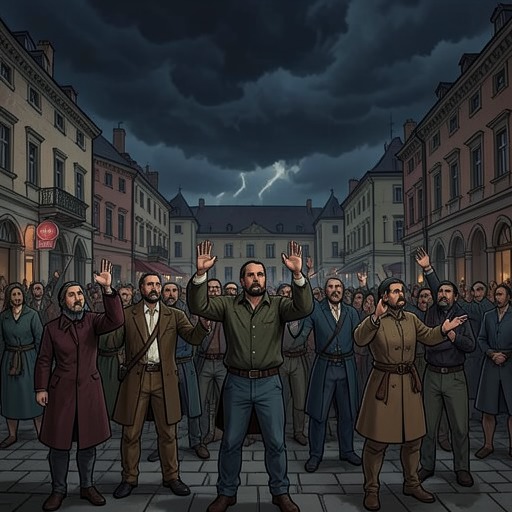
The ceremony gives this claim a physical stage. The elect take their places in the ambulatory facing the Pendulum, while the faithful stand in the nave. The initiated are then told that thirty-six highest and most secret degrees will enter. The Pendulum and the carefully ranked assembly turn an imagined hierarchy into a visible arrangement: the order can be experienced as present because people gather, take positions, and obey its ceremonial commands.
The Belbo Affair and the Gathering
The order’s pursuit of Belbo begins through coercion disguised as an invitation. A caller warns him that he can be identified as the unknown passenger in seat 45 of the train and offers to avert that danger if he reveals where the Templars’ map is. He is directed to meet at Librairie Sloane, 3 rue de la Manticore, in Paris, where a familiar bearded man will guide him toward others. The invitation promises a gradual, untraumatic conclusion before the summer solstice; its underlying leverage is the threat of exposure to the police.
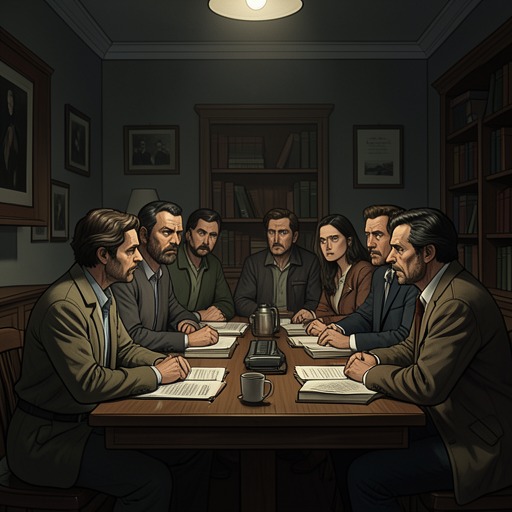
At the gathering, the order’s leaders treat Belbo as the holder of knowledge that might resolve a centuries-long error. Aglie says the meeting should have occurred on the night of June 23, 1945, and presents the present assembly as the consequence of finding someone who knows. Colonel Ardenti appears among the assembled initiates, older and unsteady, and is called forward as a possible source of what the prisoner has said. The rite thus converts the trio’s old materials and invented connections into a tribunal, with Belbo’s supposed knowledge as its object.
Fiction Made Effective
The novel makes the order’s central paradox explicit: the trio invented a nonexistent Plan, but believers identified fragments of their own confused mythology as episodes within it, joined by analogy and resemblance. Once they accepted the Plan and acted on it, its consequences became real. The imagined organization no longer needed an independently demonstrable origin to shape conduct; its followers supplied continuity, authority, and purpose by interpreting their beliefs as evidence of one another.
Belbo’s refusal to disclose the secret intensifies the order’s conviction that he possesses one. The more firmly he denies having it, the more the assembled believers treat his denial as proof that the secret must be immense. Their centuries-long search has served as a bond despite excommunications, internal struggles, and coups. Yet knowledge threatens the institution: a secret revealed might disappoint, and a secret known to all would cease to bind them. The order’s power therefore depends on postponement. Its most valuable secret is not a hidden fact that the narrative confirms, but an empty secret that must remain unattainable to sustain the believers’ shared world.