Belbo’s pursuit of Lorenza Pellegrini
Foucault's PendulumBelbo’s pursuit of Lorenza Pellegrini is less a conventional courtship than an inward struggle with desire, humiliation, and passivity. In person he watches for her and follows her movements; in his files he turns their encounters into scenes of self-reproach, imagining a revenge he never carries out. The contrast makes the relationship significant not because it resolves into mutual romance, but because it reveals the private wound beneath his practiced irony.
Introduction and Circumstances
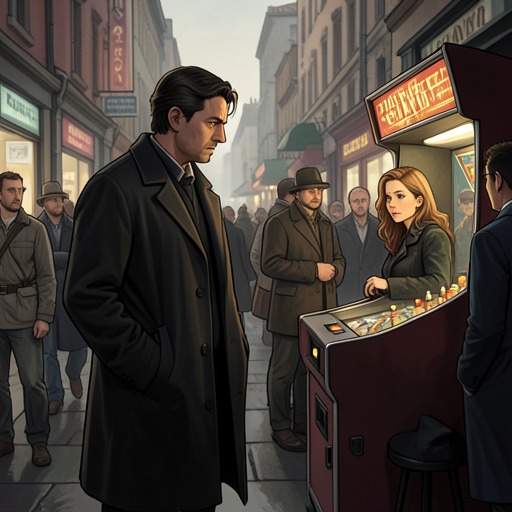
After Casaubon has told Belbo about his experience in Brazil, the two meet again, and Casaubon notices that Belbo seems more absent than usual. When Lorenza is not at the bar, Belbo keeps his eyes fixed on the door; when she arrives, his attention shifts to her, and he nervously follows her every move. His behavior makes her presence the organizing fact of his attention even while he tries to conduct an ordinary conversation.
Near closing time, Belbo turns from this watchfulness to practical business. He asks Casaubon to work several afternoons a week, researching a book commissioned by a steel company: a serious but popular illustrated history of metals, ranging from the Iron Age to spaceships. The request places Belbo in his familiar professional role as an editor who can identify useful work and enlist a researcher. Yet Lorenza’s arrival immediately interrupts that businesslike frame, and the scene reveals how readily his attention is pulled away from the work he has just proposed.
Encounters and Reversal
Lorenza asks Belbo to take her home, explaining that he is the man of her dreams. Belbo asks why she chose him. He gets up and whispers something in her ear, but she shakes her head and clarifies that she had asked only for a ride home. The passage does not disclose what Belbo whispered; what it does show is a quick mismatch between his response and her stated request. Her words invite an intimate interpretation, then her correction refuses to confirm it.
Belbo withdraws into a joke addressed to Casaubon: he must chauffeur the woman of someone else’s dreams. The line converts the immediate disappointment into a wry performance, shifting the focus from what Lorenza may mean to what Belbo can say about the situation. Its polish does not remove the frustration beneath it; rather, the joke lets him acknowledge his exclusion while keeping its emotional cost at a distance.
The Files and the Spectator’s Role
Belbo’s files supply a different register from his public banter. In a file titled “Vendetta,” he describes Lorenza arriving even when other people are in the office, taking him by the lapels, and kissing him. He compares the kiss to pinball and notes that she knows it embarrasses him and puts him on the spot. The physical directness of the encounter is striking, but the account centers on his discomfort and on Lorenza’s apparent awareness of its effect, not on any settled understanding between them.
The files also describe Lorenza’s visits in relation to Belbo’s plans and commitments. He says he is spending a weekend with a male friend—the same man Casaubon had seen with him at the bar—and insists that he has promised. Lorenza urges him not to break that promise, but also not to come to her to make a scene while she has an author coming in. Their exchange places desire beside ordinary obligations: a promised weekend, an author’s appointment, and the pressure of Lorenza’s attention. It does not deliver a romantic resolution. Instead, it shows Belbo trying to hold to a commitment while the encounter keeps turning into a test of his composure.
Another file records Lorenza’s arrival at a gallery where Belbo had been expected at Pilade’s Bar. After waiting, she goes to the gallery alone, then searches for the restaurant where the others have gone. There she sees Belbo beside a scarred man and recognizes that he is not embarrassed by her arrival. She reads his expression as both complicit and defiant, while the man with the scar looks her up and down as though she were the intruder. The scene is presented through Belbo’s account of Lorenza’s perspective: he imagines the audience waiting for him to respond, and he believes that his role has already been assigned.
Belbo says he could have picked a fight and that he would have looked good even if he had been hit. Instead, since he believes the situation demands a show, he chooses drawing-room comedy and joins the conversation amiably, hoping someone will admire his control. The hoped-for audience does not supply that recognition; he says that the only person who admired him was himself. His performance thus becomes a measure of isolation: the poise he displays does not persuade anyone else, and may not persuade him either.
Self-Accusation and Significance
The files turn the apparent love triangle into a judgment Belbo passes on himself. He calls himself a coward when he feels like one and imagines a masked avenger who punishes misunderstood geniuses while, in his own everyday identity, taking care of others. He recognizes the contradiction between that heroic fantasy and his actual position: he collaborates in exploiting those who, unlike him, have not confined themselves to watching from the sidelines. His imagined vengeance gives language to anger, but remains an image rather than an action.
He asks whether it is possible to spend a life punishing people who will never know they have been punished, then recasts the fantasy as a blow against the wretch who wanted to be a Homer. The passage connects his resentment to the wish to be a creator and to his shame at remaining an observer. His complaint that he hates anyone who tries to see him as an illusion of passion further complicates the performance: he resists being mistaken for a romantic caricature, yet the files reveal how much emotional force the relationship has acquired for him.
The episode therefore gives Belbo’s pursuit its distinctive shape: direct encounters, awkward reversals, and private rehearsals of retaliation. Lorenza can approach him physically and unsettle him, but the evidence does not establish a lasting romantic union or clarify the full terms of her intentions. What it does establish is Belbo’s recurring effort to turn vulnerability into wit, then to expose that wit as an inadequate defense. His pursuit matters as a portrait of the spectator who longs to act, feels humiliated by the role he occupies, and can imagine punishment more readily than he can change the scene.