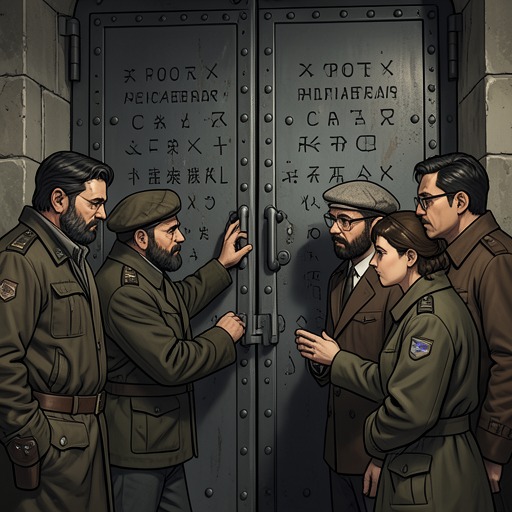
Beware of faking: people will believe you
Foucault's Pendulum“Beware of faking: people will believe you” is both a warning against the Plan’s fabricated logic and an account of how that logic becomes consequential. What begins as knowing parody—an exercise in connecting unrelated fragments—can train its makers to believe, and can persuade others that an invented conspiracy is real. The expression’s force lies in the gap between making something up and controlling what it becomes once others believe it.
The Warning and Its Image
In an argument about the Plan, Lia compares its obscure promises with Homer’s clear account of Troy. Reading Homer does not make people try to burn Troy again; the poem gives the destruction a lasting meaning without disguising itself as a secret code. The Plan, by contrast, is muddy and contradictory. Its readers can find in it whatever they want, which makes it available to people who are insecure and eager to identify with a hidden design.
The warning turns on the image of a fraudulent hair-restoration lotion. People may sense that its seller is combining incompatible truths and speaking in bad faith, yet still be drawn to the promise. The Plan is likewise a kind of invented hair oil: not a sound explanation, but a contrivance whose incoherence can be mistaken for profundity. The far-fetched seems miraculous when people have been taught that God is mysterious and beyond understanding. In this account, fakery does not persuade by proving its claims; it exploits the expectation that truth must conceal something.
From Parody to Habit
The three inventors initially treat their associations as burlesque. They know they have taken extraordinary shortcuts, and reassure themselves that they are parodying the reasoning of their supposed adversaries. But the work continues between their meetings: each gathers fragments to contribute to the next collective construction. Repeatedly connecting everything to everything else turns a performance into a habit of thought.
The narrator describes the change through two comparisons. Spies who learn to think like the enemy may eventually go over to the other side; people who imagine their dog’s human qualities may, in turn, become doglike. The same reversal overtakes the Plan’s makers. The narrator believes his daily life with Lia and their baby leaves him the least affected, but distinguishes his condition from those of his companions: he is becoming addicted, Diotallevi corrupted, and Belbo converted. All three are losing the ability to distinguish resemblance from identity and metaphor from reality. The expression therefore warns not only that an audience may believe a fabrication, but that its authors can become shaped by the fictions they maintain.
The Plan Becomes Real in Its Effects
The Plan is explicitly described as nonexistent, yet its readers believe it was real and persuade themselves that they have belonged to it for ages. They identify fragments of their own confused mythologies as episodes in a supposedly coherent web of analogy, resemblance, and suspicion. The explanation offers a pattern where there had been scattered material, and gives its adherents a role in a history they can now claim to recognize.
That belief changes the status of the invention. If a fabricated plan leads other people to carry it out, then, in its consequences, it exists. The narrator anticipates that crowds of “Diabolicals” will roam the world looking for the map. The danger is not that the invented account becomes historically true, but that belief and action give it practical reality.
Frustration, Secrecy, and Self-Confirmation
The expression also belongs to a broader account of conspiracy thinking. In ordinary life, a market crash can result from many individuals making mistaken moves; together, those mistakes produce panic. Someone unable to accept that confused outcome may instead ask who is behind it and who benefits. Blaming a plotter offers an external cause for failure and protects the believer from having to acknowledge a lack of understanding. Once people invent enemy plots to excuse themselves, they may organize their own plots in response, then become attached to the very logic they attribute to others.
A plot, if it exists, must remain secret, and the imagined secret promises either to end frustration or to provide salvation through the act of knowing. But a revealed secret disappoints: it seems small once it is known. The narrator therefore describes the ultimate secret as empty, perpetually receding as one sign is made to signify another. Belbo’s refusal to disclose a secret at the nocturnal rite gives this idea a dangerous practical form. The more he denies possessing it, the more convinced his captors become that it must be genuine; if it were false, they reason, he would reveal it. His silence enlarges their belief precisely because they have made the secret impossible to test. The warning’s final implication is that fabrication thrives wherever desire turns uncertainty into proof: a falsehood can command real allegiance, while its contradictions become part of its apparent mystery.