Brazil
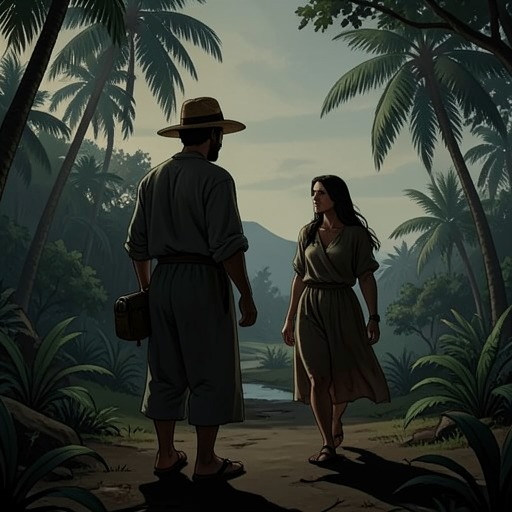
Foucault's PendulumBrazil is the setting of a decisive change in Casaubon’s relation to belief: what begins as an observer’s encounter with religious syncretism becomes an experience that unsettles the boundary he had drawn between reason and the supernatural. The country’s rites, political arguments, and bodily intensities do not resolve into a single explanation. They leave him with questions that continue after he returns to Italy.
Religion, Politics, and Social Movement
In Brazil, Casaubon listens to Amparo’s comrades debate the meaning of Afro-Brazilian religions. Their arguments emerge from the movements of the dispossessed: people from the north travel south toward industrial cities, become subproletarians, and sometimes return north in desperation, while others remain in the cities and join indigenous churches. The cults are interpreted variously as a recovery of cultural roots and resistance to the white world, as an opiate that diverts revolutionary energy, or as a mixture of white, Indigenous, and Black traditions whose political purpose remains unclear.
Amparo’s declared position is uncompromising: religion is the opiate of the people, and pseudo-tribal cults are worse still. Yet Casaubon sees a contradiction between that political judgment and her attachment to the world around her. At the escolas de samba she joins the sinuous lines of dancers, while afterward she dismisses carnival and soccer as forms of ritualized enthusiasm that absorb the disinherited’s anger and keep them from recognizing the establishment. Her body participates in what her political analysis rejects.
The conflict is not simply between belief and disbelief. The same practices are treated as cultural inheritance, political anesthetic, and a possible meeting ground among different peoples. Casaubon’s account preserves the disagreement rather than turning the rites into one stable symbol; Amparo’s own divided response makes the limits of purely ideological explanation visible.
Ritual and the Observer
A later umbanda gira gives the conflict a physical form. Before the rite, Aglie explains that its participants will be possessed by eguns, spirits of the departed, rather than by the orixás associated with candomblé. During the ceremony, incense, chanting, and accelerating drums accompany the participants’ altered movements. Casaubon recognizes the force of music and noise from his experience of samba schools and discos, but that familiarity does not make the scene emotionally neutral.
A German psychologist who has attended the rites for years dances without entering a trance. Her wide, vacant-looking eyes and increasingly strained movements contrast with the women who fall into ecstasy, their bodies moving as if carried by the beings said to possess them. The contrast makes participation an uncertain matter of selection rather than a simple performance of will: the psychologist tries to surrender control, yet repeatedly regains it.
Amparo, whom Casaubon is holding by the arm, suddenly sweats, trembles, and says she feels ill and wants to leave. Outside, she attributes her condition to food, smells, and heat. The pai-de-santo instead tells her she has the qualities of a medium and responded well to the pontos. Amparo sharply rejects that interpretation, insisting that she is merely unwell and wants to be alone. The episode leaves the source of her reaction unresolved: bodily distress, ritual influence, and the participants’ competing interpretations remain in view together.
Aglie’s Interpretation and Its Limits
Afterward, Aglie argues that race or culture belongs to the unconscious, alongside archetypal figures shared across peoples and centuries. He says that the ritual’s atmosphere has lulled everyone’s vigilance and interprets Amparo’s response as evidence that the orixás she rejected intellectually remain alive within her. He does not present possession as a positive condition. Instead, he distinguishes the mystic, who undergoes and manifests an experience, from the initiate, whose understanding is acquired through a long transformation of mind and body.
In Aglie’s account, a mystic can function as a conspicuous medium through whom signs become observable, whereas initiates remain difficult for outsiders to recognize and control the forces mystics undergo. This is his hierarchy and explanation, not a neutral finding established by the ceremony. Its importance lies in how it recasts what Casaubon has witnessed: the ritual becomes evidence within Aglie’s theory, even as the scene itself leaves room for psychological, cultural, and religious interpretations.
Return and Lasting Disorientation
Casaubon later describes the Rio rite as the first crack in a figurative breaking of the vessels, while locating the shattering itself in his return to Italy. Brazil had immersed him in a world swollen with the incredible; from a distance, events at home acquired an almost legendary aura. Near the end of his stay, during an airplane trip over the Amazonian forests, he stopped in Fortaleza and saw a newspaper photograph of a man he recognized from years of seeing him drink white wine at Pilade’s. The caption identified him as the man who had killed Moro.
The return does not restore Casaubon to a settled identity. He says he hardly knew who he was anymore and contrasts himself with his father, who at the same age had known who he was and where he lived. Brazil thus matters not as a place that supplies a definitive revelation, but as the beginning of an estrangement: its religious encounters and political conflicts loosen Casaubon’s confidence in detached observation, while the news from Italy makes the distance between lived events and the stories built around them impossible to ignore.