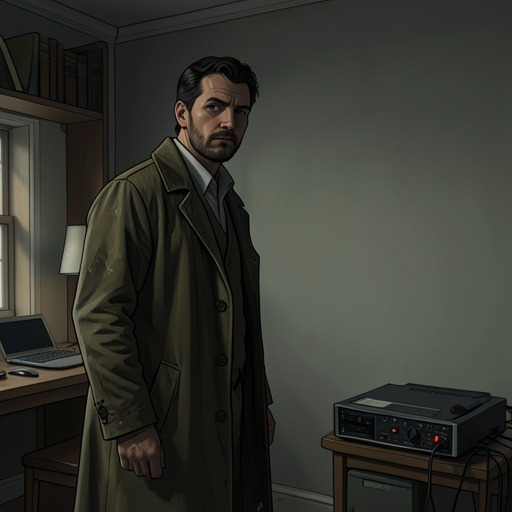
Carlo Covasso’s arrest and release by the partisans
Foucault's PendulumCarlo Covasso’s arrest and release by the partisans is a wartime episode in Belbo’s family history that turns on a reversal: the man taken away as a representative of the regime returns home after recognizing his captor as a fellow veteran. The encounter does not erase their opposing political positions, but shared military service and a common ideal of Italy momentarily outweigh faction. In Belbo’s later recollection, the episode becomes part of a world of stark, legible choices—one of the few memories he calls sweet.
Background and Arrest
By 1943, after Mussolini had been removed, Carlo continued to run the tax office under the Badoglio government. Following the September 8 armistice, the area came under the Fascists’ Social Republic, and he adjusted again, collecting taxes for its administration. His nephew Adelino Canepa meanwhile boasted of contacts with the partisan groups gathering in the mountains and promised that they would exact vengeance. The family thus lived amid competing claims to authority, while the children heard stories of partisans they had not yet seen.
When partisans descended from the hills into town, they wore no uniforms, only blue kerchiefs, and fired into the air to announce their arrival. Residents locked themselves in their homes, uncertain what the new force would do. Carlo’s sister Caterina assumed that the partisans would spare him because Adelino claimed friendship with them. Instead, around eleven in the morning, an armed squad entered the tax office, aimed its automatic rifles, arrested Carlo, and took him away. Caterina feared that a blow to the metal plate in his head would kill him. Her panic makes the arrest feel, to the household, like a possible execution before anyone knows where he has been taken.
The Meeting with Mongo
Adelino arrived with his wife and children, drawn by Caterina’s cries. She accused him of betraying Carlo because Carlo collected taxes for the Social Republic. Adelino swore that he had not reported him, but appeared to feel responsible for having talked too freely around town. Caterina sent him away; he pleaded with Belbo’s mother, invoking the cheap rabbits and chickens he had sold her, while she remained silent. Caterina continued to foam at the mouth, and the young Belbo cried. After two hours of anguish, Carlo returned on a bicycle, steering with one arm and looking as if he had just been on an outing.
The explanation lay outside town, where the partisans had taken Carlo by truck to face Mongo, their commander. Mongo stood with war medals, a gun in his right hand and a crutch in his left; Carlo, a disabled veteran with a metal plate in his head, snapped to attention and introduced himself as Major Carlo Covasso of the Alpine Division, a veteran awarded the silver medal. Mongo answered with his own military identity: Sergeant Major Rebaudengo of the Royal Carabineers, commander of the Badoglian brigade Bettino Ricasoli, and a bronze-medal recipient. Their formal introductions transform an arrest into a meeting between soldiers who recognize one another through rank, service, and injury.
Their recognition becomes specific when they compare the positions they had occupied in battle. Mongo had fought at Pordoi, on hill 327; Carlo recalled being at hill 328 with the third regiment at Sasso di Stria. They then remembered the battle of the solstice, the cannon on Five-Finger Mountain, and a bayonet attack on Saint Crispin’s Eve. In the account, military memory is not abstract nostalgia: exact places and shared episodes establish a connection that precedes their present political division. On the same impulse, the veteran without an arm and the veteran without a leg stepped forward and embraced.
Release and Its Meaning
Mongo explained that the partisans had been told Carlo collected taxes for the Fascist government serving the invaders. Carlo replied that he had a family, drew a government salary, and had not chosen the government in office. Mongo answered that he would have acted the same way in Carlo’s place, but asked him to collect the taxes slowly. Carlo promised to see what he could do and said that he had nothing against the partisans, who were also sons of Italy and valiant fighters. Both men, the narrative observes, thought of the Fatherland with a capital F. Mongo ordered his men to give Carlo a bicycle, and Carlo rode home. Adelino did not show his face for several months.
The episode’s resolution is neither a partisan conversion nor a denial of the regime’s political stakes. Mongo’s compromise leaves Carlo’s official role intact, but changes how it will be carried out; the immediate threat gives way to a conditional accommodation. Belbo’s account frames the meeting as a bond that endures above factions and parties, and wonders whether this qualifies as spiritual knighthood. The ideal he identifies is not a secret allegiance but a chivalric recognition between adversaries who share a conception of service.
Belbo’s Memory and the Episode’s Afterlife
Years later, Belbo tells the story as one of the few genuinely sweet memories he retains. Casaubon understands its force against the falsehoods and unstable interpretations that have come to surround Belbo. In the wartime memory, a bullet was simply a bullet, one ducked or taken; the opposing sides were distinct, marked red or black; a corpse was unmistakably a corpse. That apparent clarity contrasts with the slippery disappearance of Colonel Ardenti and the ambiguities Belbo encounters in the present. Casaubon considers whether the meeting between Carlo and Mongo might itself be called synarchic, because two opponents share an ideal of chivalry, but hesitates to impose another interpretive system on a memory Belbo cherishes as a rare truth.
The recollection does not make Belbo a triumphant participant in history. Casaubon notes that even in those supposedly clear days Belbo had been a spectator, watching the birth of other people’s memories and of histories he would not write. Yet Belbo adds that he performed the one heroic deed of his life. The arrest-and-release story therefore holds together two perspectives: the child’s terror at a family member’s disappearance and the adult’s account of a genuine act of courage and recognition. Its return in memory offers Belbo a counterimage to conspiracy—not a hidden master plan, but a contingent encounter in which shared experience changes what armed opponents do.