Casaubon’s Paranoid Delusion
Foucault's PendulumCasaubon’s Paranoid Delusion is the narrator’s passage from treating the Plan as a deliberate game to experiencing it as the explanation behind the world. In the Conservatoire and the streets of Paris, familiar objects and locations become evidence of hidden connections. The change is significant because it is not simply a discovery of a real conspiracy: Casaubon recognizes that the group invented the Plan, yet also sees how the habit of interpreting everything through it can make the fiction operate as reality.
From Irony to Habit
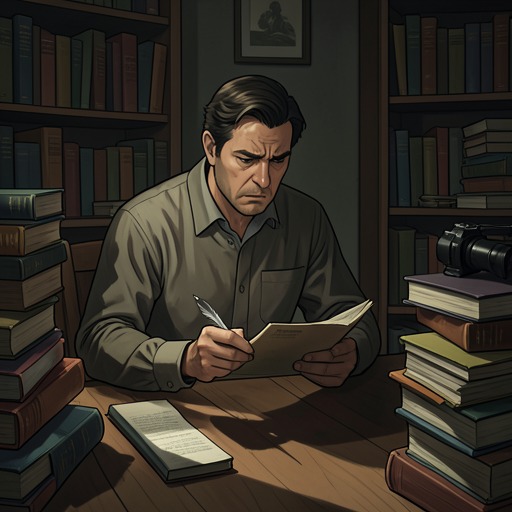
Casaubon recalls that he, Jacopo Belbo, and Diotallevi initially understood their elaborate connections as parody. At their meetings, they exchanged fantasies assembled through implausible associations and shortcuts; they would have been embarrassed to claim that they truly believed them. Their irony offered a protective explanation: they were imitating the reasoning of the Diabolicals, not adopting it. But in the long stretches between meetings, each man gathered material for the next session, and the practice of connecting everything to everything else became automatic. Casaubon identifies the danger in that gradual shift: the habit of pretending to believe may cease to differ from belief itself.
He describes the change through the analogy of spies who infiltrate an enemy service. To survive, they learn to think like the people they are observing; in time, the enemy’s way of thinking becomes their own. Casaubon also compares the process to people who, by attributing increasingly human motives to a dog, come to resemble the animal themselves. These comparisons frame the Plan not as a single decision to believe, but as an acquired interpretive reflex: repetition trains the mind until the distinction between imitation and identification becomes difficult to maintain.
Casaubon judges himself the least changed of the three, partly because daily contact with Lia and the baby kept him connected to ordinary life. He likens his position to playing the agogo during the rite in Brazil: he believed he was on the side directing emotion rather than being directed by it. His retrospective account is less confident about the others. He says Diotallevi was learning viscerally to think like a Diabolical, while Belbo was identifying with the game more consciously. Casaubon summarizes their different trajectories as addiction, corruption, and conversion. All three, however, were losing the ability to distinguish resemblance from identity and metaphor from reality—the very distinctions their game depended on.
The Conservatoire and the Moment of Conversion
The delusion becomes an immediate way of seeing when Casaubon goes to the Conservatoire in search of Belbo. He has waited in the museum and, after leaving the periscope, reviewed the mistakes of the previous years. He still has no reasonable explanation for why he is hunting for Belbo, whose own reasons seem no more reasonable. Yet as soon as he steps out of the periscope, he says that everything changes: he advances with another man’s head and becomes Belbo. In that borrowed perspective, every earthly object must be read as a hieroglyph of something else, and the Plan seems more real than any individual object. The change in viewpoint is the scene’s crucial action: Casaubon’s earlier knowledge that the connections were manufactured no longer protects him from experiencing them as revelations.
A museum apparatus gives the new logic a concrete target. Casaubon sees Froment’s Motor, a vertical structure on a rhomboid base, with reels, batteries, circuit breakers, and a belt driven by a toothed wheel. Rather than leave the machine’s purpose uncertain, he decides it must have measured telluric currents. The interpretation then expands beyond the device itself: he imagines secret operators using accumulators to detect a universal current and treat historical events as a cover for their hidden work. The ordinary appearance of scientific machinery does not weaken the theory; it becomes the means by which the theory explains how its supposed operators concealed themselves.
A sewing machine provides an even sharper example. Casaubon notices a label describing currents induced from the terrestrial field and treats it as proof that the Masters of the World have deceived humanity for centuries. What might otherwise register as a technical exhibit becomes a sign that ordinary progress, including belief in experiment and mechanics, has been misread. He imagines that people have been absorbed by the Plan while believing themselves to be celebrating the locomotive and the possibilities of modern invention. The delusion thus reverses the apparent meaning of the exhibits: public science becomes a disguise for secret purpose.
Paris as a Field of Signs
Outside the museum, Casaubon continues to interpret the city through suspicion. Near Porte Saint-Martin, a boy tells him that people are arriving for a march against the Savary law. A stranger, whom Casaubon recasts as a possible Ismaili in disguise, invites him into a club; he refuses and thinks of Alamut, deciding that he cannot know who serves whom. The scene shows uncertainty being converted into threat: an ordinary invitation and a crowd gathering for a march are absorbed into a world in which identities and affiliations may conceal a hidden allegiance.
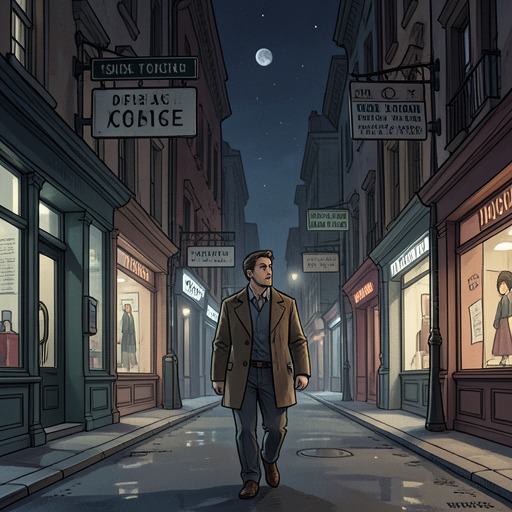
As he walks, Casaubon moves between the fear of being lost and the conviction that the city contains a legible route. He passes the dark windows of Editions Rosicruciennes and reads the displayed books, alchemical objects, crosses, candelabra, incense, and tarot cards as a pointed arrangement. At Beaubourg, the great air ducts appear to him as machinery that absorbs energy from the earth, while daytime crowds might supply it with vibrations. He knows he must not yield to hysteria, but the warning does not halt the interpretation; it becomes another sign of how difficult it is to resist the pattern once it has taken hold.
The apparent confirmation comes at the facade of Saint-Merri, where Casaubon shines his flashlight on the portal and notices a Baphomet figure among the carved ornament. He connects it to the nearby Temple and then to the house of Nicolas Flamel, locating the symbols within a supposed network of places and histories. Elsewhere, the Tour Saint-Jacques, an occult bookshop, and the Eiffel Tower enter the same imagined sequence of special locations. Each connection makes the city feel more coherent to him, but that coherence is produced by the interpretive habit itself: proximity and resemblance become evidence of coordination.
The Plan’s Reality and Its Empty Secret
Casaubon’s later explanation makes clear why the Plan can seem real without having been discovered. The three friends invented a nonexistent Plan, but the Diabolicals believed it existed and persuaded themselves that they had belonged to it all along. They fitted fragments of their own confused mythology into the pattern, treating analogy, resemblance, and suspicion as links in a logical web. Once people act on an invented scheme, Casaubon observes, it has consequences as though it existed; belief gives the fiction practical force without proving that the original conspiracy was real.
He also identifies the emotional and political appeal of conspiratorial explanations. People may prefer a hidden plot to the possibility that their failures arose without a single responsible agent, and a dictatorship may need an external enemy to bind its followers together. In that account, conspiracy supplies an apparent cause for frustration and a target for blame. Yet the response can reproduce the very logic it condemns: people invent enemy plots, organize against them, and begin to pattern their own actions on the supposed adversary’s designs.
The search for a secret is especially resistant to correction because disclosure cannot satisfy it. Casaubon concludes that a secret, if it is to promise salvation, must remain unknown; once revealed, it disappoints. Initiation becomes an endless sequence of interpretations, like peeling an onion that consists only of layers. The most durable secret is therefore empty of recoverable content: it persists because it continually invites another connection rather than arriving at a final answer.
This account also clarifies the force of the confrontation at the Pendulum. Belbo’s refusal to reveal a secret persuaded the Diabolicals that he possessed an especially important one: the more he denied having it, the more they treated the denial as confirmation. Their long search held them together, but they feared both that the answer would disappoint and that knowing it would end the secret—and with it the identity their search sustained. Casaubon’s delusion and the Diabolicals’ conviction are parallel outcomes of the same closed system: signs confirm the Plan, while denial and uncertainty are absorbed as further signs. The distinction between a game and a belief collapses not because the Plan’s hidden machinery is demonstrated, but because the act of interpreting makes the invented pattern consequential.