Creation of the Plan
Foucault's PendulumCreation of the Plan is the deliberate invention of a history-spanning Templar conspiracy by Casaubon, Jacopo Belbo, and Diotallevi. It begins as a playful experiment in connecting fragments and ends as a self-fulfilling fiction: the people who encounter the Plan mistake its borrowed pieces for evidence of a hidden design, and the inventors find that repeated pretense can become belief.
Origins and Method
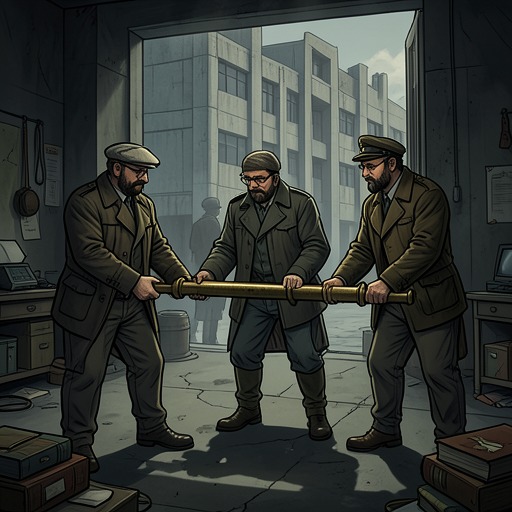
The Plan grows out of the collaborators’ work with occult manuscripts and the material gathered for Garamond’s publishing ventures. They imagine feeding a computer a small selection of claims taken from the Diabolicals, along with connective phrases such as “It’s obvious that” and “This proves that.” The machine need not discover anything: it can recombine familiar notions, while the researchers supply the gaps and treat repetitions as prophecy. Belbo calls the experiment promising, and the group begins it as a way to generate a new chapter in the history of magic.
Their procedure is not merely mechanical. The three decide that no fact should be exempt from interpretation: even an apparently trivial detail can be made to disclose a mystery. The Templars consequently become the universal connective principle, extending the game beyond occult subjects to whatever happens to enter the material. When Belbo presents the first printout the next morning, he is elated by how well the process works. Yet the result is not original revelation. Casaubon recognizes that its central story has already appeared, with variations, in books about the Grail and Rennes-le-Château. Belbo answers that the machine and its operator arrived at the story in one evening, whereas others took years. Their disagreement marks a turning point: the question shifts from whether the material is new to whether compilation can claim the authority of truth.
Rules of Construction
Casaubon later describes the Plan’s method as a crossword puzzle whose empty squares are filled not with intersecting letters but with concepts and events. Its first rule is connection by analogy. A link can pass from potato to apple through shared qualities, then from apple to snake by biblical association, and onward through resemblance or association until it returns to potato. Because almost anything can be connected to something else, the method offers no reliable first test for distinguishing a sound analogy from a bad one.
The second rule is that the chain must eventually hold together: if the argument returns to its starting point, the circle is treated as proof. The third rule forbids genuine originality. Connections should have been made before, preferably many times; familiar repetitions feel self-evident and therefore acquire an appearance of authority. As Signor Garamond’s publishing principle suggests, the Diabolicals’ books must repeat rather than innovate. The group does not invent the separate pieces, but rearranges them. Casaubon notes that Colonel Ardenti had also assembled existing material, although his arrangement was clumsy and he possessed fewer pieces.
The Plan’s historical claims show the method at work. Casaubon reexamines the Provins message and concludes that Tomar, rather than the legendary destinations he had previously considered, could serve as the Templars’ first meeting place. He recognizes the danger in the reasoning even as he pursues it: the task is not to discover the Templars’ secret, but to construct it. In another episode of the game, Belbo turns repeated references and occult associations into an elaborate account of Jesus, Mary Magdalene, the Grail, and the Rosicrucians. Casaubon points out that the same story is already in print. Each apparent confirmation can thus be understood not as independent evidence, but as material the collaborators have drawn from a circulating tradition and fitted into their design.
From Play to Conviction
At first, the collaborators believe they are parodying the Diabolicals’ reasoning. They make unwarranted associations deliberately, expecting the absurdity to remain visible. But while collecting material between their meetings, they practice connecting everything to everything else until the operation becomes habitual. Casaubon later recognizes that the boundary between pretending to believe and believing can disappear through repetition. He distinguishes their trajectories: he was becoming addicted to the game, Diotallevi was becoming corrupted by it, and Belbo was becoming converted. All three were losing the ability to distinguish resemblance from identity and metaphor from reality.
Belbo’s increasingly intense commitment becomes visible in both his reasoning and his life. He insists that every fact grows important when linked to another, and that one should suspect a hidden subtext even in an ordinary traffic sign. A driver’s manual prompts him to imagine the automobile as a metaphor for creation, with a secret structure beneath its visible surfaces. Later, when Casaubon wonders whether the Pendulum’s apparent confirmation means that the Plan and the universal plot are real, he recalls that the three of them had invented their creature—but that Belbo is now fascinated by it beyond the boundaries of a game. The Plan’s existence in their minds no longer guarantees their control over it.
Reception and Consequences
The Plan succeeds not because its authors uncover a verifiable secret, but because its structure invites readers to complete it. Casaubon recalls Lia’s warning that people hunger for plans and will seize one when it is offered. The invented scheme gives its adherents a way to recognize fragments of their own confused mythologies as stages in a single, coherent history. They come to believe that they have belonged to the Plan for ages, although its authors have joined the fragments through analogy, resemblance, and suspicion.
That reception makes the fiction consequential. Casaubon concludes that when people invent a plan and others carry it out, the Plan exists in practice. The collaborators have offered a map to people burdened by private frustration: an encompassing design can turn defeat into something other than personal failure, recasting the defeated person as a sufferer under a cosmic will. In this way, the Plan provides a total explanation while relocating responsibility from individuals to hidden forces. The need to blame an unseen plotter can also generate counterplots, until opposing groups reproduce the very conduct they attribute to their enemies.
The construction’s most elusive product is not a secret with a definite answer, but the promise that an answer exists just beyond reach. Casaubon understands why the Plan’s imagined adherents keep searching: a revealed secret might disappoint them, while a secret that remains unknown preserves their community and its sense of purpose. Belbo claims to possess such a secret, and the people around him become more convinced of its importance the more firmly he refuses to disclose it. The invented Plan thus escapes its creators by acquiring believers, habits, and consequences of its own. Its defining irony is that a fiction assembled to parody hidden-pattern thinking can reproduce that thinking so successfully that the distinction between constructing a conspiracy and inhabiting one collapses.